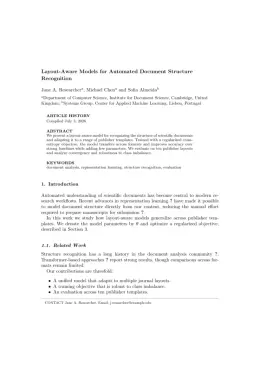
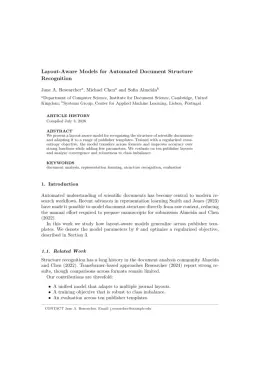
Taylor & Francis

GeoHumanities Template

Write in a clean editor, then format for GeoHumanities in one click — DocuGuru applies the official Taylor & Francis template with author–year references and exports a submission-ready PDF plus the editable LaTeX source. Free to start.

About the GeoHumanities format

GeoHumanities is a peer-reviewed journal published by Taylor & Francis, covering Geographies of human-animal interactions, Posthumanist Ethics and Activism, Ecocriticism and Environmental Literature.

PublisherTaylor & Francis
Reference styleAuthor–year (Chicago, T&F)
Author–year — (Smith, 2023) in the text
Smith, Ada, Ben Jones, and Cara Lee. 2023. "A Representative Article Title." GeoHumanities 12 (3): 45–58.

Formats any DOI in GeoHumanities style. No sign-up.

Publishes research inGeographies of human-animal interactions Posthumanist Ethics and Activism Ecocriticism and Environmental Literature Water Governance and Infrastructure Participatory Visual Research Methods
ISSN2373-566X
Citation impact (2-yr)0.78
h-index25
i10-index84
Total citations2,771
Top institutions publishing hereUniversity of Bristol
Journal websitewww.tandfonline.com
You getA submission-ready PDF and the editable LaTeX source — ready to submit.

Papers published in GeoHumanities per year

34
2015
43
2016
43
2017
34
2018
36
2019
29
2020
53
2021
26
2022
25
2023
36
2024
38
2025

Citation impact of GeoHumanities by publication year

475
2015
666
2016
346
2017
288
2018
224
2019
185
2020
277
2021
101
2022
103
2023
59
2024
14
2025

Citations each year’s papers have accumulated so far — the most recent years are still building up.

Most-cited papers in GeoHumanities

The Agency of Place: Toward a More-Than-Human Geographical Self

Soren C. Larsen, Jay T. Johnson · 2 Jan 2016

Contemporary Indigenous activism asserts an agency for place not normally found in geographical scholarship. Through place-based protest, organizing, and direct action, Native and non-Native people are interacting with place as a conscious being with the capacity to speak, create, and teach the responsibilities required for more inclusive forms of coexistence in today’s settler states. This…

Inductive Visualization: A Humanistic Alternative to GIS

Anne Kelly Knowles, Levi Westerveld, Laura Strom · 3 Jul 2015

Growing numbers of humanities researchers are turning to geographic information systems (GIS) to map spatial data and to visualize spatial relationships. This article explains the limitations inherent in GIS as a research methodology for humanistic scholarship, then introduces inductive visualization as a promising alternative that in several ways is more suitable to the acutely perceived…

Chemical Geographies

Adam M. Romero, Julie Guthman, Ryan E. Galt et al. · 2 Jan 2017

The following are a series of essays that originated from panel on Chemical Geographies at the American Association of Geographers meeting in 2016. Although the essays explore different topics, collectively they call into question the relationship of geographic scholarship to chemistry.

Geopolitics and the Anthropocene: Five Propositions for Sound

Anja Kanngieser · 2 Jan 2015

This appeal calls for sound to be considered as a geophilosophical provocation to, and a method for, political thought. It arises from experiments in ways of knowing and inhabiting the world, gesturing toward disciplines concerned with sound, the politics of language, and the physical and philosophical environment. Anchoring sound as an inherently political medium, it…

From Citizen Sensing to Collective Monitoring: Working through the Perceptive and Affective Problematics of Environmental Pollution

Helen Pritchard, Jennifer Gabrys · 2 Jul 2016

Citizen sensing, or the practice of monitoring environments through low-cost and do-it-yourself (DIY) digital technologies, is often structured as an individual pursuit. The very term citizen within citizen sensing suggests that the practice of sensing is the terrain of one political subject using a digital device to monitor her or his environment to take individual…

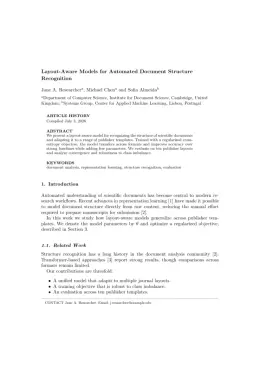
GeoHumanities template — frequently asked questions

How do I write a paper in the GeoHumanities format?
In DocuGuru you write your manuscript in a normal editor — no LaTeX setup required — and select the GeoHumanities template. When you export, DocuGuru compiles the paper into the official Taylor & Francis format and hands you a submission-ready PDF along with the editable LaTeX source.
What reference style does GeoHumanities use?
GeoHumanities uses Author–year (Chicago, T&F) references, shown as author–year markers such as (Smith, 2023) in the text. DocuGuru formats every in-text citation and the reference list in this exact style automatically. A reference appears like this: Smith, Ada, Ben Jones, and Cara Lee. 2023. "A Representative Article Title." GeoHumanities 12 (3): 45–58.
Do I need to know LaTeX to submit to GeoHumanities?
No. DocuGuru generates the interact LaTeX class and compiles the PDF for you in the background, so you get a Taylor & Francis-ready GeoHumanities document without writing any LaTeX. If you do want it, the LaTeX source is included in the export.
Can I import an existing draft into the GeoHumanities template?
Yes. Paste or upload your current manuscript — Word, LaTeX, Markdown, or plain text — and DocuGuru reflows it into the GeoHumanities format with correct headings, figures, tables, and author–year citations.
Who publishes GeoHumanities?
GeoHumanities is a multidisciplinary journal published by Taylor & Francis. DocuGuru's GeoHumanities template matches Taylor & Francis's official submission format.
Can I export a submission-ready GeoHumanities PDF?
Yes — DocuGuru produces a PDF built with the official GeoHumanities template (the interact class) that is ready to submit to Taylor & Francis, together with the matching LaTeX source files.
How much does the GeoHumanities template cost?
You can start writing in the GeoHumanities template for free. Exporting the final submission-ready GeoHumanities PDF and LaTeX source is part of DocuGuru's paid plans — see the app for current pricing.
Use the GeoHumanities template