Taylor & Francis

Evidence-Based Communication Assessment and Intervention Template

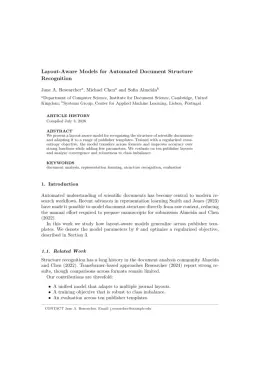
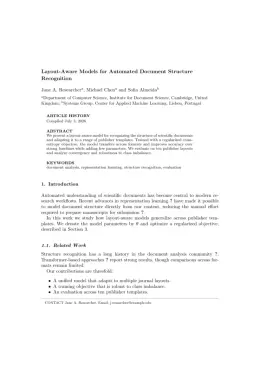
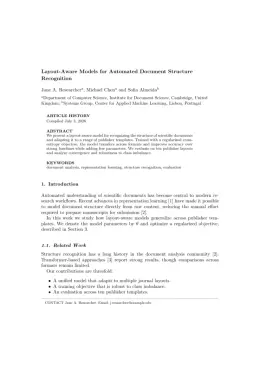
Write in a clean editor, then format for Evidence-Based Communication Assessment and Intervention in one click — DocuGuru applies the official Taylor & Francis template with author–year references and exports a submission-ready PDF plus the editable LaTeX source. Free to start.

About the Evidence-Based Communication Assessment and Intervention format

Evidence-Based Communication Assessment and Intervention is a peer-reviewed journal published by Taylor & Francis, covering Autism Spectrum Disorder Research, Behavioral and Psychological Studies, Family and Disability Support Research.

PublisherTaylor & Francis
Reference styleAuthor–year (Chicago, T&F)
Author–year — (Smith, 2023) in the text
Smith, Ada, Ben Jones, and Cara Lee. 2023. "A Representative Article Title." Evidence-Based Communication Assessment and Intervention 12 (3): 45–58.

Formats any DOI in Evidence-Based Communication Assessment and Intervention style. No sign-up.

Publishes research inAutism Spectrum Disorder Research Behavioral and Psychological Studies Family and Disability Support Research Assistive Technology in Communication and Mobility Language Development and Disorders
ISSN1748-9539
Citation impact (2-yr)0.44
h-index25
i10-index61
Total citations2,939
Top institutions publishing hereVanderbilt University
Journal websitewww.tandfonline.com
You getA submission-ready PDF and the editable LaTeX source — ready to submit.

Papers published in Evidence-Based Communication Assessment and Intervention per year

30
2014
19
2015
25
2016
20
2017
25
2018
26
2019
32
2020
23
2021
26
2022
7
2023
30
2024
24
2025

Citation impact of Evidence-Based Communication Assessment and Intervention by publication year

206
2014
58
2015
79
2016
215
2017
36
2018
57
2019
133
2020
125
2021
68
2022
8
2023
15
2024
4
2025

Citations each year’s papers have accumulated so far — the most recent years are still building up.

Most-cited papers in Evidence-Based Communication Assessment and Intervention

A review of meta-analyses of single-subject experimental designs: Methodological issues and practice

S. Natasha Beretvas, Hyewon Chung · 1 Sep 2008

Several metrics have been suggested for summarizing results from single-subject experimental designs. This study briefly reviews the most commonly used metrics, noting their methodological limitations. This study also includes a synthesis of recent meta-analyses, describing which metrics were used and how meta-analysts handled dependence in the form of multiple treatments, outcomes, and participants per study.…

The persistence of fad interventions in the face of negative scientific evidence: Facilitated communication for autism as a case example

Scott O. Lilienfeld, Julia Marshall, James T. Todd et al. · 3 Apr 2014

Communication disorder and mental health professionals may assume that once novel clinical techniques have been refuted by research, they will be promptly abandoned. Using facilitated communication (FC) for autism as a recent case example, we provide evidence to the contrary. Although FC was scientifically discredited by the mid-to-late 1990s, data we review demonstrate that it…

Social communication intervention effects vary by dependent variable type in preschoolers with autism spectrum disorders

Paul J. Yoder, Kristen Bottema‐Beutel, Tiffany G. Woynaroski et al. · 1 Dec 2013

Individuals with autism spectrum disorders (ASDs) have difficulty communicating in ways that are primarily for initiating and maintaining social relatedness (i.e., social communication). We hypothesized that the way researchers measured social communication would affect whether treatment effects were found. Using a best evidence review method, we found that treatments were shown to improve social communication…

Beyond RCTs: Innovations in research design and methods to advance implementation science

Megan E. Schliep, Crystle N. Alonzo, Megan A. Morris · 2 Oct 2017

Implementation Science (IS) studies the adoption of interventions into clinical practice, taking into account real-world populations and clinical settings. While randomized control trials (RCTs) assess the efficacy of interventions, implementation research is necessary to assess the implementation of these interventions. IS attempts to understand and address the processes used, as well as possible barriers and…

Social skills interventions for children with autism: A meta-analytic application of percentage of all non-overlapping data (PAND)

Naomi Schneider, Howard Goldstein, Richard Parker · 1 Sep 2008

This paper is an early attempt to apply a meta-analytic technique to a body of single-subject experimental design (SSED) research. The percentage of all non-overlapping data points (PAND) technique, a new approach to calculating effect sizes in SSEDs, was applied to 19 studies evaluating peer-mediated social-skills treatments for children with autism. On the basis of…

Evidence-Based Communication Assessment and Intervention template — frequently asked questions

How do I write a paper in the Evidence-Based Communication Assessment and Intervention format?
In DocuGuru you write your manuscript in a normal editor — no LaTeX setup required — and select the Evidence-Based Communication Assessment and Intervention template. When you export, DocuGuru compiles the paper into the official Taylor & Francis format and hands you a submission-ready PDF along with the editable LaTeX source.
What reference style does Evidence-Based Communication Assessment and Intervention use?
Evidence-Based Communication Assessment and Intervention uses Author–year (Chicago, T&F) references, shown as author–year markers such as (Smith, 2023) in the text. DocuGuru formats every in-text citation and the reference list in this exact style automatically. A reference appears like this: Smith, Ada, Ben Jones, and Cara Lee. 2023. "A Representative Article Title." Evidence-Based Communication Assessment and Intervention 12 (3): 45–58.
Do I need to know LaTeX to submit to Evidence-Based Communication Assessment and Intervention?
No. DocuGuru generates the interact LaTeX class and compiles the PDF for you in the background, so you get a Taylor & Francis-ready Evidence-Based Communication Assessment and Intervention document without writing any LaTeX. If you do want it, the LaTeX source is included in the export.
Can I import an existing draft into the Evidence-Based Communication Assessment and Intervention template?
Yes. Paste or upload your current manuscript — Word, LaTeX, Markdown, or plain text — and DocuGuru reflows it into the Evidence-Based Communication Assessment and Intervention format with correct headings, figures, tables, and author–year citations.
Who publishes Evidence-Based Communication Assessment and Intervention?
Evidence-Based Communication Assessment and Intervention is a multidisciplinary journal published by Taylor & Francis. DocuGuru's Evidence-Based Communication Assessment and Intervention template matches Taylor & Francis's official submission format.
Can I export a submission-ready Evidence-Based Communication Assessment and Intervention PDF?
Yes — DocuGuru produces a PDF built with the official Evidence-Based Communication Assessment and Intervention template (the interact class) that is ready to submit to Taylor & Francis, together with the matching LaTeX source files.
How much does the Evidence-Based Communication Assessment and Intervention template cost?
You can start writing in the Evidence-Based Communication Assessment and Intervention template for free. Exporting the final submission-ready Evidence-Based Communication Assessment and Intervention PDF and LaTeX source is part of DocuGuru's paid plans — see the app for current pricing.

Use the Evidence-Based Communication Assessment and Intervention template