Taylor & Francis

Environmental Bioindicators Template

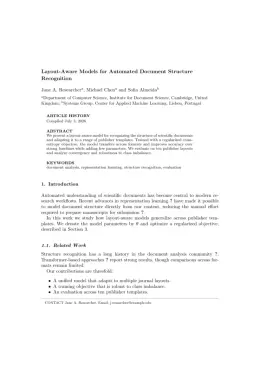
Write in a clean editor, then format for Environmental Bioindicators in one click — DocuGuru applies the official Taylor & Francis template with author–year references and exports a submission-ready PDF plus the editable LaTeX source. Free to start.

About the Environmental Bioindicators format

Environmental Bioindicators is a peer-reviewed journal published by Taylor & Francis, covering Environmental Toxicology and Ecotoxicology, Diverse Scientific and Economic Studies, Heavy metals in environment.

PublisherTaylor & Francis
Reference styleAuthor–year (Chicago, T&F)
Author–year — (Smith, 2023) in the text
Smith, Ada, Ben Jones, and Cara Lee. 2023. "A Representative Article Title." Environmental Bioindicators 12 (3): 45–58.

Formats any DOI in Environmental Bioindicators style. No sign-up.

Publishes research inEnvironmental Toxicology and Ecotoxicology Diverse Scientific and Economic Studies Heavy metals in environment Mercury impact and mitigation studies Human auditory perception and evaluation
ISSN1555-5267
h-index21
i10-index33
Total citations1,612
Top institutions publishing hereRutgers, The State University of New Jersey
Journal websitewww.tandfonline.com
You getA submission-ready PDF and the editable LaTeX source — ready to submit.

Papers published in Environmental Bioindicators per year

32
2006
33
2007
32
2008
27
2009

Citation impact of Environmental Bioindicators by publication year

659
2006
272
2007
211
2008
463
2009

Citations each year’s papers have accumulated so far — the most recent years are still building up.

Most-cited papers in Environmental Bioindicators

Bioindicators: Types, Development, and Use in Ecological Assessment and Research

Joanna Burger · 1 Jan 2006

Government, scientists, managers, and the public are interested in assessing the health of ecosystems. Initially ecologists concentrated on assessing condition, reproductive success, and survival of a wide range of individual species, but this approach quickly broadened to include the health of communities, ecosystems, and landscapes, as well as the human dimension. Monitoring ecosystem health requires…

Bioindicators: A Review of Their Use in the Environmental Literature 1970–2005

Joanna Burger · 1 Jul 2006

A wide range of scientists, managers, governmental agencies, and the public are interested in assessing the health and well-being of species, populations, and ecosystems. This has resulted in increased studies of the usefulness of different indicators as a measure of stressors and contaminants. This paper presents a review of bioindicators since 1970 by using four…

Selenium and Mercury Interactions with Emphasis on Fish Tissue

Spencer A. Peterson, Nicholas V.C. Ralston, P.D. Whanger et al. · 9 Dec 2009

This review addresses the effects of mercury (Hg) in fish as it relates to the health of the fish themselves as well as potential risks of toxicity in wildlife and humans that consume fish. In particular, it addresses selenium (Se) as a bioindicator of susceptibility to harmful effects of Hg exposures and evaluates how Se…

Biomarkers, Bioindicators, and Ecological Risk Assessment—A Brief Review and Evaluation

Steven M. Bartell · 1 Jan 2006

Cellular and subcellular measures of exposure (biomarkers) and effects (bioindicators) continue to be developed. This development is justified in part by the potential application of these technologies in supporting ecological risk assessment (ERA). However, application of biomarkers in assessing ecological risk remains infrequent and of questionable utility. The following discussion examines the potential for increasing…

Heavy Metals in the Sea Cucumber<i>Holothuria tubulosa</i>(Echinodermata) from the Mediterranean<i>Posidonia oceanica</i>Ecosystem: Body Compartment, Seasonal, Geographical and Bathymetric Variations

Michel Warnau, Sandrine Dutrieux, Gilles Ledent et al. · 1 Dec 2006

The concentrations of Cd, Cu, Fe, Pb and Zn were measured in holothuroids Holothuria tubulosa collected during different seasons and at several depths in three N W Mediterranean Posidonia oceanica meadows (Calvi, Corsica; Ischia, Italy; Marseille, France). Metals were found to be selectively distributed among the holothuroid body compartments (i.e. body wall, gut, and haemal…


Environmental Bioindicators template — frequently asked questions

How do I write a paper in the Environmental Bioindicators format?
In DocuGuru you write your manuscript in a normal editor — no LaTeX setup required — and select the Environmental Bioindicators template. When you export, DocuGuru compiles the paper into the official Taylor & Francis format and hands you a submission-ready PDF along with the editable LaTeX source.
What reference style does Environmental Bioindicators use?
Environmental Bioindicators uses Author–year (Chicago, T&F) references, shown as author–year markers such as (Smith, 2023) in the text. DocuGuru formats every in-text citation and the reference list in this exact style automatically. A reference appears like this: Smith, Ada, Ben Jones, and Cara Lee. 2023. "A Representative Article Title." Environmental Bioindicators 12 (3): 45–58.
Do I need to know LaTeX to submit to Environmental Bioindicators?
No. DocuGuru generates the interact LaTeX class and compiles the PDF for you in the background, so you get a Taylor & Francis-ready Environmental Bioindicators document without writing any LaTeX. If you do want it, the LaTeX source is included in the export.
Can I import an existing draft into the Environmental Bioindicators template?
Yes. Paste or upload your current manuscript — Word, LaTeX, Markdown, or plain text — and DocuGuru reflows it into the Environmental Bioindicators format with correct headings, figures, tables, and author–year citations.
Who publishes Environmental Bioindicators?
Environmental Bioindicators is a multidisciplinary journal published by Taylor & Francis. DocuGuru's Environmental Bioindicators template matches Taylor & Francis's official submission format.
Can I export a submission-ready Environmental Bioindicators PDF?
Yes — DocuGuru produces a PDF built with the official Environmental Bioindicators template (the interact class) that is ready to submit to Taylor & Francis, together with the matching LaTeX source files.
How much does the Environmental Bioindicators template cost?
You can start writing in the Environmental Bioindicators template for free. Exporting the final submission-ready Environmental Bioindicators PDF and LaTeX source is part of DocuGuru's paid plans — see the app for current pricing.
Use the Environmental Bioindicators template