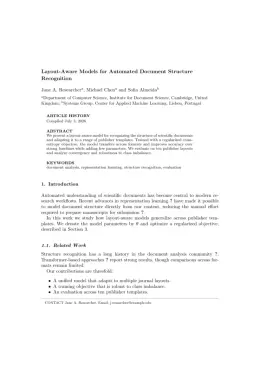
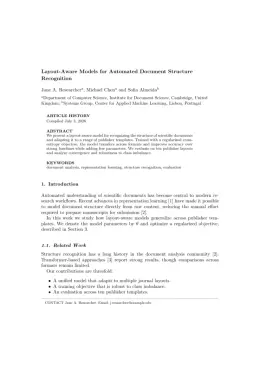
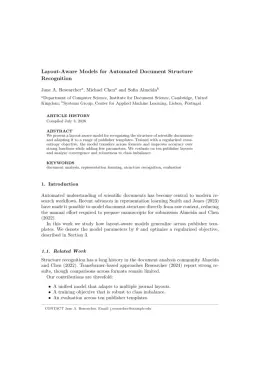
About the Contemporary Music Review format
Contemporary Music Review is a peer-reviewed journal published by Taylor & Francis, covering Music Technology and Sound Studies, Musicology and Musical Analysis, Diverse Musicological Studies.
| Publisher | Taylor & Francis |
|---|
| Reference style | Author–year (Chicago, T&F) Author–year — (Smith, 2023) in the text
Smith, Ada, Ben Jones, and Cara Lee. 2023. "A Representative Article Title." Contemporary Music Review 12 (3): 45–58.
Formats any DOI in Contemporary Music Review style. No sign-up.
|
|---|
| Publishes research in | Music Technology and Sound Studies Musicology and Musical Analysis Diverse Musicological Studies Music History and Culture Neuroscience and Music Perception |
|---|
| ISSN | 0749-4467 |
|---|
| Citation impact (2-yr) | 0.51 |
|---|
| h-index | 45 |
|---|
| i10-index | 239 |
|---|
| Total citations | 9,950 |
|---|
| Top institutions publishing here | Twitter (United States) |
|---|
| Journal website | www.tandfonline.com |
|---|
| You get | A submission-ready PDF and the editable LaTeX source — ready to submit. |
|---|
Papers published in Contemporary Music Review per year
Citation impact of Contemporary Music Review by publication year
Citations each year’s papers have accumulated so far — the most recent years are still building up.
Most-cited papers in Contemporary Music Review
Cognitive constraints on compositional systems
Fred Lerdahl · 1 Jan 1992
In this article I explore the relationship between composing and listening. I begin with a problematic story, draw some general conclusions, introduce relevant concepts from Lerdahl and Jackendoff (1983) and related work, propose some cognitive constraints on compositional systems, discuss “pitch space”, and explain why serial (or 12-tone) organizations are cognitively opaque. Most of these…
The listening imagination: Listening in the electroacoustic era
Denis Smalley · 1 Jan 1996
The extensive range of sound sources admitted into music via the electroacoustic medium has initiated a revolution in the sounding content of musical works, appealing to a variety of listening responses not fully encompassed in previously existing musics. It is my purpose in this paper to uncover the listening strategies involved in responding to electroacoustic…
Atonal prolongational structure
Fred Lerdahl · 1 Jan 1989
The early atonal music of Schoenberg and his school is emblematic of the difficulties in comprehending twentieth-century music. Music theorists have tried to analyze this music either through a modified Schenkerian approach or through pitch-set theory. After discussing limitations in these approaches, this paper develops at length a different theory for atonal music, one that…
Can Music Influence Language and Cognition?
Sylvain Moreno · 1 Jun 2009
Evidence has suggested that music can improve behavioural performance in several domains, including intelligence. Scientists have also discovered that music can modify the brain at both functional and structural levels. Such neural changes can impact several domains, but one domain seems to be particularly influenced by music—namely, language. Music and language seem to share special…
Prescriptive notation: Limits and challenges
Mieko Kanno · 1 Apr 2007
Abstract Prescriptive notation specifies means of execution rather than resultant configurations of pitch and rhythm. A focus on performative techniques influences the way in which the composer communicates through the medium of writing. In general, prescriptive notation points to a shift in the function of notation from representation to mediation. Consequently, advantages and disadvantages of…