Taylor & Francis

Cogent Mathematics & Statistics Template

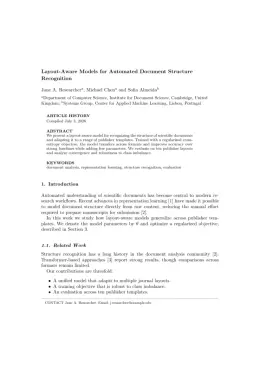
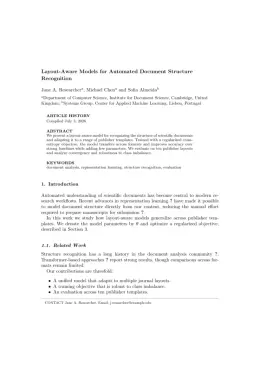
Write in a clean editor, then format for Cogent Mathematics & Statistics in one click — DocuGuru applies the official Taylor & Francis template with author–year references and exports a submission-ready PDF plus the editable LaTeX source. Free to start.

About the Cogent Mathematics & Statistics format

Cogent Mathematics & Statistics is a peer-reviewed journal published by Taylor & Francis, covering Fixed Point Theorems Analysis, Nonlinear Differential Equations Analysis, Statistical Distribution Estimation and Applications.

PublisherTaylor & Francis
Reference styleAuthor–year (Chicago, T&F)
Author–year — (Smith, 2023) in the text
Smith, Ada, Ben Jones, and Cara Lee. 2023. "A Representative Article Title." Cogent Mathematics & Statistics 12 (3): 45–58.

Formats any DOI in Cogent Mathematics & Statistics style. No sign-up.

Publishes research inFixed Point Theorems Analysis Nonlinear Differential Equations Analysis Statistical Distribution Estimation and Applications Fractional Differential Equations Solutions Statistical Methods and Bayesian Inference
ISSN2574-2558
h-index16
i10-index30
Total citations1,103
Article processing charge$1,165
Top institutions publishing hereIslamic Azad University, Tehran
Journal websitewww.tandfonline.com
You getA submission-ready PDF and the editable LaTeX source — ready to submit.

Papers published in Cogent Mathematics & Statistics per year

69
2018
33
2019
25
2020

Citation impact of Cogent Mathematics & Statistics by publication year

645
2018
233
2019
215
2020

Citations each year’s papers have accumulated so far — the most recent years are still building up.

Most-cited papers in Cogent Mathematics & Statistics

A whale optimization algorithm (WOA) approach for clustering

Jhila Nasiri, Farzin Modarres Khiyabani · 1 Jan 2018

Clustering is a powerful technique in data-mining, which involves identifing homogeneous groups of objects based on the values of attributes. Meta-heuristic algorithms such as particle swarm optimization, artificial bee colony, genetic algorithm and differential evolution are now becoming powerful methods for clustering. In this paper, we propose a new meta-heuristic clustering method, the Whale Clustering…

Approximation by finite mixtures of continuous density functions that vanish at infinity

TrungTin Nguyen, Hien D. Nguyen, Faïcel Chamroukhi et al. · 1 Jan 2020

Given sufficiently many components, it is often cited that finite mixture models can approximate any other probability density function (pdf) to an arbitrary degree of accuracy. Unfortunately, the nature of this approximation result is often left unclear. We prove that finite mixture models constructed from pdfs in 0 can be used to conduct approximation of…

Mathematical analysis of HIV/AIDS infection model with Caputo-Fabrizio fractional derivative

Samia Bushnaq, Sajjad Ali Khan, Kamal Shah et al. · 1 Jan 2018

This manuscript is concerned to the existence and stability of HIV/AIDS infection model with fractional order derivative. The corresponding derivative is taken in Caputo-Fabrizio sense, which is a new approach for such type of biological models. With the help of Sumudu transform, some new results are handled. Further for the corresponding results, existence theory and…

The principal problem with principal components regression

Heidi Artigue, Gary Smith · 1 Jan 2019

Principal components regression (PCR) reduces a large number of explanatory variables in a regression model down to a small number of principal components. PCR is thought to be more useful, the more numerous the potential explanatory variables. The reality is that a large number of candidate explanatory variables does not make PCR more valuable; instead,…

An extension of Rayleigh distribution and applications

Kahkashan Ateeq, Tahira Bano Qasim, Ayesha Rehman Alvi · 1 Jan 2019

In this article, we have derived a new distribution named as Rayleigh–Rayleigh distribution (RRD) motivated by the transformed transformer technique by Alzaatreh, Lee, and Famoye (2013). The statistical properties of RRD, comprising of explicit expressions for quantile function, moments, moment generating function, mean deviation, skewness, kurtosis, reliability measures, measures of uncertainty, distributions of order statistics…

Cogent Mathematics & Statistics template — frequently asked questions

How do I write a paper in the Cogent Mathematics & Statistics format?
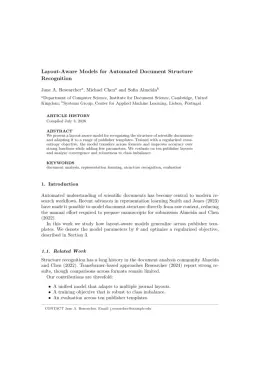
In DocuGuru you write your manuscript in a normal editor — no LaTeX setup required — and select the Cogent Mathematics & Statistics template. When you export, DocuGuru compiles the paper into the official Taylor & Francis format and hands you a submission-ready PDF along with the editable LaTeX source.
What reference style does Cogent Mathematics & Statistics use?
Cogent Mathematics & Statistics uses Author–year (Chicago, T&F) references, shown as author–year markers such as (Smith, 2023) in the text. DocuGuru formats every in-text citation and the reference list in this exact style automatically. A reference appears like this: Smith, Ada, Ben Jones, and Cara Lee. 2023. "A Representative Article Title." Cogent Mathematics & Statistics 12 (3): 45–58.
Do I need to know LaTeX to submit to Cogent Mathematics & Statistics?
No. DocuGuru generates the interact LaTeX class and compiles the PDF for you in the background, so you get a Taylor & Francis-ready Cogent Mathematics & Statistics document without writing any LaTeX. If you do want it, the LaTeX source is included in the export.
Can I import an existing draft into the Cogent Mathematics & Statistics template?
Yes. Paste or upload your current manuscript — Word, LaTeX, Markdown, or plain text — and DocuGuru reflows it into the Cogent Mathematics & Statistics format with correct headings, figures, tables, and author–year citations.
Who publishes Cogent Mathematics & Statistics?
Cogent Mathematics & Statistics is a multidisciplinary journal published by Taylor & Francis. DocuGuru's Cogent Mathematics & Statistics template matches Taylor & Francis's official submission format.
Can I export a submission-ready Cogent Mathematics & Statistics PDF?
Yes — DocuGuru produces a PDF built with the official Cogent Mathematics & Statistics template (the interact class) that is ready to submit to Taylor & Francis, together with the matching LaTeX source files.
How much does the Cogent Mathematics & Statistics template cost?
You can start writing in the Cogent Mathematics & Statistics template for free. Exporting the final submission-ready Cogent Mathematics & Statistics PDF and LaTeX source is part of DocuGuru's paid plans — see the app for current pricing.
Use the Cogent Mathematics & Statistics template