Taylor & Francis

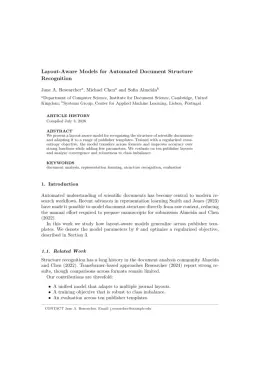
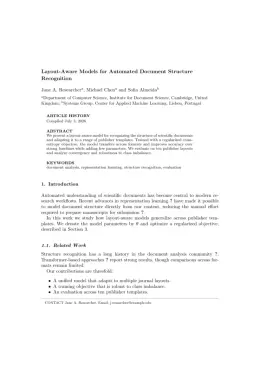
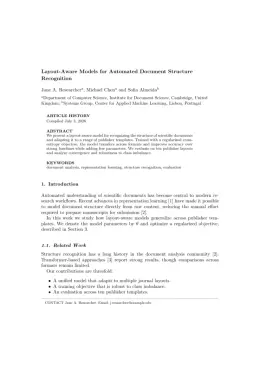
Chemical Speciation and Bioavailability Template

Write in a clean editor, then format for Chemical Speciation and Bioavailability in one click — DocuGuru applies the official Taylor & Francis template with author–year references and exports a submission-ready PDF plus the editable LaTeX source. Free to start.

About the Chemical Speciation and Bioavailability format

Chemical Speciation and Bioavailability is a peer-reviewed journal published by Taylor & Francis, covering Heavy metals in environment, Chemical and Physical Properties in Aqueous Solutions, Environmental Toxicology and Ecotoxicology.

PublisherTaylor & Francis
Reference styleAuthor–year (Chicago, T&F)
Author–year — (Smith, 2023) in the text
Smith, Ada, Ben Jones, and Cara Lee. 2023. "A Representative Article Title." Chemical Speciation and Bioavailability 12 (3): 45–58.

Formats any DOI in Chemical Speciation and Bioavailability style. No sign-up.

Publishes research inHeavy metals in environment Chemical and Physical Properties in Aqueous Solutions Environmental Toxicology and Ecotoxicology Electrochemical Analysis and Applications Mine drainage and remediation techniques
ISSN0954-2299
h-index50
i10-index324
Total citations12,633
Article processing charge$1,270
Open accessYes
Top institutions publishing hereAndhra University
Journal websitewww.tandfonline.com
You getA submission-ready PDF and the editable LaTeX source — ready to submit.

Papers published in Chemical Speciation and Bioavailability per year

23
2008
28
2009
32
2010
32
2011
33
2012
36
2013
36
2014
24
2015
31
2016
20
2017
15
2018
1
2020

Citation impact of Chemical Speciation and Bioavailability by publication year

346
2008
450
2009
557
2010
378
2011
506
2012
460
2013
1.3K
2014
444
2015
878
2016
509
2017
591
2018
0
2020

Citations each year’s papers have accumulated so far — the most recent years are still building up.

Most-cited papers in Chemical Speciation and Bioavailability

Factors influencing metal bioavailability in soils: preliminary investigations for the development of a critical loads approach for metals

John Rieuwerts, I. Thornton, M.E. Farago et al. · 1 Jan 1998

The concept of critical loads, previously applied to acidifying substances, is currently being extended, within the Convention on Long Range Transboundary Air Pollution (CLRTAP), to several metals: Cd, Cu, Hg, Pb and Zn. Receptors in the soil, such as plants and microbiota, are directly exposed to these metals via the soil solution and this should…

Investigation of heavy metal mobility and availability by the BCR sequential extraction procedure: relationship between soil properties and heavy metals availability

Ali Sungur, Mustafa Soylak, Hasan Özcan · 1 Jan 2014

In this study, surface soil and corn cob samples were collected from 15 different agricultural fields of Çanakkale, Turkey. These samples were analysed to determine the concentration of Cd, Cu, Mn, Ni, Pb and Zn. BCR sequential extraction was used to extract the binding forms of the metals in the soil samples. At the same…

Metal based nanoparticles in agricultural system: behavior, transport, and interaction with plants

Hao Chen · 1 Jan 2018

With the fast-developing nanotechnology, metal based nanoparticles (NPs) production and application are increased significantly. These metal based NPs can enter agricultural land through both direct and indirect pathways. This review presents an overview of the fate and transport of metal based NPs and their interactions with plants in agricultural ecosystem system. The physical chemical properties…

Application of geoaccumulation index and enrichment factor for assessing metal contamination in the sediments of Hara Biosphere Reserve, Iran

Mohsen Nowrouzi, Alireza Pourkhabbaz · 1 Jan 2014

Surface sediments from the Hara Biosphere Reserve of the Persian Gulf were collected to evaluate the contamination of metals including Pb, Cd, Ni and Fe. The sediment samples were subjected to a total digestion technique and analysed by atomic absorption spectrometer for metals including Pb, Cd, Ni and Fe. The concentration of heavy metals in…

Physiological responses of plants to heavy metals and the quantification of tolerance and toxicity

Alan J. M. Baker, Patricia Walker · 1 Mar 1989

AbstractTechniques available for assessing the tolerance of plants to heavy metal toxins are reviewed. All are based on physiological responses and range from long-term growth trials in metal-contaminated substrates, to rapid cytological tests. Problems associated with the ecophysiological interpretation of in vitro measurements of tolerance are considered. The implications of multiple tolerance, co-tolerance, constitutional tolerance,…

Chemical Speciation and Bioavailability template — frequently asked questions

How do I write a paper in the Chemical Speciation and Bioavailability format?
In DocuGuru you write your manuscript in a normal editor — no LaTeX setup required — and select the Chemical Speciation and Bioavailability template. When you export, DocuGuru compiles the paper into the official Taylor & Francis format and hands you a submission-ready PDF along with the editable LaTeX source.
What reference style does Chemical Speciation and Bioavailability use?
Chemical Speciation and Bioavailability uses Author–year (Chicago, T&F) references, shown as author–year markers such as (Smith, 2023) in the text. DocuGuru formats every in-text citation and the reference list in this exact style automatically. A reference appears like this: Smith, Ada, Ben Jones, and Cara Lee. 2023. "A Representative Article Title." Chemical Speciation and Bioavailability 12 (3): 45–58.
Do I need to know LaTeX to submit to Chemical Speciation and Bioavailability?
No. DocuGuru generates the interact LaTeX class and compiles the PDF for you in the background, so you get a Taylor & Francis-ready Chemical Speciation and Bioavailability document without writing any LaTeX. If you do want it, the LaTeX source is included in the export.
Can I import an existing draft into the Chemical Speciation and Bioavailability template?
Yes. Paste or upload your current manuscript — Word, LaTeX, Markdown, or plain text — and DocuGuru reflows it into the Chemical Speciation and Bioavailability format with correct headings, figures, tables, and author–year citations.
Who publishes Chemical Speciation and Bioavailability?
Chemical Speciation and Bioavailability is a multidisciplinary journal published by Taylor & Francis. DocuGuru's Chemical Speciation and Bioavailability template matches Taylor & Francis's official submission format.
Can I export a submission-ready Chemical Speciation and Bioavailability PDF?
Yes — DocuGuru produces a PDF built with the official Chemical Speciation and Bioavailability template (the interact class) that is ready to submit to Taylor & Francis, together with the matching LaTeX source files.
How much does the Chemical Speciation and Bioavailability template cost?
You can start writing in the Chemical Speciation and Bioavailability template for free. Exporting the final submission-ready Chemical Speciation and Bioavailability PDF and LaTeX source is part of DocuGuru's paid plans — see the app for current pricing.

Use the Chemical Speciation and Bioavailability template