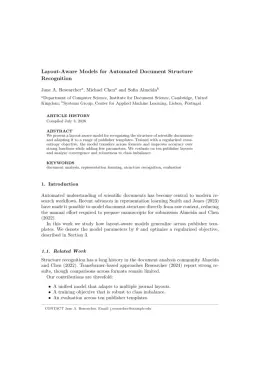
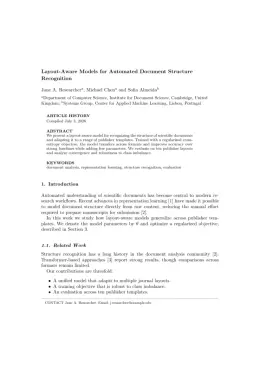
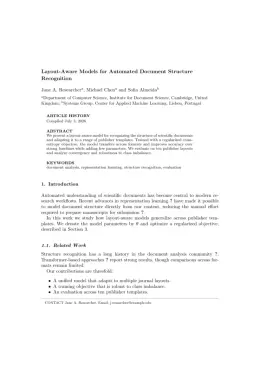
Taylor & Francis

Australian Journal of Human Communication Disorders Template

Write in a clean editor, then format for Australian Journal of Human Communication Disorders in one click — DocuGuru applies the official Taylor & Francis template with author–year references and exports a submission-ready PDF plus the editable LaTeX source. Free to start.

About the Australian Journal of Human Communication Disorders format

Australian Journal of Human Communication Disorders is a peer-reviewed journal published by Taylor & Francis, covering Language Development and Disorders, Stuttering Research and Treatment, Reading and Literacy Development.

PublisherTaylor & Francis
Reference styleAuthor–year (Chicago, T&F)
Author–year — (Smith, 2023) in the text
Smith, Ada, Ben Jones, and Cara Lee. 2023. "A Representative Article Title." Australian Journal of Human Communication Disorders 12 (3): 45–58.

Formats any DOI in Australian Journal of Human Communication Disorders style. No sign-up.

Publishes research inLanguage Development and Disorders Stuttering Research and Treatment Reading and Literacy Development Neurobiology of Language and Bilingualism Phonetics and Phonology Research
ISSN0310-6853
h-index22
i10-index65
Total citations2,104
Top institutions publishing hereThe University of Queensland
Journal websitewww.tandfonline.com
You getA submission-ready PDF and the editable LaTeX source — ready to submit.

Papers published in Australian Journal of Human Communication Disorders per year

25
1985
21
1986
17
1987
22
1988
17
1989
20
1990
8
1991
16
1992
19
1993
15
1994
14
1995
7
1996

Citation impact of Australian Journal of Human Communication Disorders by publication year

196
1985
84
1986
137
1987
164
1988
75
1989
120
1990
31
1991
106
1992
118
1993
106
1994
190
1995
143
1996

Citations each year’s papers have accumulated so far — the most recent years are still building up.

Most-cited papers in Australian Journal of Human Communication Disorders

Self-Reported Factors Related to Relapse following Treatment for Stuttering

Ashley Craig, Karen Hancock · 1 Jun 1995

This paper presents final results of earlier reported research (Craig & Calver, 1991) of the self-reported perceptions of relapse of people who stutter. The difficulties for those who struggle to remain fluent following successful treatment for stuttering requires further analysis through investigation into relapse. The present study undertook a cross sectional questionnaire study of a…

Multiple Sclerosis: Associated Speech and Language Disorders

Fiona J. Fitz Gerald, Bruce E. Murdoch, Helen J. Chenery · 1 Dec 1987

AbstractA sample of 23 Multiple Sclerosis (MS) patients were administered a battery of tests in order to determine the type, frequency and severity of their speech and language problems. Deficits were found in all aspects of speech production, including respiration, phonation, prosody, articulation and resonance. Observed speech deviations were most often mild. The speech deviation…

A Descriptive Study of the Bilingual Language Development of Aboriginal Children in the Eastern Goldfields of Western Australia

Ann M. Jacobs · 1 Dec 1988

A study of the early language development of Aboriginal children in the Eastern Goldfields of Western Australia was conducted over an 18 month period. The young Aboriginal children studied were found to have a linguistically rich and complex environment, and demonstrated well developed language learning strategies. The children's linguistic code matched all the functions documented…

Articulation Development in Children Aged Three to Nine Years

Meredith G. E. Kilminster, Elizabeth M. Laird · 1 Jun 1978

Results of articulation screening tests conducted annually by many Speech Therapists in the Queensland Education Department indicated that children were acquiring proficiency in articulatory skills at an earlier age than would be expected from previously established overseas norms. The articulation of 1756 Brisbane Metropolitan children, ranging in age from three to nine years, was evaluted…

Australian Journal of Human Communication Disorders template — frequently asked questions

How do I write a paper in the Australian Journal of Human Communication Disorders format?
In DocuGuru you write your manuscript in a normal editor — no LaTeX setup required — and select the Australian Journal of Human Communication Disorders template. When you export, DocuGuru compiles the paper into the official Taylor & Francis format and hands you a submission-ready PDF along with the editable LaTeX source.
What reference style does Australian Journal of Human Communication Disorders use?
Australian Journal of Human Communication Disorders uses Author–year (Chicago, T&F) references, shown as author–year markers such as (Smith, 2023) in the text. DocuGuru formats every in-text citation and the reference list in this exact style automatically. A reference appears like this: Smith, Ada, Ben Jones, and Cara Lee. 2023. "A Representative Article Title." Australian Journal of Human Communication Disorders 12 (3): 45–58.
Do I need to know LaTeX to submit to Australian Journal of Human Communication Disorders?
No. DocuGuru generates the interact LaTeX class and compiles the PDF for you in the background, so you get a Taylor & Francis-ready Australian Journal of Human Communication Disorders document without writing any LaTeX. If you do want it, the LaTeX source is included in the export.
Can I import an existing draft into the Australian Journal of Human Communication Disorders template?
Yes. Paste or upload your current manuscript — Word, LaTeX, Markdown, or plain text — and DocuGuru reflows it into the Australian Journal of Human Communication Disorders format with correct headings, figures, tables, and author–year citations.
Who publishes Australian Journal of Human Communication Disorders?
Australian Journal of Human Communication Disorders is a multidisciplinary journal published by Taylor & Francis. DocuGuru's Australian Journal of Human Communication Disorders template matches Taylor & Francis's official submission format.
Can I export a submission-ready Australian Journal of Human Communication Disorders PDF?
Yes — DocuGuru produces a PDF built with the official Australian Journal of Human Communication Disorders template (the interact class) that is ready to submit to Taylor & Francis, together with the matching LaTeX source files.
How much does the Australian Journal of Human Communication Disorders template cost?
You can start writing in the Australian Journal of Human Communication Disorders template for free. Exporting the final submission-ready Australian Journal of Human Communication Disorders PDF and LaTeX source is part of DocuGuru's paid plans — see the app for current pricing.

Use the Australian Journal of Human Communication Disorders template