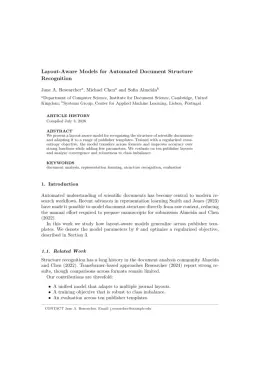
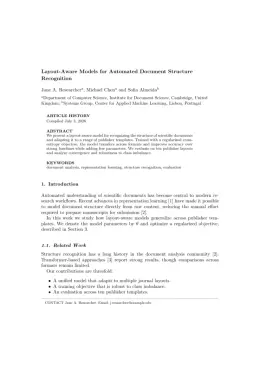
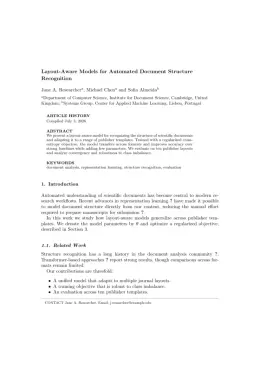
Taylor & Francis

ATMOSPHERE-OCEAN Template

Write in a clean editor, then format for ATMOSPHERE-OCEAN in one click — DocuGuru applies the official Taylor & Francis template with author–year references and exports a submission-ready PDF plus the editable LaTeX source. Free to start.

About the ATMOSPHERE-OCEAN format

ATMOSPHERE-OCEAN is a peer-reviewed journal published by Taylor & Francis, covering Climate variability and models, Oceanographic and Atmospheric Processes, Meteorological Phenomena and Simulations.

PublisherTaylor & Francis
Reference styleAuthor–year (Chicago, T&F)
Author–year — (Smith, 2023) in the text
Smith, Ada, Ben Jones, and Cara Lee. 2023. "A Representative Article Title." ATMOSPHERE-OCEAN 12 (3): 45–58.

Formats any DOI in ATMOSPHERE-OCEAN style. No sign-up.

Publishes research inClimate variability and models Oceanographic and Atmospheric Processes Meteorological Phenomena and Simulations Arctic and Antarctic ice dynamics Cryospheric studies and observations
ISSN0705-5900
Citation impact (2-yr)1.09
h-index88
i10-index733
Total citations39,421
Top institutions publishing hereEnvironment and Climate Change Canada
Journal websitewww.tandfonline.com
You getA submission-ready PDF and the editable LaTeX source — ready to submit.

Papers published in ATMOSPHERE-OCEAN per year

35
2014
37
2015
30
2016
24
2017
27
2018
25
2019
22
2020
23
2021
39
2022
24
2023
12
2024
33
2025

Citation impact of ATMOSPHERE-OCEAN by publication year

603
2014
768
2015
484
2016
413
2017
647
2018
367
2019
237
2020
176
2021
465
2022
117
2023
29
2024
29
2025

Citations each year’s papers have accumulated so far — the most recent years are still building up.

Most-cited papers in ATMOSPHERE-OCEAN

Sensitivity of climate simulations to the parameterization of cumulus convection in the Canadian climate centre general circulation model

G.J. Zhang, N. A. McFarlane · 1 Sep 1995

Abstract A simplified cumulus parameterization scheme, suitable for use in GCMs, is presented. This parameterization is based on a plume ensemble concept similar to that originally proposed by Arakawa and Schubert (1974). However, it employs three assumptions which significantly simplify the formulation and implementation of the scheme. It is assumed that an ensemble of convective‐scale…

2,018 citations Cite SaveGo to paper →
Temperature and precipitation trends in Canada during the 20th century

Xuebin Zhang, Lucie A. Vincent, William D. Hogg et al. · 1 Sep 2000

Abstract Trends in Canadian temperature and precipitation during the 20th century are analyzed using recently updated and adjusted station data. Six elements, maximum, minimum and mean temperatures along with diurnal temperature range (DTR), precipitation totals and ratio of snowfall to total precipitation are investigated. Anomalies from the 1961–1990 reference period were first obtained at individual…

1,116 citations Cite SaveGo to paper →
The UVic earth system climate model: Model description, climatology, and applications to past, present and future climates

Andrew J. Weaver, Michael Eby, Edward C. Wiebe et al. · 1 Dec 2001

Abstract A new earth system climate model of intermediate complexity has been developed and its climatology compared to observations. The UVic Earth System Climate Model consists of a three‐dimensional ocean general circulation model coupled to a thermodynamic/dynamic sea‐ice model, an energy‐moisture balance atmospheric model with dynamical feedbacks, and a thermomechanical land‐ice model. In order to…

Documentation of a highly ENSO‐related sst region in the equatorial pacific: Research note

Anthony G. Bamston, Muthuvel Chelliah, Stanley B. Goldenberg · 1 Jan 1997

Abstract A new ENSO SST index is documented that is strongly correlated to the core ENSO phenomenon. The SST anomaly in much of the east‐central and eastern tropical Pacific is closely related to ENSO. However, the anomaly from approximately the centre of the eastern half of the equatorial Pacific westward to near the date line…

An overview of the past, present and future of gravity‐wave drag parametrization for numerical climate and weather prediction models

Survey Article, Young‐Joon Kim, Stephen D. Eckermann et al. · 1 Mar 2003

Abstract An overview of the parametrization of gravity ‐wave drag in numerical ‐weather prediction and climate simulation models is presented. The focus is primarily on understanding the current status of gravity wave drag parametrization as a step towards the new parametrizations that will be needed for the next generation of atmospheric models. Both the early…

ATMOSPHERE-OCEAN template — frequently asked questions

How do I write a paper in the ATMOSPHERE-OCEAN format?
In DocuGuru you write your manuscript in a normal editor — no LaTeX setup required — and select the ATMOSPHERE-OCEAN template. When you export, DocuGuru compiles the paper into the official Taylor & Francis format and hands you a submission-ready PDF along with the editable LaTeX source.
What reference style does ATMOSPHERE-OCEAN use?
ATMOSPHERE-OCEAN uses Author–year (Chicago, T&F) references, shown as author–year markers such as (Smith, 2023) in the text. DocuGuru formats every in-text citation and the reference list in this exact style automatically. A reference appears like this: Smith, Ada, Ben Jones, and Cara Lee. 2023. "A Representative Article Title." ATMOSPHERE-OCEAN 12 (3): 45–58.
Do I need to know LaTeX to submit to ATMOSPHERE-OCEAN?
No. DocuGuru generates the interact LaTeX class and compiles the PDF for you in the background, so you get a Taylor & Francis-ready ATMOSPHERE-OCEAN document without writing any LaTeX. If you do want it, the LaTeX source is included in the export.
Can I import an existing draft into the ATMOSPHERE-OCEAN template?
Yes. Paste or upload your current manuscript — Word, LaTeX, Markdown, or plain text — and DocuGuru reflows it into the ATMOSPHERE-OCEAN format with correct headings, figures, tables, and author–year citations.
Who publishes ATMOSPHERE-OCEAN?
ATMOSPHERE-OCEAN is a multidisciplinary journal published by Taylor & Francis. DocuGuru's ATMOSPHERE-OCEAN template matches Taylor & Francis's official submission format.
Can I export a submission-ready ATMOSPHERE-OCEAN PDF?
Yes — DocuGuru produces a PDF built with the official ATMOSPHERE-OCEAN template (the interact class) that is ready to submit to Taylor & Francis, together with the matching LaTeX source files.
How much does the ATMOSPHERE-OCEAN template cost?
You can start writing in the ATMOSPHERE-OCEAN template for free. Exporting the final submission-ready ATMOSPHERE-OCEAN PDF and LaTeX source is part of DocuGuru's paid plans — see the app for current pricing.

Use the ATMOSPHERE-OCEAN template