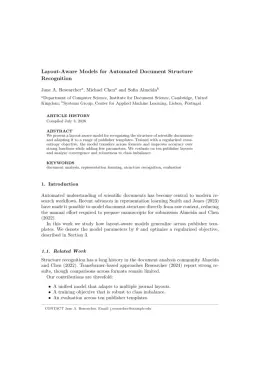
About the Astronomical Review format
Astronomical Review is a peer-reviewed journal published by Taylor & Francis, covering Stellar, planetary, and galactic studies, Astronomy and Astrophysical Research, Astrophysics and Star Formation Studies.
| Publisher | Taylor & Francis |
|---|
| Reference style | Author–year (Chicago, T&F) Author–year — (Smith, 2023) in the text
Smith, Ada, Ben Jones, and Cara Lee. 2023. "A Representative Article Title." Astronomical Review 12 (3): 45–58.
Formats any DOI in Astronomical Review style. No sign-up.
|
|---|
| Publishes research in | Stellar, planetary, and galactic studies Astronomy and Astrophysical Research Astrophysics and Star Formation Studies Gamma-ray bursts and supernovae Galaxies: Formation, Evolution, Phenomena |
|---|
| ISSN | 2167-2857 |
|---|
| h-index | 12 |
|---|
| i10-index | 13 |
|---|
| Total citations | 521 |
|---|
| Top institutions publishing here | Los Alamos National Laboratory |
|---|
| Journal website | www.tandfonline.com |
|---|
| You get | A submission-ready PDF and the editable LaTeX source — ready to submit. |
|---|
Papers published in Astronomical Review per year
Citation impact of Astronomical Review by publication year
Citations each year’s papers have accumulated so far — the most recent years are still building up.
Most-cited papers in Astronomical Review
A guided map to the spiral arms in the galactic disk of the Milky Way
J. P. Vallée · 2 Oct 2017
An up-to-date overview of the recent history is given, aiming is to present a helpful working guide to the literature and at the same time introduce key systems and observational results, starting from the Sun and going toward the Galactic Center and parts of the Zona Galactica Incognita, and beyond. We start by presenting an…
X-ray morphological estimators for galaxy clusters
Elena Rasia, M. Meneghetti, S. Ettori · 1 Jan 2013
The classification of galaxy clusters according to their X-ray appearance is a powerful tool to discriminate between regular clusters (associated to relaxed objects) and disturbed ones (linked to dynamically active systems). The compilation of the two subsamples is a necessary step both for cosmological studies- oriented towards spherical and virialized systems- and for astrophysical investigations…
Super-Renormalizable Multidimensional Gravity: Theory and Applications
Leonardo Modesto · 1 Apr 2013
In this paper we introduce a perturbatively super-renormalizable and unitary theory of quantum gravity in any dimension D. In four dimensions the theory is an extension of the Stelle higher derivative gravity that involves an infinite number of derivative terms characterized by two entire functions, a.k .a. “form factors”. In dimension D we preserve two…
Robotic telescopes in education
E. L. Gomez, M. T. Fitzgerald · 2 Jan 2017
The power of robotic telescopes to transform science education has been voiced by multiple sources, since the 1980s. Since then, much technical progress has been made in robotic telescope provision to end users via a variety of different approaches. The educational transformation hoped for by the provision of this technology has, so far, yet to…
Exozodiacal clouds: hot and warm dust around main sequence stars
Quentin Kral, A. V. Krivov, Denis Defrère et al. · 3 Apr 2017