Springer Nature

Visual Intelligence Template

Write in a clean editor, then format for Visual Intelligence in one click — DocuGuru applies the official Springer Nature template with superscript references and exports a submission-ready PDF plus the editable LaTeX source. Free to start.

About the Visual Intelligence format

Visual Intelligence is a peer-reviewed journal published by Springer Nature, covering Multimodal Machine Learning Applications, Advanced Neural Network Applications, Video Surveillance and Tracking Methods.

PublisherSpringer Nature
Reference styleSuperscript numbered (Nature)
Superscript — small raised numerals in the text
1. Smith, A., Jones, B. & Lee, C. A representative article title. Visual Intelligence 12, 45–58 (2023).

Formats any DOI in Visual Intelligence style. No sign-up.

Publishes research inMultimodal Machine Learning Applications Advanced Neural Network Applications Video Surveillance and Tracking Methods Data Visualization and Analytics Human Pose and Action Recognition
ISSN2731-9008
Citation impact (2-yr)11.23
h-index21
i10-index51
Total citations1,557
Open accessYes
Top institutions publishing hereSun Yat-sen University
You getA submission-ready PDF and the editable LaTeX source — ready to submit.

Papers published in Visual Intelligence per year

12
1997
20
2013
31
2023
38
2024
30
2025

Citation impact of Visual Intelligence by publication year

0
1997
2
2013
587
2023
685
2024
184
2025

Citations each year’s papers have accumulated so far — the most recent years are still building up.

Most-cited papers in Visual Intelligence

FusionMamba: dynamic feature enhancement for multimodal image fusion with Mamba

Xinyu Xie, Yawen Cui, Tao Tan et al. · 31 Dec 2024

Abstract Multimodal image fusion aims to integrate information from different imaging techniques to produce a comprehensive, detail-rich single image for downstream vision tasks. Existing methods based on local convolutional neural networks (CNNs) struggle to capture global features efficiently, while Transformer-based models are computationally expensive, although they excel at global modeling. Mamba addresses these limitations by…

Advances in deep concealed scene understanding

Deng-Ping Fan, Ge-Peng Ji, Peng Xu et al. · 14 Aug 2023

Abstract Concealed scene understanding (CSU) is a hot computer vision topic aiming to perceive objects exhibiting camouflage. The current boom in terms of techniques and applications warrants an up-to-date survey. This can help researchers better understand the global CSU field, including both current achievements and remaining challenges. This paper makes four contributions: (1) For the…

An overview of large AI models and their applications

Xiaoguang Tu, Zhimin He, Yi Huang et al. · 27 Dec 2024

Abstract In recent years, large-scale artificial intelligence (AI) models have become a focal point in technology, attracting widespread attention and acclaim. Notable examples include Google’s BERT and OpenAI’s GPT, which have scaled their parameter sizes to hundreds of billions or even tens of trillions. This growth has been accompanied by a significant increase in the…

SAM2-UNet: segment anything 2 makes strong encoder for natural and medical image segmentation

Xinyu Xiong, Zihuang Wu, Shuangyi Tan et al. · 13 Jan 2026

Abstract Image segmentation plays an important role in vision understanding. Recently, the emerging vision foundation models continuously achieved superior performance on various tasks. Following such success, in this paper, we prove that the Segment Anything Model 2 (SAM2) can be a strong encoder for U-shaped segmentation models. We propose a simple but effective framework, termed…

A survey on deep learning for polyp segmentation: techniques, challenges and future trends

Jiaxin Mei, Tao Zhou, Kaiwen Huang et al. · 3 Jan 2025

Abstract Early detection and assessment of polyps play a crucial role in the prevention and treatment of colorectal cancer (CRC). Polyp segmentation provides an effective solution to assist clinicians in accurately locating and segmenting polyp regions. In the past, people often relied on manually extracted lower-level features such as color, texture, and shape, which often…

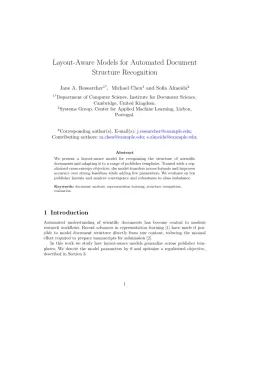
Visual Intelligence template — frequently asked questions

How do I write a paper in the Visual Intelligence format?
In DocuGuru you write your manuscript in a normal editor — no LaTeX setup required — and select the Visual Intelligence template. When you export, DocuGuru compiles the paper into the official Springer Nature format and hands you a submission-ready PDF along with the editable LaTeX source.
What reference style does Visual Intelligence use?
Visual Intelligence uses Superscript numbered (Nature) references, shown as superscript numerals in the text. DocuGuru formats every in-text citation and the reference list in this exact style automatically. A reference appears like this: 1. Smith, A., Jones, B. & Lee, C. A representative article title. Visual Intelligence 12, 45–58 (2023).
Do I need to know LaTeX to submit to Visual Intelligence?
No. DocuGuru generates the sn-jnl LaTeX class and compiles the PDF for you in the background, so you get a Springer Nature-ready Visual Intelligence document without writing any LaTeX. If you do want it, the LaTeX source is included in the export.
Can I import an existing draft into the Visual Intelligence template?
Yes. Paste or upload your current manuscript — Word, LaTeX, Markdown, or plain text — and DocuGuru reflows it into the Visual Intelligence format with correct headings, figures, tables, and superscript citations.
Who publishes Visual Intelligence?
Visual Intelligence is a multidisciplinary journal published by Springer Nature. DocuGuru's Visual Intelligence template matches Springer Nature's official submission format.
Can I export a submission-ready Visual Intelligence PDF?
Yes — DocuGuru produces a PDF built with the official Visual Intelligence template (the sn-jnl class) that is ready to submit to Springer Nature, together with the matching LaTeX source files.
How much does the Visual Intelligence template cost?
You can start writing in the Visual Intelligence template for free. Exporting the final submission-ready Visual Intelligence PDF and LaTeX source is part of DocuGuru's paid plans — see the app for current pricing.
Use the Visual Intelligence template