Springer Nature

Standards in Genomic Sciences Template

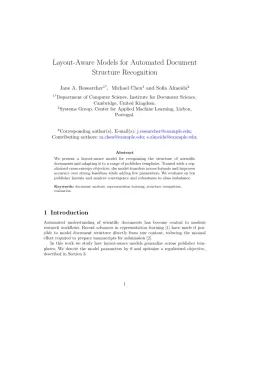
Write in a clean editor, then format for Standards in Genomic Sciences in one click — DocuGuru applies the official Springer Nature template with superscript references and exports a submission-ready PDF plus the editable LaTeX source. Free to start.

About the Standards in Genomic Sciences format

Standards in Genomic Sciences is a peer-reviewed journal published by Springer Nature, covering Genomics and Phylogenetic Studies, Microbial Community Ecology and Physiology, Bacteriophages and microbial interactions.

PublisherSpringer Nature
Reference styleSuperscript numbered (Nature)
Superscript — small raised numerals in the text
1. Smith, A., Jones, B. & Lee, C. A representative article title. Standards in Genomic Sciences 12, 45–58 (2023).

Formats any DOI in Standards in Genomic Sciences style. No sign-up.

Publishes research inGenomics and Phylogenetic Studies Microbial Community Ecology and Physiology Bacteriophages and microbial interactions Legume Nitrogen Fixing Symbiosis Protist diversity and phylogeny
ISSN1944-3277
h-index61
i10-index555
Total citations22,206
Article processing charge$1,429
Open accessYes
Top institutions publishing hereJoint Genome Institute
Journal websitewww.standardsingenomics.com
You getA submission-ready PDF and the editable LaTeX source — ready to submit.

Papers published in Standards in Genomic Sciences per year

1
1977
1
1990
44
2009
82
2010
87
2011
79
2012
110
2013
91
2014
128
2015
91
2016
91
2017
36
2018

Citation impact of Standards in Genomic Sciences by publication year

4
1977
0
1990
872
2009
4.9K
2010
2.4K
2011
2.6K
2012
2.2K
2013
2.3K
2014
2.7K
2015
2K
2016
1.4K
2017
609
2018

Citations each year’s papers have accumulated so far — the most recent years are still building up.

Most-cited papers in Standards in Genomic Sciences

Digital DNA-DNA hybridization for microbial species delineation by means of genome-to-genome sequence comparison

Alexander F. Auch, Mathias von Jan, Hans‐Peter Klenk et al. · 28 Jan 2010

The pragmatic species concept for Bacteria and Archaea is ultimately based on DNA-DNA hybridization (DDH). While enabling the taxonomist, in principle, to obtain an estimate of the overall similarity between the genomes of two strains, this technique is tedious and error-prone and cannot be used to incrementally build up a comparative database. Recent technological progress…

1,723 citations Cite SaveGo to paper →
Complete genome sequence of DSM 30083T, the type strain (U5/41T) of Escherichia coli, and a proposal for delineating subspecies in microbial taxonomy

Jan P. Meier‐Kolthoff, Richard L. Hahnke, Jörn Petersen et al. · 8 Dec 2014

Although Escherichia coli is the most widely studied bacterial model organism and often considered to be the model bacterium per se, its type strain was until now forgotten from microbial genomics. As a part of the G enomic E ncyclopedia of B acteria and A rchaea project, we here describe the features of E. coli…

Standard operating procedure for calculating genome-to-genome distances based on high-scoring segment pairs

Alexander F. Auch, Hans‐Peter Klenk, Markus Göker · 28 Jan 2010

DNA-DNA hybridization (DDH) is a widely applied wet-lab technique to obtain an estimate of the overall similarity between the genomes of two organisms. To base the species concept for prokaryotes ultimately on DDH was chosen by microbiologists as a pragmatic approach for deciding about the recognition of novel species, but also allowed a relatively high…

The standard operating procedure of the DOE-JGI Microbial Genome Annotation Pipeline (MGAP v.4)

Marcel Huntemann, Natalia Ivanova, Konstantinos Mavromatis et al. · 26 Oct 2015

The DOE-JGI Metagenome Annotation Pipeline (MAP v.4) performs structural and functional annotation for metagenomic sequences that are submitted to the Integrated Microbial Genomes with Microbiomes (IMG/M) system for comparative analysis. The pipeline runs on nucleotide sequences provided via the IMG submission site. Users must first define their analysis projects in GOLD and then submit the…

Meeting Report: The Terabase Metagenomics Workshop and the Vision of an Earth Microbiome Project

Jack A. Gilbert, Folker Meyer, Dion Antonopoulos et al. · 1 Jan 2010

Between July 18(th) and 24(th) 2010, 26 leading microbial ecology, computation, bioinformatics and statistics researchers came together in Snowbird, Utah (USA) to discuss the challenge of how to best characterize the microbial world using next-generation sequencing technologies. The meeting was entitled "Terabase Metagenomics" and was sponsored by the Institute for Computing in Science (ICiS) summer…

Standards in Genomic Sciences template — frequently asked questions

How do I write a paper in the Standards in Genomic Sciences format?
In DocuGuru you write your manuscript in a normal editor — no LaTeX setup required — and select the Standards in Genomic Sciences template. When you export, DocuGuru compiles the paper into the official Springer Nature format and hands you a submission-ready PDF along with the editable LaTeX source.
What reference style does Standards in Genomic Sciences use?
Standards in Genomic Sciences uses Superscript numbered (Nature) references, shown as superscript numerals in the text. DocuGuru formats every in-text citation and the reference list in this exact style automatically. A reference appears like this: 1. Smith, A., Jones, B. & Lee, C. A representative article title. Standards in Genomic Sciences 12, 45–58 (2023).
Do I need to know LaTeX to submit to Standards in Genomic Sciences?
No. DocuGuru generates the sn-jnl LaTeX class and compiles the PDF for you in the background, so you get a Springer Nature-ready Standards in Genomic Sciences document without writing any LaTeX. If you do want it, the LaTeX source is included in the export.
Can I import an existing draft into the Standards in Genomic Sciences template?
Yes. Paste or upload your current manuscript — Word, LaTeX, Markdown, or plain text — and DocuGuru reflows it into the Standards in Genomic Sciences format with correct headings, figures, tables, and superscript citations.
Who publishes Standards in Genomic Sciences?
Standards in Genomic Sciences is a multidisciplinary journal published by Springer Nature. DocuGuru's Standards in Genomic Sciences template matches Springer Nature's official submission format.
Can I export a submission-ready Standards in Genomic Sciences PDF?
Yes — DocuGuru produces a PDF built with the official Standards in Genomic Sciences template (the sn-jnl class) that is ready to submit to Springer Nature, together with the matching LaTeX source files.
How much does the Standards in Genomic Sciences template cost?
You can start writing in the Standards in Genomic Sciences template for free. Exporting the final submission-ready Standards in Genomic Sciences PDF and LaTeX source is part of DocuGuru's paid plans — see the app for current pricing.

Use the Standards in Genomic Sciences template