
368 citations
Cite
SaveGo to paper →
Springer Nature
Quantum Machine Intelligence Template
Write in a clean editor, then format for Quantum Machine Intelligence in one click — DocuGuru applies the official Springer Nature template with superscript references and exports a submission-ready PDF plus the editable LaTeX source. Free to start.
About the Quantum Machine Intelligence format
Quantum Machine Intelligence is a peer-reviewed journal published by Springer Nature, covering Quantum Computing Algorithms and Architecture, Quantum Information and Cryptography, Neural Networks and Reservoir Computing.
| Publisher | Springer Nature |
|---|---|
| Reference style | Superscript numbered (Nature) Superscript — small raised numerals in the text 1. Smith, A., Jones, B. & Lee, C. A representative article title. Quantum Machine Intelligence 12, 45–58 (2023).
Formats any DOI in Quantum Machine Intelligence style. No sign-up. |
| Publishes research in | Quantum Computing Algorithms and Architecture Quantum Information and Cryptography Neural Networks and Reservoir Computing Quantum many-body systems Quantum-Dot Cellular Automata |
| ISSN | 2524-4906 |
| Citation impact (2-yr) | 5.89 |
| h-index | 33 |
| i10-index | 124 |
| Total citations | 4,822 |
| Article processing charge | $2,990 |
| Top institutions publishing here | University of Oxford |
| Journal website | www.springer.com |
| You get | A submission-ready PDF and the editable LaTeX source — ready to submit. |
Papers published in Quantum Machine Intelligence per year
Citation impact of Quantum Machine Intelligence by publication year
Citations each year’s papers have accumulated so far — the most recent years are still building up.
Most-cited papers in Quantum Machine Intelligence
Abstract With the increased focus on quantum circuit learning for near-term applications on quantum devices, in conjunction with unique challenges presented by cost function landscapes of parametrized quantum circuits, strategies for effective training are becoming increasingly important. In order to ameliorate some of these challenges, we investigate a layerwise learning strategy for parametrized quantum circuits.…
334 citations
Cite
SaveGo to paper →
227 citations
Cite
SaveGo to paper →
108 citations
Cite
SaveGo to paper →
Abstract This work presents a novel realization approach to quantum Boltzmann machines (QBMs). The preparation of the required Gibbs states, as well as the evaluation of the loss function’s analytic gradient, is based on variational quantum imaginary time evolution, a technique that is typically used for ground-state computation. In contrast to existing methods, this implementation…
98 citations
Cite
SaveGo to paper →
Related journal templates
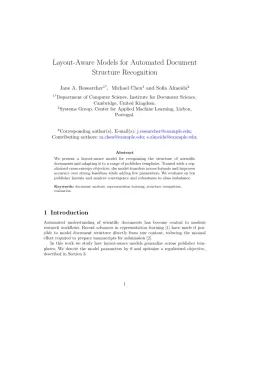
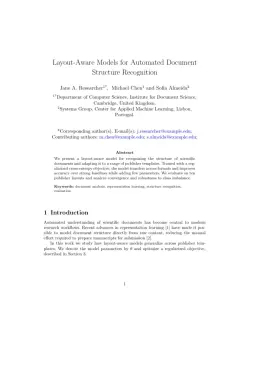
Quantum Machine Intelligence template — frequently asked questions
How do I write a paper in the Quantum Machine Intelligence format?
In DocuGuru you write your manuscript in a normal editor — no LaTeX setup required — and select the Quantum Machine Intelligence template. When you export, DocuGuru compiles the paper into the official Springer Nature format and hands you a submission-ready PDF along with the editable LaTeX source.
What reference style does Quantum Machine Intelligence use?
Quantum Machine Intelligence uses Superscript numbered (Nature) references, shown as superscript numerals in the text. DocuGuru formats every in-text citation and the reference list in this exact style automatically. A reference appears like this: 1. Smith, A., Jones, B. & Lee, C. A representative article title. Quantum Machine Intelligence 12, 45–58 (2023).
Do I need to know LaTeX to submit to Quantum Machine Intelligence?
No. DocuGuru generates the sn-jnl LaTeX class and compiles the PDF for you in the background, so you get a Springer Nature-ready Quantum Machine Intelligence document without writing any LaTeX. If you do want it, the LaTeX source is included in the export.
Can I import an existing draft into the Quantum Machine Intelligence template?
Yes. Paste or upload your current manuscript — Word, LaTeX, Markdown, or plain text — and DocuGuru reflows it into the Quantum Machine Intelligence format with correct headings, figures, tables, and superscript citations.
Who publishes Quantum Machine Intelligence?
Quantum Machine Intelligence is a multidisciplinary journal published by Springer Nature. DocuGuru's Quantum Machine Intelligence template matches Springer Nature's official submission format.
Can I export a submission-ready Quantum Machine Intelligence PDF?
Yes — DocuGuru produces a PDF built with the official Quantum Machine Intelligence template (the sn-jnl class) that is ready to submit to Springer Nature, together with the matching LaTeX source files.
How much does the Quantum Machine Intelligence template cost?
You can start writing in the Quantum Machine Intelligence template for free. Exporting the final submission-ready Quantum Machine Intelligence PDF and LaTeX source is part of DocuGuru's paid plans — see the app for current pricing.