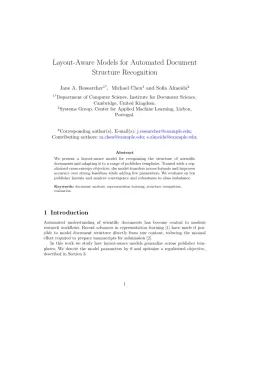
About the Minds and Machines format
Minds and Machines is a peer-reviewed journal published by Springer Nature, covering Computability, Logic, AI Algorithms, Philosophy and Theoretical Science, Embodied and Extended Cognition.
| Publisher | Springer Nature |
|---|
| Reference style | Superscript numbered (Nature) Superscript — small raised numerals in the text
1. Smith, A., Jones, B. & Lee, C. A representative article title. Minds and Machines 12, 45–58 (2023).
Formats any DOI in Minds and Machines style. No sign-up.
|
|---|
| Publishes research in | Computability, Logic, AI Algorithms Philosophy and Theoretical Science Embodied and Extended Cognition Ethics and Social Impacts of AI Philosophy and History of Science |
|---|
| ISSN | 0924-6495 |
|---|
| Citation impact (2-yr) | 7.2 |
|---|
| h-index | 78 |
|---|
| i10-index | 499 |
|---|
| Total citations | 35,136 |
|---|
| Article processing charge | $2,990 |
|---|
| Top institutions publishing here | University of Oxford |
|---|
| Journal website | www.springer.com |
|---|
| You get | A submission-ready PDF and the editable LaTeX source — ready to submit. |
|---|
Papers published in Minds and Machines per year
Citation impact of Minds and Machines by publication year
Citations each year’s papers have accumulated so far — the most recent years are still building up.
Most-cited papers in Minds and Machines
AI4People—An Ethical Framework for a Good AI Society: Opportunities, Risks, Principles, and Recommendations
Luciano Floridi, Josh Cowls, Monica Beltrametti et al. · 25 Nov 2018
This article reports the findings of AI4People, an Atomium-EISMD initiative designed to lay the foundations for a "Good AI Society". We introduce the core opportunities and risks of AI for society; present a synthesis of five ethical principles that should undergird its development and adoption; and offer 20 concrete recommendations-to assess, to develop, to incentivise,…
GPT-3: Its Nature, Scope, Limits, and Consequences
Luciano Floridi, Massimo Chiriatti · 1 Nov 2020
Abstract In this commentary, we discuss the nature of reversible and irreversible questions, that is, questions that may enable one to identify the nature of the source of their answers. We then introduce GPT-3, a third-generation, autoregressive language model that uses deep learning to produce human-like texts, and use the previous distinction to analyse it.…
The Ethics of AI Ethics: An Evaluation of Guidelines
Thilo Hagendorff · 1 Feb 2020
Abstract Current advances in research, development and application of artificial intelligence (AI) systems have yielded a far-reaching discourse on AI ethics. In consequence, a number of ethics guidelines have been released in recent years. These guidelines comprise normative principles and recommendations aimed to harness the “disruptive” potentials of new AI technologies. Designed as a semi-systematic…
On the Morality of Artificial Agents
Luciano Floridi, J. W. Sanders · 21 Jul 2004
Universal Intelligence: A Definition of Machine Intelligence
Shane Legg, Marcus Hütter · 9 Nov 2007