
5,099 citations
Cite
SaveGo to paper →
Springer Nature
Metabolomics Template
Write in a clean editor, then format for Metabolomics in one click — DocuGuru applies the official Springer Nature template with superscript references and exports a submission-ready PDF plus the editable LaTeX source. Free to start.
About the Metabolomics format
Metabolomics is a peer-reviewed journal published by Springer Nature, covering Metabolomics and Mass Spectrometry Studies, Advanced Chemical Sensor Technologies, Advanced Proteomics Techniques and Applications.
| Publisher | Springer Nature |
|---|---|
| Reference style | Superscript numbered (Nature) Superscript — small raised numerals in the text 1. Smith, A., Jones, B. & Lee, C. A representative article title. Metabolomics 12, 45–58 (2023).
Formats any DOI in Metabolomics style. No sign-up. |
| Publishes research in | Metabolomics and Mass Spectrometry Studies Advanced Chemical Sensor Technologies Advanced Proteomics Techniques and Applications Gut microbiota and health Analytical Chemistry and Chromatography |
| ISSN | 1573-3882 |
| Citation impact (2-yr) | 3.18 |
| h-index | 121 |
| i10-index | 1,571 |
| Total citations | 91,012 |
| Article processing charge | $3,690 |
| Top institutions publishing here | University of Manchester |
| Journal website | www.springer.com |
| You get | A submission-ready PDF and the editable LaTeX source — ready to submit. |
Papers published in Metabolomics per year
Citation impact of Metabolomics by publication year
Citations each year’s papers have accumulated so far — the most recent years are still building up.
Most-cited papers in Metabolomics
Classifying groups of individuals based on their metabolic profile is one of the main topics in metabolomics research. Due to the low number of individuals compared to the large number of variables, this is not an easy task. PLSDA is one of the data analysis methods used for the classification. Unfortunately this method eagerly overfits…
1,458 citations
Cite
SaveGo to paper →
Saliva is a readily accessible and informative biofluid, making it ideal for the early detection of a wide range of diseases including cardiovascular, renal, and autoimmune diseases, viral and bacterial infections and, importantly, cancers. Saliva-based diagnostics, particularly those based on metabolomics technology, are emerging and offer a promising clinical strategy, characterizing the association between salivary…
1,008 citations
Cite
SaveGo to paper →
Metabolomics is increasingly being applied towards the identification of biomarkers for disease diagnosis, prognosis and risk prediction. Unfortunately among the many published metabolomic studies focusing on biomarker discovery, there is very little consistency and relatively little rigor in how researchers select, assess or report their candidate biomarkers. In particular, few studies report any measure of…
961 citations
Cite
SaveGo to paper →
Partial Least Squares-Discriminant Analysis (PLS-DA) is a PLS regression method with a special binary 'dummy' y-variable and it is commonly used for classification purposes and biomarker selection in metabolomics studies. Several statistical approaches are currently in use to validate outcomes of PLS-DA analyses e.g. double cross validation procedures or permutation testing. However, there is a…
890 citations
Cite
SaveGo to paper →
Related journal templates
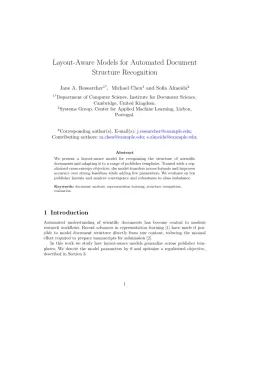
Metabolomics template — frequently asked questions
How do I write a paper in the Metabolomics format?
In DocuGuru you write your manuscript in a normal editor — no LaTeX setup required — and select the Metabolomics template. When you export, DocuGuru compiles the paper into the official Springer Nature format and hands you a submission-ready PDF along with the editable LaTeX source.
What reference style does Metabolomics use?
Metabolomics uses Superscript numbered (Nature) references, shown as superscript numerals in the text. DocuGuru formats every in-text citation and the reference list in this exact style automatically. A reference appears like this: 1. Smith, A., Jones, B. & Lee, C. A representative article title. Metabolomics 12, 45–58 (2023).
Do I need to know LaTeX to submit to Metabolomics?
No. DocuGuru generates the sn-jnl LaTeX class and compiles the PDF for you in the background, so you get a Springer Nature-ready Metabolomics document without writing any LaTeX. If you do want it, the LaTeX source is included in the export.
Can I import an existing draft into the Metabolomics template?
Yes. Paste or upload your current manuscript — Word, LaTeX, Markdown, or plain text — and DocuGuru reflows it into the Metabolomics format with correct headings, figures, tables, and superscript citations.
Who publishes Metabolomics?
Metabolomics is a multidisciplinary journal published by Springer Nature. DocuGuru's Metabolomics template matches Springer Nature's official submission format.
Can I export a submission-ready Metabolomics PDF?
Yes — DocuGuru produces a PDF built with the official Metabolomics template (the sn-jnl class) that is ready to submit to Springer Nature, together with the matching LaTeX source files.
How much does the Metabolomics template cost?
You can start writing in the Metabolomics template for free. Exporting the final submission-ready Metabolomics PDF and LaTeX source is part of DocuGuru's paid plans — see the app for current pricing.