Springer Nature

Materials for Renewable and Sustainable Energy Template

Write in a clean editor, then format for Materials for Renewable and Sustainable Energy in one click — DocuGuru applies the official Springer Nature template with numbered references and exports a submission-ready PDF plus the editable LaTeX source. Free to start.

About the Materials for Renewable and Sustainable Energy format

Materials for Renewable and Sustainable Energy is a peer-reviewed journal published by Springer Nature, covering Supercapacitor Materials and Fabrication, Electrocatalysts for Energy Conversion, Fuel Cells and Related Materials.

PublisherSpringer Nature
Reference styleNumbered (Springer)
Numbered — [1], [2] in the text
1. Smith, A., Jones, B., Lee, C.: A representative article title. Materials for Renewable and Sustainable Energy 12, 45–58 (2023)

Formats any DOI in Materials for Renewable and Sustainable Energy style. No sign-up.

Publishes research inSupercapacitor Materials and Fabrication Electrocatalysts for Energy Conversion Fuel Cells and Related Materials Advanced Photocatalysis Techniques Conducting polymers and applications
ISSN2194-1459
Citation impact (2-yr)6.98
h-index45
i10-index208
Total citations8,279
Open accessYes
Top institutions publishing hereCentre National de la Recherche Scientifique
Journal websitelink.springer.com
You getA submission-ready PDF and the editable LaTeX source — ready to submit.

Papers published in Materials for Renewable and Sustainable Energy per year

19
2014
22
2015
22
2016
22
2017
32
2018
20
2019
24
2020
18
2021
20
2022
20
2023
34
2024
64
2025

Citation impact of Materials for Renewable and Sustainable Energy by publication year

827
2014
1.1K
2015
442
2016
498
2017
699
2018
797
2019
995
2020
353
2021
549
2022
399
2023
426
2024
434
2025

Citations each year’s papers have accumulated so far — the most recent years are still building up.

Most-cited papers in Materials for Renewable and Sustainable Energy

Electrode materials for microbial fuel cells: nanomaterial approach

Mustakeem Mustakeem · 5 Nov 2015

Microbial fuel cell (MFC) technology has the potential to become a major renewable energy resource by degrading organic pollutants in wastewater. The performance of MFC directly depends on the kinetics of the electrode reactions within the fuel cell, with the performance of the electrodes heavily influenced by the materials they are made from. A wide…

Materials science aspects of zinc–air batteries: a review

Vincenzo Caramia, Benedetto Bozzini · 2 Apr 2014

Metal–air batteries are becoming of particular interest, from both fundamental and industrial viewpoints, for their high specific energy density compared to other energy storage devices, in particular the Li-ion systems. Among metal–air batteries, the zinc–air option represents a safe, environmentally friendly and potentially cheap and simple way to store and deliver electrical energy for both…

Fractional-order models of supercapacitors, batteries and fuel cells: a survey

Todd J. Freeborn, Brent Maundy, Ahmed S. Elwakil · 13 Jun 2015

This paper surveys fractional-order electric circuit models that have been reported in the literature to best fit experimentally collected impedance data from energy storage and generation elements, including super-capacitors, batteries, and fuel cells. In all surveyed models, the employment of fractional-order capacitors, also known as constant phase elements, is imperative not only to the accuracy…

Design of an isolated renewable hybrid energy system: a case study

Yasser F. Nassar, Samer Alsadi, Hala J. El‐Khozondar et al. · 13 Nov 2022

Abstract In addition to the fact that most renewable energies such as solar and wind energy have become more competitive in the global energy market, thanks to the great development in conversion technologies, it believes that renewable energy can play a crucial role in global environmental issues. However, in Palestine, the situation is different from…

Towards high-efficiency CZTS solar cell through buffer layer optimization

Farjana Akter Jhuma, Marshia Zaman Shaily, Mohammad Junaebur Rashid · 13 Feb 2019

Cu2ZnSnS4 (CZTS)-based solar cells show a promising performance in the field of sunlight-based energy production system. To increase the performance of CZTS-based solar cell, buffer layer optimization is still an obstacle. In this work, numerical simulations were performed on structures based on CZTS absorber layer, ZnO window layer, and transparent conducting layer n-ITO with different…

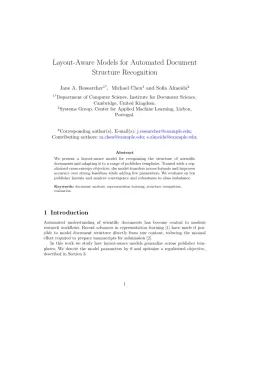
Materials for Renewable and Sustainable Energy template — frequently asked questions

How do I write a paper in the Materials for Renewable and Sustainable Energy format?
In DocuGuru you write your manuscript in a normal editor — no LaTeX setup required — and select the Materials for Renewable and Sustainable Energy template. When you export, DocuGuru compiles the paper into the official Springer Nature format and hands you a submission-ready PDF along with the editable LaTeX source.
What reference style does Materials for Renewable and Sustainable Energy use?
Materials for Renewable and Sustainable Energy uses Numbered (Springer) references, shown as numbered [1], [2] markers in the text. DocuGuru formats every in-text citation and the reference list in this exact style automatically. A reference appears like this: 1. Smith, A., Jones, B., Lee, C.: A representative article title. Materials for Renewable and Sustainable Energy 12, 45–58 (2023)
Do I need to know LaTeX to submit to Materials for Renewable and Sustainable Energy?
No. DocuGuru generates the sn-jnl LaTeX class and compiles the PDF for you in the background, so you get a Springer Nature-ready Materials for Renewable and Sustainable Energy document without writing any LaTeX. If you do want it, the LaTeX source is included in the export.
Can I import an existing draft into the Materials for Renewable and Sustainable Energy template?
Yes. Paste or upload your current manuscript — Word, LaTeX, Markdown, or plain text — and DocuGuru reflows it into the Materials for Renewable and Sustainable Energy format with correct headings, figures, tables, and numbered citations.
Who publishes Materials for Renewable and Sustainable Energy?
Materials for Renewable and Sustainable Energy is a physics journal published by Springer Nature. DocuGuru's Materials for Renewable and Sustainable Energy template matches Springer Nature's official submission format.
Can I export a submission-ready Materials for Renewable and Sustainable Energy PDF?
Yes — DocuGuru produces a PDF built with the official Materials for Renewable and Sustainable Energy template (the sn-jnl class) that is ready to submit to Springer Nature, together with the matching LaTeX source files.
How much does the Materials for Renewable and Sustainable Energy template cost?
You can start writing in the Materials for Renewable and Sustainable Energy template for free. Exporting the final submission-ready Materials for Renewable and Sustainable Energy PDF and LaTeX source is part of DocuGuru's paid plans — see the app for current pricing.
Use the Materials for Renewable and Sustainable Energy template