Springer Nature

Journal of the Brazilian Computer Society Template

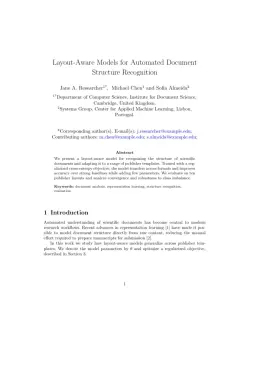
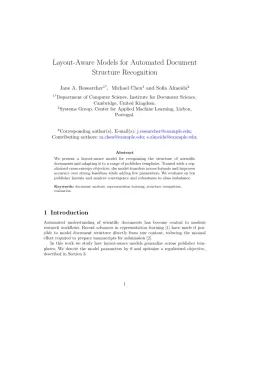
Write in a clean editor, then format for Journal of the Brazilian Computer Society in one click — DocuGuru applies the official Springer Nature template with numbered references and exports a submission-ready PDF plus the editable LaTeX source. Free to start.

About the Journal of the Brazilian Computer Society format

Journal of the Brazilian Computer Society is a peer-reviewed journal published by Springer Nature, covering Software Engineering Research, Advanced Software Engineering Methodologies, Service-Oriented Architecture and Web Services.

PublisherSpringer Nature
Reference styleNumbered (Springer Basic)
Numbered — [1], [2] in the text
1. Smith A, Jones B, Lee C (2023) A representative article title. Journal of the Brazilian Computer Society 12:45–58

Formats any DOI in Journal of the Brazilian Computer Society style. No sign-up.

Publishes research inSoftware Engineering Research Advanced Software Engineering Methodologies Service-Oriented Architecture and Web Services Software Engineering Techniques and Practices Topic Modeling
ISSN0104-6500
Citation impact (2-yr)0.93
h-index36
i10-index188
Total citations6,429
Open accessYes
Top institutions publishing hereUniversidade de São Paulo
Journal websitewww.scielo.br
You getA submission-ready PDF and the editable LaTeX source — ready to submit.

Papers published in Journal of the Brazilian Computer Society per year

18
2014
21
2015
9
2016
16
2017
17
2018
13
2019
9
2020
17
2021
10
2022
9
2023
44
2024
76
2025

Citation impact of Journal of the Brazilian Computer Society by publication year

214
2014
206
2015
71
2016
316
2017
203
2018
329
2019
45
2020
266
2021
28
2022
69
2023
133
2024
58
2025

Citations each year’s papers have accumulated so far — the most recent years are still building up.

Most-cited papers in Journal of the Brazilian Computer Society

scriptLattes: an open-source knowledge extraction system from the Lattes platform

Jesús Pascual Mena‐Chalco, Roberto M. César · 1 Dec 2009

Abstract The Lattes platform is the major scientific information system maintained by the National Council for Scientific and Technological Development (CNPq). This platform allows to manage the curricular information of researchers and institutions working in Brazil based on the so called Lattes Curriculum. However, the public information is individually available for each researcher, not providing…

Ginga-NCL: the declarative environment of the Brazilian digital TV System

Luiz Fernando Gomes Soares, Rogério Ferreira Rodrigues, Márcio Ferreira Moreno · 1 Mar 2007

Abstract As in all main terrestrial DTV Systems, the Brazilian middleware, named Ginga, supports both declarative applications (through its presentation, or declarative, environment Ginga-NCL) and procedural applications (through its execution, or procedural, environment Ginga-J). Since hybrid applications are common, either type of Ginga application may make use of facilities of both presentation and execution application…

ScriptLattes: an open-source knowledge extraction system from the Lattes platform

Jesús Pascual Mena‐Chalco, Roberto M. César · 1 Dec 2009

The Lattes platform is the major scientific information system maintained by the National Council for Scientific and Technological Development (CNPq). This platform allows to manage the curricular information of researchers and institutions working in Brazil based on the so called Lattes Curriculum. However, the public information is individually available for each researcher, not providing the…

VANET simulators: an updated review

Julia Silva Weber, Miguel Neves, Tiago Ferreto · 6 May 2021

Abstract Research on VANETs (vehicular ad hoc networks) date back to the beginning of the 2000s. The possibility of enabling communication between vehicles through a wireless network stimulated the creation of new protocols, devices, and diverse utilization scenarios. Due to the intrinsic difficulties of using a real testbed to evaluate these research contributions, several simulators…

A maximum uncertainty LDA-based approach for limited sample size problems — with application to face recognition

Carlos Eduardo Thomaz, Edson C. Kitani, Duncan Gillies · 1 Jun 2006

Abstract A critical issue of applying Linear Discriminant Analysis (LDA) is both the singularity and instability of the within-class scatter matrix. In practice, particularly in image recognition applications such as face recognition, there are often a large number of pixels or pre-processed features available, but the total number of training patterns is limited and commonly…

Journal of the Brazilian Computer Society template — frequently asked questions

How do I write a paper in the Journal of the Brazilian Computer Society format?
In DocuGuru you write your manuscript in a normal editor — no LaTeX setup required — and select the Journal of the Brazilian Computer Society template. When you export, DocuGuru compiles the paper into the official Springer Nature format and hands you a submission-ready PDF along with the editable LaTeX source.
What reference style does Journal of the Brazilian Computer Society use?
Journal of the Brazilian Computer Society uses Numbered (Springer Basic) references, shown as numbered [1], [2] markers in the text. DocuGuru formats every in-text citation and the reference list in this exact style automatically. A reference appears like this: 1. Smith A, Jones B, Lee C (2023) A representative article title. Journal of the Brazilian Computer Society 12:45–58
Do I need to know LaTeX to submit to Journal of the Brazilian Computer Society?
No. DocuGuru generates the sn-jnl LaTeX class and compiles the PDF for you in the background, so you get a Springer Nature-ready Journal of the Brazilian Computer Society document without writing any LaTeX. If you do want it, the LaTeX source is included in the export.
Can I import an existing draft into the Journal of the Brazilian Computer Society template?
Yes. Paste or upload your current manuscript — Word, LaTeX, Markdown, or plain text — and DocuGuru reflows it into the Journal of the Brazilian Computer Society format with correct headings, figures, tables, and numbered citations.
Who publishes Journal of the Brazilian Computer Society?
Journal of the Brazilian Computer Society is a multidisciplinary journal published by Springer Nature. DocuGuru's Journal of the Brazilian Computer Society template matches Springer Nature's official submission format.
Can I export a submission-ready Journal of the Brazilian Computer Society PDF?
Yes — DocuGuru produces a PDF built with the official Journal of the Brazilian Computer Society template (the sn-jnl class) that is ready to submit to Springer Nature, together with the matching LaTeX source files.
How much does the Journal of the Brazilian Computer Society template cost?
You can start writing in the Journal of the Brazilian Computer Society template for free. Exporting the final submission-ready Journal of the Brazilian Computer Society PDF and LaTeX source is part of DocuGuru's paid plans — see the app for current pricing.
Use the Journal of the Brazilian Computer Society template