Springer Nature

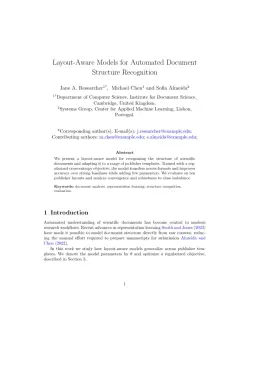
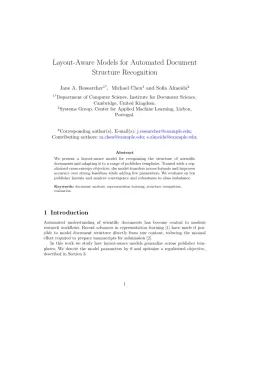
Journal of Pediatric Neuropsychology Template

Write in a clean editor, then format for Journal of Pediatric Neuropsychology in one click — DocuGuru applies the official Springer Nature template with superscript references and exports a submission-ready PDF plus the editable LaTeX source. Free to start.

About the Journal of Pediatric Neuropsychology format

Journal of Pediatric Neuropsychology is a peer-reviewed journal published by Springer Nature, covering Traumatic Brain Injury Research, Attention Deficit Hyperactivity Disorder, Autism Spectrum Disorder Research.

PublisherSpringer Nature
Reference styleSuperscript numbered (Nature)
Superscript — small raised numerals in the text
1. Smith, A., Jones, B. & Lee, C. A representative article title. Journal of Pediatric Neuropsychology 12, 45–58 (2023).

Formats any DOI in Journal of Pediatric Neuropsychology style. No sign-up.

Publishes research inTraumatic Brain Injury Research Attention Deficit Hyperactivity Disorder Autism Spectrum Disorder Research Prenatal Substance Exposure Effects Cardiac Arrest and Resuscitation
ISSN2199-2673
Citation impact (2-yr)0.53
h-index13
i10-index27
Total citations887
Article processing charge$2,990
Top institutions publishing hereBall State University
Journal websitewww.springer.com
You getA submission-ready PDF and the editable LaTeX source — ready to submit.

Papers published in Journal of Pediatric Neuropsychology per year

10
2015
14
2016
24
2017
14
2018
15
2019
23
2020
24
2021
23
2022
25
2023
30
2024
37
2025

Citation impact of Journal of Pediatric Neuropsychology by publication year

138
2015
113
2016
105
2017
68
2018
44
2019
137
2020
103
2021
70
2022
60
2023
34
2024
8
2025

Citations each year’s papers have accumulated so far — the most recent years are still building up.

Most-cited papers in Journal of Pediatric Neuropsychology

Behavior Rating Inventory of Executive Function, Second Edition Gerard A. Gioia, Peter K. Isquith, Steven C. Guy, and Lauren Kenworthy.

Peter Dodzik · 26 Jul 2017

The Behavior Rating Inventory of Executive Functioning-2 (BRIEF2) provides an updated version of one of the most widely used measures of executive functioning in children. The BRIEF2 is a well-researched instrument that provides clinicians with a comprehensive assessment tool that can be completed by parents, teachers, or the child that results in reliable and valid…

Relationship between sluggish cognitive tempo and sleep, psychological, somatic, and cognitive problems in elementary school children.

Susan Dickerson Mayes, Daniel A. Waschbusch, Julio Fernández‐Mendoza et al. · 30 May 2021

This is the first study exploring relationships between sluggish cognitive tempo (SCT) and sleep, internalizing, externalizing, somatic, and cognitive problems in elementary school children using subjective and objective sleep measures. From a population-based sample, 665 children (6–12 years of age) were rated by their mothers on the Pediatric Behavior Scale (PBS) and underwent an overnight…

Is the Cattell–Horn–Carroll-based factor structure of the Wechsler Intelligence Scale for Children—Fifth Edition (WISC-V) construct invariant for a representative sample of African–American, Hispanic, and Caucasian male and female students ages 6 to 16 years?

Caroline Scheiber · 8 Sep 2016

Since the inception of testing, the examination of test bias has been discussed and debated in the literature. As new tests are developed or old tests are revised, part of the standardization process involves the examination of gender and ethnic item bias. The exploration of construct invariance across different ethnic and gender groups, however, is…

The Yale Outcome Study: Outcomes for graduates with and without dyslexia.

Sally E. Shaywitz, John M. Holahan, Blair Kenney et al. · 13 Oct 2020

Dyslexia is defined in recent federal legislation as an unexpected difficulty in reading for an individual who has the intelligence to be a much better reader. Despite its high prevalence (20%), there have been few studies of the experience and outcome of dyslexic students at selective 4-year colleges. We examined academic and social experiences in…

One-minute PVT: Further evidence for the utility of the California Verbal Learning Test—Children’s Version forced choice recognition trial.

Jonathan D. Lichtenstein, Matthew Holcomb, László A. Erdődi · 19 Oct 2018

To replicate previous research on the forced choice recognition trial for the California Verbal Learning Test—Children’s Version (FCR-C). Classification accuracy of the FCR-C was computed in 178 children referred for neuropsychological assessment to a tertiary care hospital. FCR-C ≤ 14 produced the best combination of sensitivity (.12–.42) and specificity (.88–.96). Unlike some of the criterion…

Journal of Pediatric Neuropsychology template — frequently asked questions

How do I write a paper in the Journal of Pediatric Neuropsychology format?
In DocuGuru you write your manuscript in a normal editor — no LaTeX setup required — and select the Journal of Pediatric Neuropsychology template. When you export, DocuGuru compiles the paper into the official Springer Nature format and hands you a submission-ready PDF along with the editable LaTeX source.
What reference style does Journal of Pediatric Neuropsychology use?
Journal of Pediatric Neuropsychology uses Superscript numbered (Nature) references, shown as superscript numerals in the text. DocuGuru formats every in-text citation and the reference list in this exact style automatically. A reference appears like this: 1. Smith, A., Jones, B. & Lee, C. A representative article title. Journal of Pediatric Neuropsychology 12, 45–58 (2023).
Do I need to know LaTeX to submit to Journal of Pediatric Neuropsychology?
No. DocuGuru generates the sn-jnl LaTeX class and compiles the PDF for you in the background, so you get a Springer Nature-ready Journal of Pediatric Neuropsychology document without writing any LaTeX. If you do want it, the LaTeX source is included in the export.
Can I import an existing draft into the Journal of Pediatric Neuropsychology template?
Yes. Paste or upload your current manuscript — Word, LaTeX, Markdown, or plain text — and DocuGuru reflows it into the Journal of Pediatric Neuropsychology format with correct headings, figures, tables, and superscript citations.
Who publishes Journal of Pediatric Neuropsychology?
Journal of Pediatric Neuropsychology is a multidisciplinary journal published by Springer Nature. DocuGuru's Journal of Pediatric Neuropsychology template matches Springer Nature's official submission format.
Can I export a submission-ready Journal of Pediatric Neuropsychology PDF?
Yes — DocuGuru produces a PDF built with the official Journal of Pediatric Neuropsychology template (the sn-jnl class) that is ready to submit to Springer Nature, together with the matching LaTeX source files.
How much does the Journal of Pediatric Neuropsychology template cost?
You can start writing in the Journal of Pediatric Neuropsychology template for free. Exporting the final submission-ready Journal of Pediatric Neuropsychology PDF and LaTeX source is part of DocuGuru's paid plans — see the app for current pricing.

Use the Journal of Pediatric Neuropsychology template