
132 citations
Cite
SaveGo to paper →
Springer Nature
Journal of Big Data Analytics in Transportation Template
Write in a clean editor, then format for Journal of Big Data Analytics in Transportation in one click — DocuGuru applies the official Springer Nature template with superscript references and exports a submission-ready PDF plus the editable LaTeX source. Free to start.
About the Journal of Big Data Analytics in Transportation format
Journal of Big Data Analytics in Transportation is a peer-reviewed journal published by Springer Nature, covering Traffic Prediction and Management Techniques, Transportation Planning and Optimization, Human Mobility and Location-Based Analysis.
| Publisher | Springer Nature |
|---|---|
| Reference style | Superscript numbered (Nature) Superscript — small raised numerals in the text 1. Smith, A., Jones, B. & Lee, C. A representative article title. Journal of Big Data Analytics in Transportation 12, 45–58 (2023).
Formats any DOI in Journal of Big Data Analytics in Transportation style. No sign-up. |
| Publishes research in | Traffic Prediction and Management Techniques Transportation Planning and Optimization Human Mobility and Location-Based Analysis Urban Transport and Accessibility Advanced Neural Network Applications |
| ISSN | 2523-3556 |
| h-index | 18 |
| i10-index | 32 |
| Total citations | 966 |
| Article processing charge | $2,890 |
| Top institutions publishing here | Iowa State University |
| Journal website | link.springer.com |
| You get | A submission-ready PDF and the editable LaTeX source — ready to submit. |
Papers published in Journal of Big Data Analytics in Transportation per year
Citation impact of Journal of Big Data Analytics in Transportation by publication year
Citations each year’s papers have accumulated so far — the most recent years are still building up.
Most-cited papers in Journal of Big Data Analytics in Transportation
Abstract The Federal Highway Administration (FHWA) reported between 2016 and 2017, fatal crashes in work zones increased by 3%, while fatal crashes outside of work zones decreased by 1.5%. The FHWA also reported that work zones account for approximately 10% of the nation’s overall congestion and 24% of unexpected interstate delays. This paper reports on…
70 citations
Cite
SaveGo to paper →
Abstract Typical safety improvements at signalized intersections are identified and prioritized using crash data over 3–5 years. Enhanced probe data that provides date, time, heading, and location of hard-braking events has recently become available to agencies. In a typical month, over six million hard-braking events are logged in the state of Indiana. This study compared…
63 citations
Cite
SaveGo to paper →
40 citations
Cite
SaveGo to paper →
Abstract As ride-hailing services become increasingly popular, being able to accurately predict demand for such services can help operators efficiently allocate drivers to customers, and reduce idle time, improve traffic congestion, and enhance the passenger experience. This paper proposes UberNet , a deep learning convolutional neural network for short-time prediction of demand for ride-hailing services.…
40 citations
Cite
SaveGo to paper →
Related journal templates
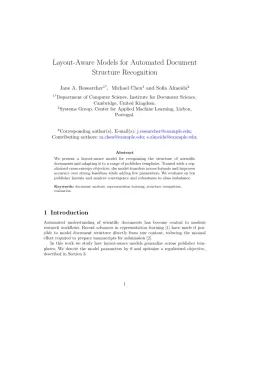
Journal of Big Data Analytics in Transportation template — frequently asked questions
How do I write a paper in the Journal of Big Data Analytics in Transportation format?
In DocuGuru you write your manuscript in a normal editor — no LaTeX setup required — and select the Journal of Big Data Analytics in Transportation template. When you export, DocuGuru compiles the paper into the official Springer Nature format and hands you a submission-ready PDF along with the editable LaTeX source.
What reference style does Journal of Big Data Analytics in Transportation use?
Journal of Big Data Analytics in Transportation uses Superscript numbered (Nature) references, shown as superscript numerals in the text. DocuGuru formats every in-text citation and the reference list in this exact style automatically. A reference appears like this: 1. Smith, A., Jones, B. & Lee, C. A representative article title. Journal of Big Data Analytics in Transportation 12, 45–58 (2023).
Do I need to know LaTeX to submit to Journal of Big Data Analytics in Transportation?
No. DocuGuru generates the sn-jnl LaTeX class and compiles the PDF for you in the background, so you get a Springer Nature-ready Journal of Big Data Analytics in Transportation document without writing any LaTeX. If you do want it, the LaTeX source is included in the export.
Can I import an existing draft into the Journal of Big Data Analytics in Transportation template?
Yes. Paste or upload your current manuscript — Word, LaTeX, Markdown, or plain text — and DocuGuru reflows it into the Journal of Big Data Analytics in Transportation format with correct headings, figures, tables, and superscript citations.
Who publishes Journal of Big Data Analytics in Transportation?
Journal of Big Data Analytics in Transportation is a multidisciplinary journal published by Springer Nature. DocuGuru's Journal of Big Data Analytics in Transportation template matches Springer Nature's official submission format.
Can I export a submission-ready Journal of Big Data Analytics in Transportation PDF?
Yes — DocuGuru produces a PDF built with the official Journal of Big Data Analytics in Transportation template (the sn-jnl class) that is ready to submit to Springer Nature, together with the matching LaTeX source files.
How much does the Journal of Big Data Analytics in Transportation template cost?
You can start writing in the Journal of Big Data Analytics in Transportation template for free. Exporting the final submission-ready Journal of Big Data Analytics in Transportation PDF and LaTeX source is part of DocuGuru's paid plans — see the app for current pricing.