Springer Nature

IPSJ Transactions on Computer Vision and Applications Template

Write in a clean editor, then format for IPSJ Transactions on Computer Vision and Applications in one click — DocuGuru applies the official Springer Nature template with superscript references and exports a submission-ready PDF plus the editable LaTeX source. Free to start.

About the IPSJ Transactions on Computer Vision and Applications format

IPSJ Transactions on Computer Vision and Applications is a peer-reviewed journal published by Springer Nature, covering Advanced Vision and Imaging, Advanced Image and Video Retrieval Techniques, Robotics and Sensor-Based Localization.

PublisherSpringer Nature
Reference styleSuperscript numbered (Nature)
Superscript — small raised numerals in the text
1. Smith, A., Jones, B. & Lee, C. A representative article title. IPSJ Transactions on Computer Vision and Applications 12, 45–58 (2023).

Formats any DOI in IPSJ Transactions on Computer Vision and Applications style. No sign-up.

Publishes research inAdvanced Vision and Imaging Advanced Image and Video Retrieval Techniques Robotics and Sensor-Based Localization Video Surveillance and Tracking Methods Human Pose and Action Recognition
ISSN1882-6695
h-index31
i10-index80
Total citations4,357
Top institutions publishing hereThe University of Osaka
Journal websiteipsjcva.springeropen.com
You getA submission-ready PDF and the editable LaTeX source — ready to submit.

Papers published in IPSJ Transactions on Computer Vision and Applications per year

26
2009
25
2010
21
2011
17
2012
28
2013
24
2014
22
2015
14
2016
25
2017
16
2018
10
2019
4
2020

Citation impact of IPSJ Transactions on Computer Vision and Applications by publication year

376
2009
199
2010
180
2011
347
2012
251
2013
145
2014
180
2015
126
2016
1.3K
2017
732
2018
436
2019
57
2020

Citations each year’s papers have accumulated so far — the most recent years are still building up.

Most-cited papers in IPSJ Transactions on Computer Vision and Applications

Visual SLAM algorithms: a survey from 2010 to 2016

Takafumi Taketomi, Hideaki Uchiyama, Sei Ikeda · 2 Jun 2017

Abstract SLAM is an abbreviation for simultaneous localization and mapping, which is a technique for estimating sensor motion and reconstructing structure in an unknown environment. Especially, Simultaneous Localization and Mapping (SLAM) using cameras is referred to as visual SLAM (vSLAM) because it is based on visual information only. vSLAM can be used as a fundamental…

Multi-view large population gait dataset and its performance evaluation for cross-view gait recognition

Noriko Takemura, Yasushi Makihara, Daigo Muramatsu et al. · 20 Feb 2018

Abstract This paper describes the world’s largest gait database with wide view variation, the “OU-ISIR gait database, multi-view large population dataset (OU-MVLP)”, and its application to a statistically reliable performance evaluation of vision-based cross-view gait recognition. Specifically, we construct a gait dataset that includes 10,307 subjects (5114 males and 5193 females) from 14 view angles…

The OU-ISIR Gait Database Comprising the Treadmill Dataset

Yasushi Makihara, Hidetoshi Mannami, Akira Tsuji et al. · 1 Jan 2012

This paper describes a large-scale gait database comprising the Treadmill Dataset. The dataset focuses on variations in walking conditions and includes 200 subjects with 25 views, 34 subjects with 9 speed variations from 2km/h to 10km/h with a 1km/h interval, and 68 subjects with at most 32 clothes variations. The range of variations in these…

Deep learning-based strategies for the detection and tracking of drones using several cameras

Eren Unlu, Emmanuel Zenou, Nicolas Rivière et al. · 24 Jul 2019

Abstract Commercial Unmanned aerial vehicle (UAV) industry, which is publicly known as drone , has seen a tremendous increase in last few years, making these devices highly accessible to public. This phenomenon has immediately raised security concerns due to fact that these devices can intentionally or unintentionally cause serious hazards. In order to protect critical…

A survey of diminished reality: Techniques for visually concealing, eliminating, and seeing through real objects

Shohei Mori, Sei Ikeda, Hideo Saitô · 28 Jun 2017

Abstract In this paper, we review diminished reality (DR) studies that visually remove, hide, and see through real objects from the real world. We systematically analyze and classify publications and present a technology map as a reference for future research. We also discuss future directions, including multimodal diminished reality. We believe that this paper will…

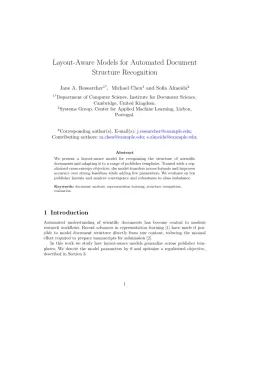
IPSJ Transactions on Computer Vision and Applications template — frequently asked questions

How do I write a paper in the IPSJ Transactions on Computer Vision and Applications format?
In DocuGuru you write your manuscript in a normal editor — no LaTeX setup required — and select the IPSJ Transactions on Computer Vision and Applications template. When you export, DocuGuru compiles the paper into the official Springer Nature format and hands you a submission-ready PDF along with the editable LaTeX source.
What reference style does IPSJ Transactions on Computer Vision and Applications use?
IPSJ Transactions on Computer Vision and Applications uses Superscript numbered (Nature) references, shown as superscript numerals in the text. DocuGuru formats every in-text citation and the reference list in this exact style automatically. A reference appears like this: 1. Smith, A., Jones, B. & Lee, C. A representative article title. IPSJ Transactions on Computer Vision and Applications 12, 45–58 (2023).
Do I need to know LaTeX to submit to IPSJ Transactions on Computer Vision and Applications?
No. DocuGuru generates the sn-jnl LaTeX class and compiles the PDF for you in the background, so you get a Springer Nature-ready IPSJ Transactions on Computer Vision and Applications document without writing any LaTeX. If you do want it, the LaTeX source is included in the export.
Can I import an existing draft into the IPSJ Transactions on Computer Vision and Applications template?
Yes. Paste or upload your current manuscript — Word, LaTeX, Markdown, or plain text — and DocuGuru reflows it into the IPSJ Transactions on Computer Vision and Applications format with correct headings, figures, tables, and superscript citations.
Who publishes IPSJ Transactions on Computer Vision and Applications?
IPSJ Transactions on Computer Vision and Applications is a multidisciplinary journal published by Springer Nature. DocuGuru's IPSJ Transactions on Computer Vision and Applications template matches Springer Nature's official submission format.
Can I export a submission-ready IPSJ Transactions on Computer Vision and Applications PDF?
Yes — DocuGuru produces a PDF built with the official IPSJ Transactions on Computer Vision and Applications template (the sn-jnl class) that is ready to submit to Springer Nature, together with the matching LaTeX source files.
How much does the IPSJ Transactions on Computer Vision and Applications template cost?
You can start writing in the IPSJ Transactions on Computer Vision and Applications template for free. Exporting the final submission-ready IPSJ Transactions on Computer Vision and Applications PDF and LaTeX source is part of DocuGuru's paid plans — see the app for current pricing.
Use the IPSJ Transactions on Computer Vision and Applications template