Springer Nature

Intelligent Marine Technology and Systems Template

Write in a clean editor, then format for Intelligent Marine Technology and Systems in one click — DocuGuru applies the official Springer Nature template with superscript references and exports a submission-ready PDF plus the editable LaTeX source. Free to start.

About the Intelligent Marine Technology and Systems format

Intelligent Marine Technology and Systems is a peer-reviewed journal published by Springer Nature, covering Underwater Acoustics Research, Image Enhancement Techniques, Underwater Vehicles and Communication Systems.

PublisherSpringer Nature
Reference styleSuperscript numbered (Nature)
Superscript — small raised numerals in the text
1. Smith, A., Jones, B. & Lee, C. A representative article title. Intelligent Marine Technology and Systems 12, 45–58 (2023).

Formats any DOI in Intelligent Marine Technology and Systems style. No sign-up.

Publishes research inUnderwater Acoustics Research Image Enhancement Techniques Underwater Vehicles and Communication Systems Advanced Neural Network Applications Oceanographic and Atmospheric Processes
ISSN2948-1953
Citation impact (2-yr)3.52
h-index11
i10-index14
Total citations602
Top institutions publishing hereOcean University of China
You getA submission-ready PDF and the editable LaTeX source — ready to submit.

Papers published in Intelligent Marine Technology and Systems per year

13
2023
35
2024
39
2025

Citation impact of Intelligent Marine Technology and Systems by publication year

254
2023
225
2024
84
2025

Citations each year’s papers have accumulated so far — the most recent years are still building up.

Most-cited papers in Intelligent Marine Technology and Systems

Underwater object detection and datasets: a survey

Muwei Jian, Nan Yang, Tao Chen et al. · 4 Mar 2024

Abstract The rapidly growing exploitation and utilization of marine resources by humans has sparked considerable interest in underwater object detection tasks. Targets captured in underwater environments differ significantly from those captured in general images owing to various factors, such as water turbidity, complex background conditions, and lighting variations. These adverse factors pose a host of…

Review of research and control technology of underwater bionic robots

Zhongao Cui, Liao Li, Yuhang Wang et al. · 18 Oct 2023

Abstract As marine resources continue to be exploited, the remarkable locomotion and coordination of fish provide an excellent source of inspiration for scientists and engineers to design and control the next -generation autonomous underwater vehicles within a bionic framework. Underwater biomimetic robots combine bionics and robot technology, and their biological characteristics offer a lot of…

Toward digital twin of the ocean: from digitalization to cloning

Ge Chen, Jie Yang, Baoxiang Huang et al. · 28 Sep 2023

Abstract The forthcoming wave of progress in oceanographic technology is the digital twin of the ocean, a concept that integrates marine big data and artificial intelligence (AI). This development is a logical consequence of combining data science and marine science and is considered superior to previous models, such as the digital ocean, transparent ocean, and…

Advances and applications of machine learning in underwater acoustics

Haiqiang Niu, Xiaolei Li, Yonglin Zhang et al. · 20 Oct 2023

Abstract Recent advancements in machine learning (ML) techniques applied to underwater acoustics have significantly impacted various aspects of this field, such as source localization, target recognition, communication, and geoacoustic inversion. This review provides a comprehensive summary and evaluation of these developments. As a data-driven approach, ML played a pivotal role in discerning intricate relationships between…

Underwater image enhancement via histogram similarity-oriented color compensation complemented by multiple attribute adjustment

Hao Wang, Alejandro C. Frery, Mingjie Li et al. · 28 Dec 2023

Abstract Underwater images are often influenced by color casts, low contrast, and blurred details. We observe that images taken in natural settings typically have similar histograms across color channels, while underwater images do not. To improve the natural appearance of an underwater image, it is critical to improve the histogram similarity across its color channels.…

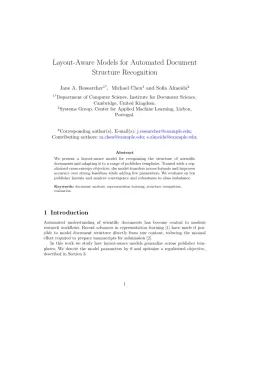
Intelligent Marine Technology and Systems template — frequently asked questions

How do I write a paper in the Intelligent Marine Technology and Systems format?
In DocuGuru you write your manuscript in a normal editor — no LaTeX setup required — and select the Intelligent Marine Technology and Systems template. When you export, DocuGuru compiles the paper into the official Springer Nature format and hands you a submission-ready PDF along with the editable LaTeX source.
What reference style does Intelligent Marine Technology and Systems use?
Intelligent Marine Technology and Systems uses Superscript numbered (Nature) references, shown as superscript numerals in the text. DocuGuru formats every in-text citation and the reference list in this exact style automatically. A reference appears like this: 1. Smith, A., Jones, B. & Lee, C. A representative article title. Intelligent Marine Technology and Systems 12, 45–58 (2023).
Do I need to know LaTeX to submit to Intelligent Marine Technology and Systems?
No. DocuGuru generates the sn-jnl LaTeX class and compiles the PDF for you in the background, so you get a Springer Nature-ready Intelligent Marine Technology and Systems document without writing any LaTeX. If you do want it, the LaTeX source is included in the export.
Can I import an existing draft into the Intelligent Marine Technology and Systems template?
Yes. Paste or upload your current manuscript — Word, LaTeX, Markdown, or plain text — and DocuGuru reflows it into the Intelligent Marine Technology and Systems format with correct headings, figures, tables, and superscript citations.
Who publishes Intelligent Marine Technology and Systems?
Intelligent Marine Technology and Systems is a multidisciplinary journal published by Springer Nature. DocuGuru's Intelligent Marine Technology and Systems template matches Springer Nature's official submission format.
Can I export a submission-ready Intelligent Marine Technology and Systems PDF?
Yes — DocuGuru produces a PDF built with the official Intelligent Marine Technology and Systems template (the sn-jnl class) that is ready to submit to Springer Nature, together with the matching LaTeX source files.
How much does the Intelligent Marine Technology and Systems template cost?
You can start writing in the Intelligent Marine Technology and Systems template for free. Exporting the final submission-ready Intelligent Marine Technology and Systems PDF and LaTeX source is part of DocuGuru's paid plans — see the app for current pricing.
Use the Intelligent Marine Technology and Systems template