Springer Nature

In Silico Pharmacology Template

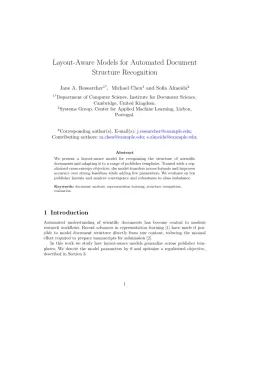
Write in a clean editor, then format for In Silico Pharmacology in one click — DocuGuru applies the official Springer Nature template with author–year references and exports a submission-ready PDF plus the editable LaTeX source. Free to start.

About the In Silico Pharmacology format

In Silico Pharmacology is a peer-reviewed journal published by Springer Nature, covering Computational Drug Discovery Methods, vaccines and immunoinformatics approaches, Natural Antidiabetic Agents Studies.

PublisherSpringer Nature
Reference styleAuthor–year (Vancouver)
Author–year — (Smith, 2023) in the text
Smith, A., Jones, B. and Lee, C. (2023) 'A representative article title', In Silico Pharmacology, 12(3), pp. 45–58.

Formats any DOI in In Silico Pharmacology style. No sign-up.

Publishes research inComputational Drug Discovery Methods vaccines and immunoinformatics approaches Natural Antidiabetic Agents Studies Synthesis and biological activity Cholinesterase and Neurodegenerative Diseases
ISSN2193-9616
Citation impact (2-yr)1.73
h-index33
i10-index140
Total citations4,693
Article processing charge$3,190
Top institutions publishing hereFederal University of Technology
Journal websitewww.springer.com
You getA submission-ready PDF and the editable LaTeX source — ready to submit.

Papers published in In Silico Pharmacology per year

4
2014
10
2015
6
2016
17
2017
12
2018
3
2019
8
2020
57
2021
21
2022
39
2023
116
2024
219
2025

Citation impact of In Silico Pharmacology by publication year

152
2014
252
2015
124
2016
325
2017
184
2018
30
2019
194
2020
1.1K
2021
304
2022
313
2023
467
2024
351
2025

Citations each year’s papers have accumulated so far — the most recent years are still building up.

Most-cited papers in In Silico Pharmacology

In silico drug metabolism and pharmacokinetic profiles of natural products from medicinal plants in the Congo basin

Fidele Ntie‐Kang, Lydia L. Lifongo, James A. Mbah et al. · 8 Aug 2013

PURPOSE: Drug metabolism and pharmacokinetics (DMPK) assessment has come to occupy a place of interest during the early stages of drug discovery today. The use of computer modelling to predict the DMPK and toxicity properties of a natural product library derived from medicinal plants from Central Africa (named ConMedNP). Material from some of the plant…

The Simcyp Population Based Simulator: Architecture, Implementation, and Quality Assurance

Masoud Jamei, Steve Marciniak, Duncan L. Edwards et al. · 3 Jun 2013

Developing a user-friendly platform that can handle a vast number of complex physiologically based pharmacokinetic and pharmacodynamic (PBPK/PD) models both for conventional small molecules and larger biologic drugs is a substantial challenge. Over the last decade the Simcyp Population Based Simulator has gained popularity in major pharmaceutical companies (70% of top 40 - in term…

Molecular dynamics simulations: from structure function relationships to drug discovery

Pramod C. Nair, John O. Miners · 20 Nov 2014

Molecular dynamics (MD) simulation is an emerging in silico technique with potential applications in diverse areas of pharmacology. Over the past three decades MD has evolved as an area of importance for understanding the atomic basis of complex phenomena such as molecular recognition, protein folding, and the transport of ions and small molecules across membranes.…

Drug-target and disease networks: polypharmacology in the post-genomic era

Ali Masoudi‐Nejad, Zaynab Mousavian, Joseph Hannon Bozorgmehr · 5 Dec 2013

With the growing understanding of complex diseases, the focus of drug discovery has shifted away from the well-accepted "one target, one drug" model, to a new "multi-target, multi-drug" model, aimed at systemically modulating multiple targets. Identification of the interaction between drugs and target proteins plays an important role in genomic drug discovery, in order to…

In Silico Pharmacology template — frequently asked questions

How do I write a paper in the In Silico Pharmacology format?
In DocuGuru you write your manuscript in a normal editor — no LaTeX setup required — and select the In Silico Pharmacology template. When you export, DocuGuru compiles the paper into the official Springer Nature format and hands you a submission-ready PDF along with the editable LaTeX source.
What reference style does In Silico Pharmacology use?
In Silico Pharmacology uses Author–year (Vancouver) references, shown as author–year markers such as (Smith, 2023) in the text. DocuGuru formats every in-text citation and the reference list in this exact style automatically. A reference appears like this: Smith, A., Jones, B. and Lee, C. (2023) 'A representative article title', In Silico Pharmacology, 12(3), pp. 45–58.
Do I need to know LaTeX to submit to In Silico Pharmacology?
No. DocuGuru generates the sn-jnl LaTeX class and compiles the PDF for you in the background, so you get a Springer Nature-ready In Silico Pharmacology document without writing any LaTeX. If you do want it, the LaTeX source is included in the export.
Can I import an existing draft into the In Silico Pharmacology template?
Yes. Paste or upload your current manuscript — Word, LaTeX, Markdown, or plain text — and DocuGuru reflows it into the In Silico Pharmacology format with correct headings, figures, tables, and author–year citations.
Who publishes In Silico Pharmacology?
In Silico Pharmacology is a multidisciplinary journal published by Springer Nature. DocuGuru's In Silico Pharmacology template matches Springer Nature's official submission format.
Can I export a submission-ready In Silico Pharmacology PDF?
Yes — DocuGuru produces a PDF built with the official In Silico Pharmacology template (the sn-jnl class) that is ready to submit to Springer Nature, together with the matching LaTeX source files.
How much does the In Silico Pharmacology template cost?
You can start writing in the In Silico Pharmacology template for free. Exporting the final submission-ready In Silico Pharmacology PDF and LaTeX source is part of DocuGuru's paid plans — see the app for current pricing.

Use the In Silico Pharmacology template