Springer Nature

Frontiers of Information Technology & Electronic Engineering Template

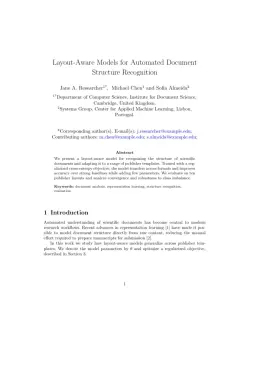
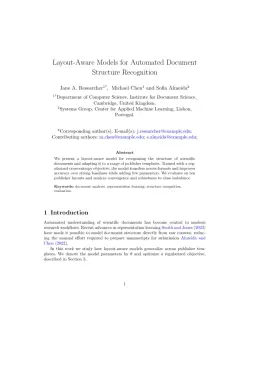
Write in a clean editor, then format for Frontiers of Information Technology & Electronic Engineering in one click — DocuGuru applies the official Springer Nature template with superscript references and exports a submission-ready PDF plus the editable LaTeX source. Free to start.

About the Frontiers of Information Technology & Electronic Engineering format

Frontiers of Information Technology & Electronic Engineering is a peer-reviewed journal published by Springer Nature, covering Distributed Control Multi-Agent Systems, Advanced MIMO Systems Optimization, Antenna Design and Analysis.

PublisherSpringer Nature
Reference styleSuperscript numbered (Nature)
Superscript — small raised numerals in the text
1. Smith, A., Jones, B. & Lee, C. A representative article title. Frontiers of Information Technology & Electronic Engineering 12, 45–58 (2023).

Formats any DOI in Frontiers of Information Technology & Electronic Engineering style. No sign-up.

Publishes research inDistributed Control Multi-Agent Systems Advanced MIMO Systems Optimization Antenna Design and Analysis Topic Modeling Advanced Wireless Communication Technologies
ISSN2095-9184
Citation impact (2-yr)3.07
h-index56
i10-index516
Total citations23,569
Top institutions publishing hereZhejiang University
Journal websitewww.zju.edu.cn
You getA submission-ready PDF and the editable LaTeX source — ready to submit.

Papers published in Frontiers of Information Technology & Electronic Engineering per year

6
2014
85
2015
112
2016
168
2017
125
2018
148
2019
132
2020
125
2021
139
2022
147
2023
118
2024
158
2025

Citation impact of Frontiers of Information Technology & Electronic Engineering by publication year

62
2014
986
2015
1.5K
2016
4.2K
2017
5.8K
2018
2.8K
2019
2.7K
2020
1.6K
2021
1.5K
2022
1.5K
2023
620
2024
161
2025

Citations each year’s papers have accumulated so far — the most recent years are still building up.

Most-cited papers in Frontiers of Information Technology & Electronic Engineering

Artificial intelligence and statistics

Bin Yu, Karl Kumbier · 1 Jan 2018

Artificial intelligence (AI) is intrinsically data-driven. It calls for the application of statistical concepts through human-machine collaboration during the generation of data, the development of algorithms, and the evaluation of results. This paper discusses how such human-machine collaboration can be approached through the statistical concepts of population, question of interest, representativeness of training data, and…

1,995 citations Cite SaveGo to paper →
Visual interpretability for deep learning: a survey

Quanshi Zhang, Song‐Chun Zhu · 1 Jan 2018

This paper reviews recent studies in understanding neural-network representations and learning neural networks with interpretable/disentangled middle-layer representations. Although deep neural networks have exhibited superior performance in various tasks, interpretability is always Achilles’ heel of deep neural networks. At present, deep neural networks obtain high discrimination power at the cost of a low interpretability of their…

Applications of artificial intelligence in intelligent manufacturing: a review

Bo-hu Li, Baocun Hou, Wentao Yu et al. · 1 Jan 2017

Based on research into the applications of artificial intelligence (AI) technology in the manufacturing industry in recent years, we analyze the rapid development of core technologies in the new era of ‘Internet plus AI’, which is triggering a great change in the models, means, and ecosystems of the manufacturing industry, as well as in the…

From Eliza to XiaoIce: challenges and opportunities with social chatbots

Heung‐Yeung Shum, Xiaodong He, Di Li · 1 Jan 2018

Conversational systems have come a long way since their inception in the 1960s. After decades of research and development, we have seen progress from Eliza and Parry in the 1960s and 1970s, to task-completion systems as in the Defense Advanced Research Projects Agency (DARPA) communicator program in the 2000s, to intelligent personal assistants such as…

Hybrid-augmented intelligence: collaboration and cognition

Nanning Zheng, Ziyi Liu, Pengju Ren et al. · 1 Feb 2017

The long-term goal of artificial intelligence (AI) is to make machines learn and think like human beings. Due to the high levels of uncertainty and vulnerability in human life and the open-ended nature of problems that humans are facing, no matter how intelligent machines are, they are unable to completely replace humans. Therefore, it is…

Frontiers of Information Technology & Electronic Engineering template — frequently asked questions

How do I write a paper in the Frontiers of Information Technology & Electronic Engineering format?
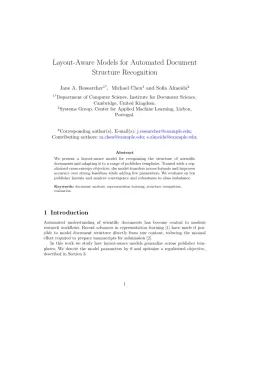
In DocuGuru you write your manuscript in a normal editor — no LaTeX setup required — and select the Frontiers of Information Technology & Electronic Engineering template. When you export, DocuGuru compiles the paper into the official Springer Nature format and hands you a submission-ready PDF along with the editable LaTeX source.
What reference style does Frontiers of Information Technology & Electronic Engineering use?
Frontiers of Information Technology & Electronic Engineering uses Superscript numbered (Nature) references, shown as superscript numerals in the text. DocuGuru formats every in-text citation and the reference list in this exact style automatically. A reference appears like this: 1. Smith, A., Jones, B. & Lee, C. A representative article title. Frontiers of Information Technology & Electronic Engineering 12, 45–58 (2023).
Do I need to know LaTeX to submit to Frontiers of Information Technology & Electronic Engineering?
No. DocuGuru generates the sn-jnl LaTeX class and compiles the PDF for you in the background, so you get a Springer Nature-ready Frontiers of Information Technology & Electronic Engineering document without writing any LaTeX. If you do want it, the LaTeX source is included in the export.
Can I import an existing draft into the Frontiers of Information Technology & Electronic Engineering template?
Yes. Paste or upload your current manuscript — Word, LaTeX, Markdown, or plain text — and DocuGuru reflows it into the Frontiers of Information Technology & Electronic Engineering format with correct headings, figures, tables, and superscript citations.
Who publishes Frontiers of Information Technology & Electronic Engineering?
Frontiers of Information Technology & Electronic Engineering is a multidisciplinary journal published by Springer Nature. DocuGuru's Frontiers of Information Technology & Electronic Engineering template matches Springer Nature's official submission format.
Can I export a submission-ready Frontiers of Information Technology & Electronic Engineering PDF?
Yes — DocuGuru produces a PDF built with the official Frontiers of Information Technology & Electronic Engineering template (the sn-jnl class) that is ready to submit to Springer Nature, together with the matching LaTeX source files.
How much does the Frontiers of Information Technology & Electronic Engineering template cost?
You can start writing in the Frontiers of Information Technology & Electronic Engineering template for free. Exporting the final submission-ready Frontiers of Information Technology & Electronic Engineering PDF and LaTeX source is part of DocuGuru's paid plans — see the app for current pricing.
Use the Frontiers of Information Technology & Electronic Engineering template