
1,265 citations
Cite
SaveGo to paper →
Springer Nature
Experimental Astronomy Template
Write in a clean editor, then format for Experimental Astronomy in one click — DocuGuru applies the official Springer Nature template with numbered references and exports a submission-ready PDF plus the editable LaTeX source. Free to start.
About the Experimental Astronomy format
Experimental Astronomy is a peer-reviewed journal published by Springer Nature, covering Stellar, planetary, and galactic studies, Astronomy and Astrophysical Research, Adaptive optics and wavefront sensing.
| Publisher | Springer Nature |
|---|---|
| Reference style | Numbered (Springer) Numbered — [1], [2] in the text 1. Smith, A., Jones, B., Lee, C.: A representative article title. Experimental Astronomy 12, 45–58 (2023)
Formats any DOI in Experimental Astronomy style. No sign-up. |
| Publishes research in | Stellar, planetary, and galactic studies Astronomy and Astrophysical Research Adaptive optics and wavefront sensing Astrophysics and Cosmic Phenomena Astro and Planetary Science |
| ISSN | 0922-6435 |
| Citation impact (2-yr) | 3.47 |
| h-index | 60 |
| i10-index | 520 |
| Total citations | 22,722 |
| Article processing charge | $3,390 |
| Top institutions publishing here | Centre National de la Recherche Scientifique |
| Journal website | link.springer.com |
| You get | A submission-ready PDF and the editable LaTeX source — ready to submit. |
Papers published in Experimental Astronomy per year
Citation impact of Experimental Astronomy by publication year
Citations each year’s papers have accumulated so far — the most recent years are still building up.
Most-cited papers in Experimental Astronomy
Ground-based gamma-ray astronomy has had a major breakthrough with the impressive results obtained using systems of imaging atmospheric Cherenkov telescopes. Ground-based gamma-ray astronomy has a huge potential in astrophysics, particle physics and cosmology. CTA is an international initiative to build the next generation instrument, with a factor of 5-10 improvement in sensitivity in the 100…
922 citations
Cite
SaveGo to paper →
Thousands of exoplanets have now been discovered with a huge range of masses, sizes and orbits: from rocky Earth-like planets to large gas giants grazing the surface of their host star. However, the essential nature of these exoplanets remains largely mysterious: there is no known, discernible pattern linking the presence, size, or orbital parameters of…
439 citations
Cite
SaveGo to paper →
The Kilo Degree Survey (KiDS) is a 1500 square degree optical imaging survey with the recently commissioned OmegaCAM wide-field imager on the VLT Survey Telescope (VST). A suite of data products will be delivered to the European Southern Observatory (ESO) and the community by the KiDS survey team. Spread over Europe, the KiDS team uses…
416 citations
Cite
SaveGo to paper →
413 citations
Cite
SaveGo to paper →
Related journal templates
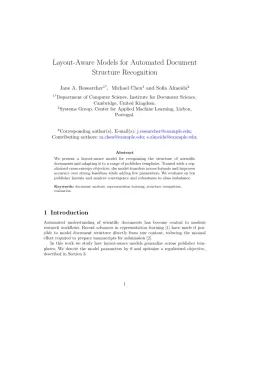
Experimental Astronomy template — frequently asked questions
How do I write a paper in the Experimental Astronomy format?
In DocuGuru you write your manuscript in a normal editor — no LaTeX setup required — and select the Experimental Astronomy template. When you export, DocuGuru compiles the paper into the official Springer Nature format and hands you a submission-ready PDF along with the editable LaTeX source.
What reference style does Experimental Astronomy use?
Experimental Astronomy uses Numbered (Springer) references, shown as numbered [1], [2] markers in the text. DocuGuru formats every in-text citation and the reference list in this exact style automatically. A reference appears like this: 1. Smith, A., Jones, B., Lee, C.: A representative article title. Experimental Astronomy 12, 45–58 (2023)
Do I need to know LaTeX to submit to Experimental Astronomy?
No. DocuGuru generates the sn-jnl LaTeX class and compiles the PDF for you in the background, so you get a Springer Nature-ready Experimental Astronomy document without writing any LaTeX. If you do want it, the LaTeX source is included in the export.
Can I import an existing draft into the Experimental Astronomy template?
Yes. Paste or upload your current manuscript — Word, LaTeX, Markdown, or plain text — and DocuGuru reflows it into the Experimental Astronomy format with correct headings, figures, tables, and numbered citations.
Who publishes Experimental Astronomy?
Experimental Astronomy is a physics journal published by Springer Nature. DocuGuru's Experimental Astronomy template matches Springer Nature's official submission format.
Can I export a submission-ready Experimental Astronomy PDF?
Yes — DocuGuru produces a PDF built with the official Experimental Astronomy template (the sn-jnl class) that is ready to submit to Springer Nature, together with the matching LaTeX source files.
How much does the Experimental Astronomy template cost?
You can start writing in the Experimental Astronomy template for free. Exporting the final submission-ready Experimental Astronomy PDF and LaTeX source is part of DocuGuru's paid plans — see the app for current pricing.