
790 citations
Cite
SaveGo to paper →
Springer Nature
European Journal of Population / Revue européenne de Démographie Template
Write in a clean editor, then format for European Journal of Population / Revue européenne de Démographie in one click — DocuGuru applies the official Springer Nature template with superscript references and exports a submission-ready PDF plus the editable LaTeX source. Free to start.
About the European Journal of Population / Revue européenne de Démographie format
European Journal of Population / Revue européenne de Démographie is a peer-reviewed journal published by Springer Nature, covering Family Dynamics and Relationships, Intergenerational Family Dynamics and Caregiving, Demographic Trends and Gender Preferences.
| Publisher | Springer Nature |
|---|---|
| Reference style | Superscript numbered (Nature) Superscript — small raised numerals in the text 1. Smith, A., Jones, B. & Lee, C. A representative article title. European Journal of Population / Revue européenne de Démographie 12, 45–58 (2023).
Formats any DOI in European Journal of Population / Revue européenne de Démographie style. No sign-up. |
| Publishes research in | Family Dynamics and Relationships Intergenerational Family Dynamics and Caregiving Demographic Trends and Gender Preferences Gender, Labor, and Family Dynamics Global Health Care Issues |
| ISSN | 0168-6577 |
| Citation impact (2-yr) | 3.52 |
| h-index | 92 |
| i10-index | 625 |
| Total citations | 36,124 |
| Article processing charge | $2,890 |
| Top institutions publishing here | Stockholm University |
| Journal website | www.springer.com |
| You get | A submission-ready PDF and the editable LaTeX source — ready to submit. |
Papers published in European Journal of Population / Revue européenne de Démographie per year
Citation impact of European Journal of Population / Revue européenne de Démographie by publication year
Citations each year’s papers have accumulated so far — the most recent years are still building up.
Most-cited papers in European Journal of Population / Revue européenne de Démographie
This paper provides a review of fertility research in advanced societies, societies in which birth control is the default option. The central aim is to provide a comprehensive review that summarizes how contemporary research has explained ongoing and expected fertility changes across time and space (i.e., cross- and within-country heterogeneity). A secondary aim is to…
625 citations
Cite
SaveGo to paper →
We introduce a number of new methods based on sequence analysis to test hypotheses on the de-standardization of family-life trajectories in early adulthood, using Fertility and Family Survey data on 19 countries. Across cohorts, family-life trajectories of young adults have not become more turbulent. However, in most countries family-life trajectories of young adults have become…
447 citations
Cite
SaveGo to paper →
Do low fertility and population aging lead to economic decline if couples have fewer children, but invest more in each child? By addressing this question, this article extends previous work in which the authors show that population aging leads to an increased demand for wealth that can, under some conditions, lead to increased capital per…
417 citations
Cite
SaveGo to paper →
Systematic comparisons of fertility developments based on education, gender and country context are rare. Using harmonized register data, we compare cohort total fertility and ultimate childlessness by gender and educational attainment for cohorts born beginning in 1940 in four Nordic countries. Cohort fertility (CTF) initially declined in all four countries, although for cohorts born in…
410 citations
Cite
SaveGo to paper →
Related journal templates
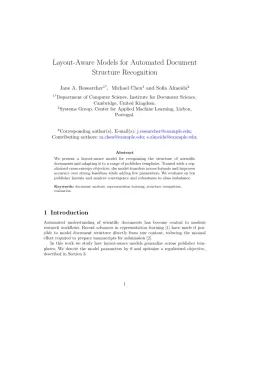
European Journal of Population / Revue européenne de Démographie template — frequently asked questions
How do I write a paper in the European Journal of Population / Revue européenne de Démographie format?
In DocuGuru you write your manuscript in a normal editor — no LaTeX setup required — and select the European Journal of Population / Revue européenne de Démographie template. When you export, DocuGuru compiles the paper into the official Springer Nature format and hands you a submission-ready PDF along with the editable LaTeX source.
What reference style does European Journal of Population / Revue européenne de Démographie use?
European Journal of Population / Revue européenne de Démographie uses Superscript numbered (Nature) references, shown as superscript numerals in the text. DocuGuru formats every in-text citation and the reference list in this exact style automatically. A reference appears like this: 1. Smith, A., Jones, B. & Lee, C. A representative article title. European Journal of Population / Revue européenne de Démographie 12, 45–58 (2023).
Do I need to know LaTeX to submit to European Journal of Population / Revue européenne de Démographie?
No. DocuGuru generates the sn-jnl LaTeX class and compiles the PDF for you in the background, so you get a Springer Nature-ready European Journal of Population / Revue européenne de Démographie document without writing any LaTeX. If you do want it, the LaTeX source is included in the export.
Can I import an existing draft into the European Journal of Population / Revue européenne de Démographie template?
Yes. Paste or upload your current manuscript — Word, LaTeX, Markdown, or plain text — and DocuGuru reflows it into the European Journal of Population / Revue européenne de Démographie format with correct headings, figures, tables, and superscript citations.
Who publishes European Journal of Population / Revue européenne de Démographie?
European Journal of Population / Revue européenne de Démographie is a multidisciplinary journal published by Springer Nature. DocuGuru's European Journal of Population / Revue européenne de Démographie template matches Springer Nature's official submission format.
Can I export a submission-ready European Journal of Population / Revue européenne de Démographie PDF?
Yes — DocuGuru produces a PDF built with the official European Journal of Population / Revue européenne de Démographie template (the sn-jnl class) that is ready to submit to Springer Nature, together with the matching LaTeX source files.
How much does the European Journal of Population / Revue européenne de Démographie template cost?
You can start writing in the European Journal of Population / Revue européenne de Démographie template for free. Exporting the final submission-ready European Journal of Population / Revue européenne de Démographie PDF and LaTeX source is part of DocuGuru's paid plans — see the app for current pricing.