Springer Nature

Elektronnaya Obrabotka Materialov Template

Write in a clean editor, then format for Elektronnaya Obrabotka Materialov in one click — DocuGuru applies the official Springer Nature template with superscript references and exports a submission-ready PDF plus the editable LaTeX source. Free to start.

About the Elektronnaya Obrabotka Materialov format

Elektronnaya Obrabotka Materialov is a peer-reviewed journal published by Springer Nature, covering Surface Treatment and Coatings, Electrohydrodynamics and Fluid Dynamics, Industrial Engineering and Technologies.

PublisherSpringer Nature
Reference styleSuperscript numbered (Nature)
Superscript — small raised numerals in the text
1. Smith, A., Jones, B. & Lee, C. A representative article title. Elektronnaya Obrabotka Materialov 12, 45–58 (2023).

Formats any DOI in Elektronnaya Obrabotka Materialov style. No sign-up.

Publishes research inSurface Treatment and Coatings Electrohydrodynamics and Fluid Dynamics Industrial Engineering and Technologies Metal and Thin Film Mechanics Engineering Diagnostics and Reliability
ISSN0013-5739
Citation impact (2-yr)0.12
h-index3
i10-index1
Total citations183
Open accessYes
Top institutions publishing hereWeatherford College
You getA submission-ready PDF and the editable LaTeX source — ready to submit.

Papers published in Elektronnaya Obrabotka Materialov per year

3
1980
1
1981
47
2021
60
2022
46
2023
52
2024
42
2025

Citation impact of Elektronnaya Obrabotka Materialov by publication year

0
1980
0
1981
124
2021
24
2022
21
2023
11
2024
1
2025

Citations each year’s papers have accumulated so far — the most recent years are still building up.

Most-cited papers in Elektronnaya Obrabotka Materialov

Whey: State of the Art. Part II. Processes and Treatment Methods

Irina Paladii, Е. Г. Врабие, Catalina Sprincean et al. · 1 Jun 2021

The current state of the art on studying of whey is considered. The processes and methods of whey processing (thermal, chemical, physicochemical, biotechnological, and electrophysical) are presented. Thermal and isoelectric precipitation of proteins, using reagents and coagulants, as well as the main membrane processing methods (reverse osmosis, diafiltration, microfiltration, ultrafiltration, and nanofiltration) are described. Possibi-lities…

Высоковольтная деградация электродов, обусловленная электрохимической инжекцией в жидких диэлектриках

Федеральное государственное бюджетное образовательное учреждение высшего образования «Юго-Западный государственный университет», А. И. Жакин, А. Е. Кузько et al. · 1 Dec 2021

The results of experimental studies of the electrode degradation caused by electrochemical reactions under the action of high-voltage fields are presented. Under study were technical hydrocarbon and polymethylsiloxane (PMS) liquids, their solutions with iodine (I2) at chemically active (Cu) and indifferent (Ti) electrodes. It is shown that in hydrocarbons the Cu electrodes interact intensively with…

Features of Electrospark Coatings Formation on a Chromium Substrate Using Ceramic ZrSi2-MoSi2-ZrB2 and HfSi2-MoSi2-HfB2 Electrodes

A. E. Kudryashov, Е. И. Замулаева, Ph. V. Kiryukhantsev–Korneev et al. · 1 Jun 2024

The work is devoted to the study of the features of mass transfer, structure and properties of electrospark coatings on substrates made of the chromium alloy grade VKh1-17A using SHS-electrode ceramics of the compositions ZrSi2-MoSi2-ZrB2 and HfSi2-MoSi2-HfB2. The coatings were studied using X-ray diffraction, scanning electron microscopy, energy-dispersive analysis, and tribological tests using the “pin-on-disk”;…

Characteristics and Parameters of Overstressed Nanosecond Discharge Plasma in Air between an Electrode from Aluminum and Electrode from Chalcopyrite (CuInSe2)

A.K. Shuaibov, A.Y. Minya, А. А. Малинина et al. · 1 Oct 2021

The characteristics and parameters of an overstressed high-current discharge with a duration of 100–150 ns in air, which was ignited between an aluminum electrode and a chalcopyrite electrode (CuInSe2), are presented. The air pressure was 13.3 and 101.3 kPa. In the process of microexplosions of inhomogeneities on the working surfaces of electrodes in a strong…

Kinetics of Electrochemical Nanonucleation by Induced Codeposition of Iron Group Metals with Refractory Metals (W, Mo, Re)

С. А. Баранов, А. И. Дикусар · 1 Oct 2021

It is shown that the earlier discovered features of the composition and properties of electrochemical coatings obtained by the induced codeposition from alloys of iron group metals (W, Mo, Re) such as nanocrystallinity (X-ray amorphism), macroscopic dimensional effects of microhardness and corrosion resistance, the effect of the volume current density on the properties and composition…

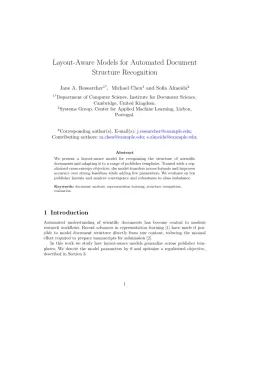
Elektronnaya Obrabotka Materialov template — frequently asked questions

How do I write a paper in the Elektronnaya Obrabotka Materialov format?
In DocuGuru you write your manuscript in a normal editor — no LaTeX setup required — and select the Elektronnaya Obrabotka Materialov template. When you export, DocuGuru compiles the paper into the official Springer Nature format and hands you a submission-ready PDF along with the editable LaTeX source.
What reference style does Elektronnaya Obrabotka Materialov use?
Elektronnaya Obrabotka Materialov uses Superscript numbered (Nature) references, shown as superscript numerals in the text. DocuGuru formats every in-text citation and the reference list in this exact style automatically. A reference appears like this: 1. Smith, A., Jones, B. & Lee, C. A representative article title. Elektronnaya Obrabotka Materialov 12, 45–58 (2023).
Do I need to know LaTeX to submit to Elektronnaya Obrabotka Materialov?
No. DocuGuru generates the sn-jnl LaTeX class and compiles the PDF for you in the background, so you get a Springer Nature-ready Elektronnaya Obrabotka Materialov document without writing any LaTeX. If you do want it, the LaTeX source is included in the export.
Can I import an existing draft into the Elektronnaya Obrabotka Materialov template?
Yes. Paste or upload your current manuscript — Word, LaTeX, Markdown, or plain text — and DocuGuru reflows it into the Elektronnaya Obrabotka Materialov format with correct headings, figures, tables, and superscript citations.
Who publishes Elektronnaya Obrabotka Materialov?
Elektronnaya Obrabotka Materialov is a multidisciplinary journal published by Springer Nature. DocuGuru's Elektronnaya Obrabotka Materialov template matches Springer Nature's official submission format.
Can I export a submission-ready Elektronnaya Obrabotka Materialov PDF?
Yes — DocuGuru produces a PDF built with the official Elektronnaya Obrabotka Materialov template (the sn-jnl class) that is ready to submit to Springer Nature, together with the matching LaTeX source files.
How much does the Elektronnaya Obrabotka Materialov template cost?
You can start writing in the Elektronnaya Obrabotka Materialov template for free. Exporting the final submission-ready Elektronnaya Obrabotka Materialov PDF and LaTeX source is part of DocuGuru's paid plans — see the app for current pricing.
Use the Elektronnaya Obrabotka Materialov template