
2,559 citations
Cite
SaveGo to paper →
Springer Nature
Electronic Markets Template
Write in a clean editor, then format for Electronic Markets in one click — DocuGuru applies the official Springer Nature template with superscript references and exports a submission-ready PDF plus the editable LaTeX source. Free to start.
About the Electronic Markets format
Electronic Markets is a peer-reviewed journal published by Springer Nature, covering Management, Economics, and Public Policy, Diverse academic and cultural studies, Digital Platforms and Economics.
| Publisher | Springer Nature |
|---|---|
| Reference style | Superscript numbered (Nature) Superscript — small raised numerals in the text 1. Smith, A., Jones, B. & Lee, C. A representative article title. Electronic Markets 12, 45–58 (2023).
Formats any DOI in Electronic Markets style. No sign-up. |
| Publishes research in | Management, Economics, and Public Policy Diverse academic and cultural studies Digital Platforms and Economics Digital Marketing and Social Media Technology Adoption and User Behaviour |
| ISSN | 1019-6781 |
| Citation impact (2-yr) | 6.8 |
| h-index | 99 |
| i10-index | 845 |
| Total citations | 57,301 |
| Article processing charge | $3,190 |
| Top institutions publishing here | Leipzig University |
| Journal website | www.electronicmarkets.org |
| You get | A submission-ready PDF and the editable LaTeX source — ready to submit. |
Papers published in Electronic Markets per year
Citation impact of Electronic Markets by publication year
Citations each year’s papers have accumulated so far — the most recent years are still building up.
Most-cited papers in Electronic Markets
Abstract Today, intelligent systems that offer artificial intelligence capabilities often rely on machine learning. Machine learning describes the capacity of systems to learn from problem-specific training data to automate the process of analytical model building and solve associated tasks. Deep learning is a machine learning concept based on artificial neural networks. For many applications, deep…
2,527 citations
Cite
SaveGo to paper →
Abstract Smart tourism is a new buzzword applied to describe the increasing reliance of tourism destinations, their industries and their tourists on emerging forms of ICT that allow for massive amounts of data to be transformed into value propositions. However, it remains ill-defined as a concept, which hinders its theoretical development. The paper defines smart…
2,282 citations
Cite
SaveGo to paper →
Abstract Communicating with customers through live chat interfaces has become an increasingly popular means to provide real-time customer service in many e-commerce settings. Today, human chat service agents are frequently replaced by conversational software agents or chatbots, which are systems designed to communicate with human users by means of natural language often based on artificial…
1,111 citations
Cite
SaveGo to paper →
Abstract “Gamification” has gained considerable scholarly and practitioner attention; however, the discussion in academia has been largely confined to the human–computer interaction and game studies domains. Since gamification is often used in service design, it is important that the concept be brought in line with the service literature. So far, though, there has been a…
1,052 citations
Cite
SaveGo to paper →
Related journal templates
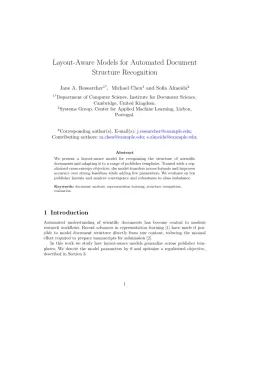
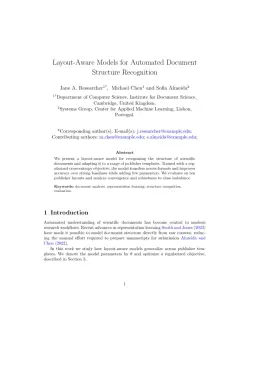
Electronic Markets template — frequently asked questions
How do I write a paper in the Electronic Markets format?
In DocuGuru you write your manuscript in a normal editor — no LaTeX setup required — and select the Electronic Markets template. When you export, DocuGuru compiles the paper into the official Springer Nature format and hands you a submission-ready PDF along with the editable LaTeX source.
What reference style does Electronic Markets use?
Electronic Markets uses Superscript numbered (Nature) references, shown as superscript numerals in the text. DocuGuru formats every in-text citation and the reference list in this exact style automatically. A reference appears like this: 1. Smith, A., Jones, B. & Lee, C. A representative article title. Electronic Markets 12, 45–58 (2023).
Do I need to know LaTeX to submit to Electronic Markets?
No. DocuGuru generates the sn-jnl LaTeX class and compiles the PDF for you in the background, so you get a Springer Nature-ready Electronic Markets document without writing any LaTeX. If you do want it, the LaTeX source is included in the export.
Can I import an existing draft into the Electronic Markets template?
Yes. Paste or upload your current manuscript — Word, LaTeX, Markdown, or plain text — and DocuGuru reflows it into the Electronic Markets format with correct headings, figures, tables, and superscript citations.
Who publishes Electronic Markets?
Electronic Markets is a multidisciplinary journal published by Springer Nature. DocuGuru's Electronic Markets template matches Springer Nature's official submission format.
Can I export a submission-ready Electronic Markets PDF?
Yes — DocuGuru produces a PDF built with the official Electronic Markets template (the sn-jnl class) that is ready to submit to Springer Nature, together with the matching LaTeX source files.
How much does the Electronic Markets template cost?
You can start writing in the Electronic Markets template for free. Exporting the final submission-ready Electronic Markets PDF and LaTeX source is part of DocuGuru's paid plans — see the app for current pricing.