Springer Nature

EJNMMI Research Template

Write in a clean editor, then format for EJNMMI Research in one click — DocuGuru applies the official Springer Nature template with superscript references and exports a submission-ready PDF plus the editable LaTeX source. Free to start.

About the EJNMMI Research format

EJNMMI Research is a peer-reviewed journal published by Springer Nature, covering Medical Imaging Techniques and Applications, Radiopharmaceutical Chemistry and Applications, Prostate Cancer Treatment and Research.

PublisherSpringer Nature
Reference styleSuperscript numbered (Nature)
Superscript — small raised numerals in the text
1. Smith, A., Jones, B. & Lee, C. A representative article title. EJNMMI Research 12, 45–58 (2023).

Formats any DOI in EJNMMI Research style. No sign-up.

Publishes research inMedical Imaging Techniques and Applications Radiopharmaceutical Chemistry and Applications Prostate Cancer Treatment and Research Radiomics and Machine Learning in Medical Imaging Neuroendocrine Tumor Research Advances
ISSN2191-219X
Citation impact (2-yr)2.35
h-index73
i10-index884
Total citations31,612
Article processing charge$2,318
Open accessYes
Top institutions publishing hereInserm
Journal websiteejnmmires.springeropen.com
You getA submission-ready PDF and the editable LaTeX source — ready to submit.

Papers published in EJNMMI Research per year

77
2014
77
2015
92
2016
103
2017
116
2018
118
2019
155
2020
130
2021
77
2022
109
2023
127
2024
168
2025

Citation impact of EJNMMI Research by publication year

1.8K
2014
2.5K
2015
2.6K
2016
3.5K
2017
3.1K
2018
2.6K
2019
3.3K
2020
2.3K
2021
1.2K
2022
972
2023
613
2024
276
2025

Citations each year’s papers have accumulated so far — the most recent years are still building up.

Most-cited papers in EJNMMI Research

Early side effects and first results of radioligand therapy with 177Lu-DKFZ-617 PSMA of castrate-resistant metastatic prostate cancer: a two-centre study

Hojjat Ahmadzadehfar, Kambiz Rahbar, Stefan Kürpig et al. · 19 Jun 2015

BACKGROUND: Radioligand therapy (RLT) with (177)Lu-DKFZ-617 PSMA (Lu-PSMA) (prostate-specific membrane antigen) is a novel targeted therapy of metastatic prostate cancer. We analysed retrospectively the early side effects and the response rate in the first patients, who received a therapy with Lu-PSMA in our departments. METHODS: RLT was performed in ten hormone- and/or chemo-refractory patients with…

Comparison of machine learning methods for classifying mediastinal lymph node metastasis of non-small cell lung cancer from 18F-FDG PET/CT images

Hongkai Wang, Zongwei Zhou, Yingci Li et al. · 27 Jan 2017

BACKGROUND: F-FDG PET/CT images. Another objective was to compare the discriminative power of the recently popular PET/CT texture features with the widely used diagnostic features such as tumor size, CT value, SUV, image contrast, and intensity standard deviation. The four classical machine learning methods included random forests, support vector machines, adaptive boosting, and artificial neural…

IDAC-Dose 2.1, an internal dosimetry program for diagnostic nuclear medicine based on the ICRP adult reference voxel phantoms

Martin Andersson, Lennart Johansson, Keith F. Eckerman et al. · 25 Oct 2017

To date, the estimated radiation-absorbed dose to organs and tissues in patients undergoing diagnostic examinations in nuclear medicine is derived via calculations based on models of the human body and the biokinetic behaviour of the radiopharmaceutical. An internal dosimetry computer program, IDAC-Dose2.1, was developed based on the International Commission on Radiological Protection (ICRP)-specific absorbed fractions…

44Sc-PSMA-617 for radiotheragnostics in tandem with 177Lu-PSMA-617—preclinical investigations in comparison with 68Ga-PSMA-11 and 68Ga-PSMA-617

Christoph A. Umbricht, Martina Benešová, Raffaella M. Schmid et al. · 19 Jan 2017

The targeting of the prostate-specific membrane antigen (PSMA) is of particular interest for radiotheragnostic purposes of prostate cancer. Radiolabeled PSMA-617, a 1,4,7,10-tetraazacyclododecane-N,N′,N′′,N′′′-tetraacetic acid (DOTA)-functionalized PSMA ligand, revealed favorable kinetics with high tumor uptake, enabling its successful application for PET imaging (68Ga) and radionuclide therapy (177Lu) in the clinics. In this study, PSMA-617 was labeled with…

Gastrointestinal transit measurements in mice with 99mTc-DTPA-labeled activated charcoal using NanoSPECT-CT

Parasuraman Padmanabhan, Johannes Grosse, A.B.M.A. Asad et al. · 1 Jan 2013

BACKGROUND: Gastrointestinal (GI) disorders are commonly associated with chronic conditions such as diabetes, obesity, and hypertension. Direct consequences are obstipation or diarrhea as opposite aspects of the irritable bowel syndrome, and more indirectly, alteration of appetite, feeling of fullness, flatulence, bloatedness, and eventually leading to altered absorption of nutrients. Moreover, GI retention and passage times…

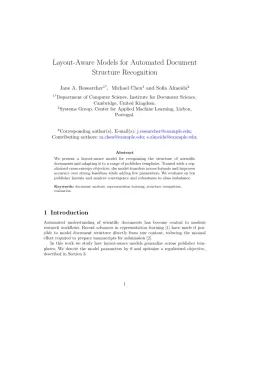
EJNMMI Research template — frequently asked questions

How do I write a paper in the EJNMMI Research format?
In DocuGuru you write your manuscript in a normal editor — no LaTeX setup required — and select the EJNMMI Research template. When you export, DocuGuru compiles the paper into the official Springer Nature format and hands you a submission-ready PDF along with the editable LaTeX source.
What reference style does EJNMMI Research use?
EJNMMI Research uses Superscript numbered (Nature) references, shown as superscript numerals in the text. DocuGuru formats every in-text citation and the reference list in this exact style automatically. A reference appears like this: 1. Smith, A., Jones, B. & Lee, C. A representative article title. EJNMMI Research 12, 45–58 (2023).
Do I need to know LaTeX to submit to EJNMMI Research?
No. DocuGuru generates the sn-jnl LaTeX class and compiles the PDF for you in the background, so you get a Springer Nature-ready EJNMMI Research document without writing any LaTeX. If you do want it, the LaTeX source is included in the export.
Can I import an existing draft into the EJNMMI Research template?
Yes. Paste or upload your current manuscript — Word, LaTeX, Markdown, or plain text — and DocuGuru reflows it into the EJNMMI Research format with correct headings, figures, tables, and superscript citations.
Who publishes EJNMMI Research?
EJNMMI Research is a multidisciplinary journal published by Springer Nature. DocuGuru's EJNMMI Research template matches Springer Nature's official submission format.
Can I export a submission-ready EJNMMI Research PDF?
Yes — DocuGuru produces a PDF built with the official EJNMMI Research template (the sn-jnl class) that is ready to submit to Springer Nature, together with the matching LaTeX source files.
How much does the EJNMMI Research template cost?
You can start writing in the EJNMMI Research template for free. Exporting the final submission-ready EJNMMI Research PDF and LaTeX source is part of DocuGuru's paid plans — see the app for current pricing.
Use the EJNMMI Research template