Springer Nature

Die Pathologie Template

Write in a clean editor, then format for Die Pathologie in one click — DocuGuru applies the official Springer Nature template with superscript references and exports a submission-ready PDF plus the editable LaTeX source. Free to start.

About the Die Pathologie format

Die Pathologie is a peer-reviewed journal published by Springer Nature, covering Genetic factors in colorectal cancer, Lymphoma Diagnosis and Treatment, Medical History and Research.

PublisherSpringer Nature
Reference styleSuperscript numbered (Nature)
Superscript — small raised numerals in the text
1. Smith, A., Jones, B. & Lee, C. A representative article title. Die Pathologie 12, 45–58 (2023).

Formats any DOI in Die Pathologie style. No sign-up.

Publishes research inGenetic factors in colorectal cancer Lymphoma Diagnosis and Treatment Medical History and Research Cancer Genomics and Diagnostics Medical and Health Sciences Research
ISSN2731-7188
Citation impact (2-yr)0.4
h-index10
i10-index10
Total citations489
Top institutions publishing hereHeidelberg University
You getA submission-ready PDF and the editable LaTeX source — ready to submit.

Papers published in Die Pathologie per year

1
2021
102
2022
114
2023
115
2024
117
2025

Citation impact of Die Pathologie by publication year

0
2021
146
2022
217
2023
81
2024
30
2025

Citations each year’s papers have accumulated so far — the most recent years are still building up.

Most-cited papers in Die Pathologie

Testing for deficient mismatch repair and microsatellite instability

Josef Rüschoff, Josef Rüschoff, Hans‐Ulrich Schildhaus et al. · 24 Oct 2023

Testing to detect mismatch repair deficiency (dMMR) and high-grade microsatellite instability (MSI-H) has become an integral part of the routine diagnostic workup for colorectal cancer (CRC). While MSI was initially considered to be a possible indicator of a hereditary disposition to cancer (Lynch syndrome, LS), today the prediction of the therapy response to immune checkpoint…

Structure and content of the EU-IVDR

Andy Kahles, Hannah Goldschmid, Anna‐Lena Volckmar et al. · 3 Feb 2023

BACKGROUND: Regulation (EU) 2017/746 on in vitro diagnostic medical devices (IVDR) was passed by the European Parliament and the Council of the European Union on 5 April 2017 and came into force on 26 May 2017. A new amending regulation, which introduces a phased implementation of the IVDR with new transitional provisions for certain in…

Neue Therapiemöglichkeiten beim metastasierten HER2-low-Mammakarzinom

Carsten Denkert, Annette Lebeau, Hans‐Ulrich Schildhaus et al. · 13 Oct 2022

The overexpression of HER2 in breast cancer is a classic example for molecular targeted therapy, and it has been shown that classical anti-HER2 therapeutics were only effective in patients with HER2 overexpressing tumors. Therefore, in recent decades, pathologists have been focused on the reliable identification of HER2 overexpressing tumors. Based on the results of recent…

New treatment options for metastatic HER2-low breast cancer

Carsten Denkert, Annette Lebeau, Hans‐Ulrich Schildhaus et al. · 6 Dec 2022

The overexpression of HER2 in breast cancer is a classic example for molecular targeted therapy, and it has been shown that classical anti-HER2 therapeutics were only effective in patients with HER2 overexpressing tumors. Therefore, in recent decades, pathologists have been focused on the reliable identification of HER2 overexpressing tumors. Based on the results of recent…

Regulation (EU) 2017/746 (IVDR): practical implementation of annex I in pathology

Andy Kahles, Hannah Goldschmid, Anna‐Lena Volckmar et al. · 1 Nov 2023

BACKGROUND: Regulation (EU) 2017/746 on in vitro diagnostic medical devices (IVDR) imposes several conditions on pathology departments that develop and use in-house in vitro diagnostic medical devices (IH-IVDs). However, not all of these conditions need to be implemented immediately after the IVDR entered into force on 26 May 2022. Based on an amending regulation of…

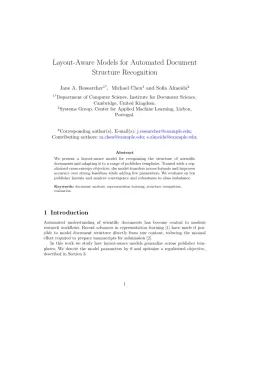
Die Pathologie template — frequently asked questions

How do I write a paper in the Die Pathologie format?
In DocuGuru you write your manuscript in a normal editor — no LaTeX setup required — and select the Die Pathologie template. When you export, DocuGuru compiles the paper into the official Springer Nature format and hands you a submission-ready PDF along with the editable LaTeX source.
What reference style does Die Pathologie use?
Die Pathologie uses Superscript numbered (Nature) references, shown as superscript numerals in the text. DocuGuru formats every in-text citation and the reference list in this exact style automatically. A reference appears like this: 1. Smith, A., Jones, B. & Lee, C. A representative article title. Die Pathologie 12, 45–58 (2023).
Do I need to know LaTeX to submit to Die Pathologie?
No. DocuGuru generates the sn-jnl LaTeX class and compiles the PDF for you in the background, so you get a Springer Nature-ready Die Pathologie document without writing any LaTeX. If you do want it, the LaTeX source is included in the export.
Can I import an existing draft into the Die Pathologie template?
Yes. Paste or upload your current manuscript — Word, LaTeX, Markdown, or plain text — and DocuGuru reflows it into the Die Pathologie format with correct headings, figures, tables, and superscript citations.
Who publishes Die Pathologie?
Die Pathologie is a multidisciplinary journal published by Springer Nature. DocuGuru's Die Pathologie template matches Springer Nature's official submission format.
Can I export a submission-ready Die Pathologie PDF?
Yes — DocuGuru produces a PDF built with the official Die Pathologie template (the sn-jnl class) that is ready to submit to Springer Nature, together with the matching LaTeX source files.
How much does the Die Pathologie template cost?
You can start writing in the Die Pathologie template for free. Exporting the final submission-ready Die Pathologie PDF and LaTeX source is part of DocuGuru's paid plans — see the app for current pricing.
Use the Die Pathologie template