
48 citations
Cite
SaveGo to paper →
Springer Nature
Data Science for Transportation Template
Write in a clean editor, then format for Data Science for Transportation in one click — DocuGuru applies the official Springer Nature template with superscript references and exports a submission-ready PDF plus the editable LaTeX source. Free to start.
About the Data Science for Transportation format
Data Science for Transportation is a peer-reviewed journal published by Springer Nature, covering Traffic Prediction and Management Techniques, Transportation Planning and Optimization, Human Mobility and Location-Based Analysis.
| Publisher | Springer Nature |
|---|---|
| Reference style | Superscript numbered (Nature) Superscript — small raised numerals in the text 1. Smith, A., Jones, B. & Lee, C. A representative article title. Data Science for Transportation 12, 45–58 (2023).
Formats any DOI in Data Science for Transportation style. No sign-up. |
| Publishes research in | Traffic Prediction and Management Techniques Transportation Planning and Optimization Human Mobility and Location-Based Analysis Traffic control and management Autonomous Vehicle Technology and Safety |
| ISSN | 2948-135X |
| Citation impact (2-yr) | 2.9 |
| h-index | 10 |
| i10-index | 11 |
| Total citations | 436 |
| Top institutions publishing here | University of Massachusetts Amherst |
| You get | A submission-ready PDF and the editable LaTeX source — ready to submit. |
Papers published in Data Science for Transportation per year
Citation impact of Data Science for Transportation by publication year
Citations each year’s papers have accumulated so far — the most recent years are still building up.
Most-cited papers in Data Science for Transportation
36 citations
Cite
SaveGo to paper →
Abstract Research in short-term traffic forecasting has been blooming in recent years due to its significant implications in traffic management and intelligent transportation systems. The unprecedented advancements in deep learning have provided immense opportunities to leverage traffic data sensed from various locations of the road network, yet significantly increased the models’ complexity and data and…
27 citations
Cite
SaveGo to paper →
Abstract Data science in transportation networks (DSTNs) refers to using diverse types of spatio-temporal data for various transportation tasks, including pattern analysis, traffic prediction, and traffic controls. Graph neural networks (GNNs) are essential in many DSTN problems due to their capability to represent spatial correlations between entities. Between 2016 and 2024, the notable applications of…
25 citations
Cite
SaveGo to paper →
Abstract Currently available trajectory data sets undoubtedly provide valuable insights into traffic events, the behavior of road users and traffic flow theory, thus enabling a wide range of applications. However, there are still shortcomings that need to be addressed: (i) the continuous temporal recording (ii) of a coherent area covering several intersections (iii) with the…
16 citations
Cite
SaveGo to paper →
Related journal templates
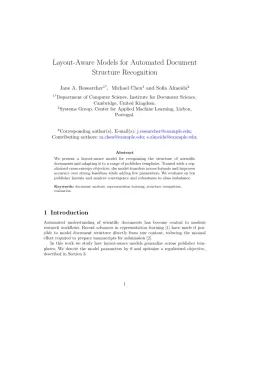
Data Science for Transportation template — frequently asked questions
How do I write a paper in the Data Science for Transportation format?
In DocuGuru you write your manuscript in a normal editor — no LaTeX setup required — and select the Data Science for Transportation template. When you export, DocuGuru compiles the paper into the official Springer Nature format and hands you a submission-ready PDF along with the editable LaTeX source.
What reference style does Data Science for Transportation use?
Data Science for Transportation uses Superscript numbered (Nature) references, shown as superscript numerals in the text. DocuGuru formats every in-text citation and the reference list in this exact style automatically. A reference appears like this: 1. Smith, A., Jones, B. & Lee, C. A representative article title. Data Science for Transportation 12, 45–58 (2023).
Do I need to know LaTeX to submit to Data Science for Transportation?
No. DocuGuru generates the sn-jnl LaTeX class and compiles the PDF for you in the background, so you get a Springer Nature-ready Data Science for Transportation document without writing any LaTeX. If you do want it, the LaTeX source is included in the export.
Can I import an existing draft into the Data Science for Transportation template?
Yes. Paste or upload your current manuscript — Word, LaTeX, Markdown, or plain text — and DocuGuru reflows it into the Data Science for Transportation format with correct headings, figures, tables, and superscript citations.
Who publishes Data Science for Transportation?
Data Science for Transportation is a multidisciplinary journal published by Springer Nature. DocuGuru's Data Science for Transportation template matches Springer Nature's official submission format.
Can I export a submission-ready Data Science for Transportation PDF?
Yes — DocuGuru produces a PDF built with the official Data Science for Transportation template (the sn-jnl class) that is ready to submit to Springer Nature, together with the matching LaTeX source files.
How much does the Data Science for Transportation template cost?
You can start writing in the Data Science for Transportation template for free. Exporting the final submission-ready Data Science for Transportation PDF and LaTeX source is part of DocuGuru's paid plans — see the app for current pricing.