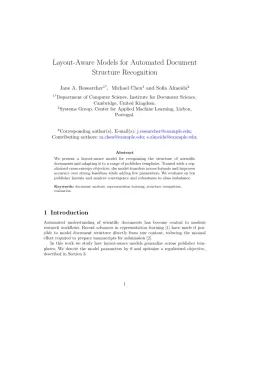
About the Current Robotics Reports format
Current Robotics Reports is a peer-reviewed journal published by Springer Nature, covering Soft Robotics and Applications, Robotics and Sensor-Based Localization, Robotic Path Planning Algorithms.
| Publisher | Springer Nature |
|---|
| Reference style | Superscript numbered (Nature) Superscript — small raised numerals in the text
1. Smith, A., Jones, B. & Lee, C. A representative article title. Current Robotics Reports 12, 45–58 (2023).
Formats any DOI in Current Robotics Reports style. No sign-up.
|
|---|
| Publishes research in | Soft Robotics and Applications Robotics and Sensor-Based Localization Robotic Path Planning Algorithms Social Robot Interaction and HRI Underwater Vehicles and Communication Systems |
|---|
| ISSN | 2662-4087 |
|---|
| Citation impact (2-yr) | 4.67 |
|---|
| h-index | 40 |
|---|
| i10-index | 85 |
|---|
| Total citations | 5,657 |
|---|
| Article processing charge | $2,890 |
|---|
| Top institutions publishing here | Centre National de la Recherche Scientifique |
|---|
| Journal website | www.springer.com |
|---|
| You get | A submission-ready PDF and the editable LaTeX source — ready to submit. |
|---|
Papers published in Current Robotics Reports per year
Citation impact of Current Robotics Reports by publication year
Citations each year’s papers have accumulated so far — the most recent years are still building up.
Most-cited papers in Current Robotics Reports
A Survey on Learning-Based Robotic Grasping
Kilian Kleeberger, Richard Bormann, Werner Kraus et al. · 20 Sep 2020
Abstract Purpose of Review This review provides a comprehensive overview of machine learning approaches for vision-based robotic grasping and manipulation. Current trends and developments as well as various criteria for categorization of approaches are provided. Recent Findings Model-free approaches are attractive due to their generalization capabilities to novel objects, but are mostly limited to top-down…
What Makes a Robot Social? A Review of Social Robots from Science Fiction to a Home or Hospital Near You
Anna Henschel, Guy Laban, Emily S. Cross · 4 Feb 2021
Purpose of Review: We provide an outlook on the definitions, laboratory research, and applications of social robots, with an aim to understand what makes a robot social-in the eyes of science and the general public. Recent Findings: Social robots demonstrate their potential when deployed within contexts appropriate to their form and functions. Some examples include…
Selective Harvesting Robotics: Current Research, Trends, and Future Directions
Gert Kootstra, Xin Wang, Pieter M. Blok et al. · 29 Jan 2021
Abstract Purpose of Review The world-wide demand for agricultural products is rapidly growing. However, despite the growing population, labor shortage becomes a limiting factor for agricultural production. Further automation of agriculture is an important solution to tackle these challenges. Recent Findings Selective harvesting of high-value crops, such as apples, tomatoes, and broccoli, is currently mainly…
Actuation Technologies for Soft Robot Grippers and Manipulators: A Review
Shadab Zaidi, Martina Maselli, Cecilia Laschi et al. · 20 May 2021
Abstract Purpose of Review The new paradigm of soft robotics has been widely developed in the international robotics community. These robots being soft can be used in applications where delicate yet effective interaction is necessary. Soft grippers and manipulators are important, and their actuation is a fundamental area of study. The main purpose of this…
Trust in Robots: Challenges and Opportunities
Bing Cai Kok, Harold Soh · 3 Sep 2020