Springer Nature

Bioresources and Bioprocessing Template

Write in a clean editor, then format for Bioresources and Bioprocessing in one click — DocuGuru applies the official Springer Nature template with numbered references and exports a submission-ready PDF plus the editable LaTeX source. Free to start.

About the Bioresources and Bioprocessing format

Bioresources and Bioprocessing is a peer-reviewed journal published by Springer Nature, covering Biofuel production and bioconversion, Microbial Metabolic Engineering and Bioproduction, Enzyme Catalysis and Immobilization.

PublisherSpringer Nature
Reference styleNumbered (Springer Basic)
Numbered — [1], [2] in the text
1. Smith A, Jones B, Lee C (2023) A representative article title. Bioresources and Bioprocessing 12:45–58

Formats any DOI in Bioresources and Bioprocessing style. No sign-up.

Publishes research inBiofuel production and bioconversion Microbial Metabolic Engineering and Bioproduction Enzyme Catalysis and Immobilization Enzyme Production and Characterization Algal biology and biofuel production
ISSN2197-4365
Citation impact (2-yr)5.7
h-index76
i10-index627
Total citations32,211
Open accessYes
Top institutions publishing hereEast China University of Science and Technology
Journal websitebioresourcesbioprocessing.springeropen.com
You getA submission-ready PDF and the editable LaTeX source — ready to submit.

Papers published in Bioresources and Bioprocessing per year

28
2014
49
2015
53
2016
56
2017
49
2018
53
2019
64
2020
136
2021
131
2022
95
2023
115
2024
156
2025

Citation impact of Bioresources and Bioprocessing by publication year

1.3K
2014
2.2K
2015
2.3K
2016
4.9K
2017
3.9K
2018
2.7K
2019
2.1K
2020
4.9K
2021
3.3K
2022
2.1K
2023
1.1K
2024
866
2025

Citations each year’s papers have accumulated so far — the most recent years are still building up.

Most-cited papers in Bioresources and Bioprocessing

Recent updates on different methods of pretreatment of lignocellulosic feedstocks: a review

Adepu Kiran Kumar, Shaishav Sharma · 18 Jan 2017

Lignocellulosic feedstock materials are the most abundant renewable bioresource material available on earth. It is primarily composed of cellulose, hemicellulose, and lignin, which are strongly associated with each other. Pretreatment processes are mainly involved in effective separation of these complex interlinked fractions and increase the accessibility of each individual component, thereby becoming an essential step…

1,415 citations Cite SaveGo to paper →
Agro-industrial wastes and their utilization using solid state fermentation: a review

Pardeep Kumar Sadh, Surekha Duhan, Joginder Singh Duhan · 2 Jan 2018

Agricultural residues are rich in bioactive compounds. These residues can be used as an alternate source for the production of different products like biogas, biofuel, mushroom, and tempeh as the raw material in various researches and industries. The use of agro-industrial wastes as raw materials can help to reduce the production cost and also reduce…

1,278 citations Cite SaveGo to paper →
Review on the current status of polymer degradation: a microbial approach

Vinay Mohan Pathak, Navneet · 23 Mar 2017

Inertness and the indiscriminate use of synthetic polymers leading to increased land and water pollution are of great concern. Plastic is the most useful synthetic polymer, employed in wide range of applications viz. the packaging industries, agriculture, household practices, etc. Unpredicted use of synthetic polymers is leading towards the accumulation of increased solid waste in…

Leaf extract mediated green synthesis of silver nanoparticles from widely available Indian plants: synthesis, characterization, antimicrobial property and toxicity analysis

Priya Banerjee, Mantosh Kumar Satapathy, Aniruddha Mukhopahayay et al. · 21 Jul 2014

Abstract Background In recent years, green synthesis of silver nanoparticles (AgNPs) has gained much interest from chemists and researchers. In this concern, Indian flora has yet to divulge innumerable sources of cost-effective non-hazardous reducing and stabilizing compounds utilized in preparing AgNPs. This study investigates an efficient and sustainable route of AgNP preparation from 1 mM…

Seafood waste: a source for preparation of commercially employable chitin/chitosan materials

Monika Yadav, Priynshi Goswami, Kunwar Paritosh et al. · 8 Feb 2019

Modern seafood processing practices result in amassment of a large volume of waste products, i.e., skin, head, tails, shells, scales, backbones, etc. These waste products may often encompass several high-value products which are still untapped due to the dearth of appropriate management. Moreover, inadequate disposal of waste also has negative implications on both environment and…

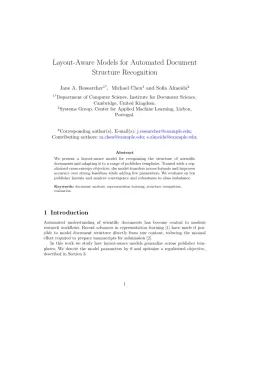
Bioresources and Bioprocessing template — frequently asked questions

How do I write a paper in the Bioresources and Bioprocessing format?
In DocuGuru you write your manuscript in a normal editor — no LaTeX setup required — and select the Bioresources and Bioprocessing template. When you export, DocuGuru compiles the paper into the official Springer Nature format and hands you a submission-ready PDF along with the editable LaTeX source.
What reference style does Bioresources and Bioprocessing use?
Bioresources and Bioprocessing uses Numbered (Springer Basic) references, shown as numbered [1], [2] markers in the text. DocuGuru formats every in-text citation and the reference list in this exact style automatically. A reference appears like this: 1. Smith A, Jones B, Lee C (2023) A representative article title. Bioresources and Bioprocessing 12:45–58
Do I need to know LaTeX to submit to Bioresources and Bioprocessing?
No. DocuGuru generates the sn-jnl LaTeX class and compiles the PDF for you in the background, so you get a Springer Nature-ready Bioresources and Bioprocessing document without writing any LaTeX. If you do want it, the LaTeX source is included in the export.
Can I import an existing draft into the Bioresources and Bioprocessing template?
Yes. Paste or upload your current manuscript — Word, LaTeX, Markdown, or plain text — and DocuGuru reflows it into the Bioresources and Bioprocessing format with correct headings, figures, tables, and numbered citations.
Who publishes Bioresources and Bioprocessing?
Bioresources and Bioprocessing is a multidisciplinary journal published by Springer Nature. DocuGuru's Bioresources and Bioprocessing template matches Springer Nature's official submission format.
Can I export a submission-ready Bioresources and Bioprocessing PDF?
Yes — DocuGuru produces a PDF built with the official Bioresources and Bioprocessing template (the sn-jnl class) that is ready to submit to Springer Nature, together with the matching LaTeX source files.
How much does the Bioresources and Bioprocessing template cost?
You can start writing in the Bioresources and Bioprocessing template for free. Exporting the final submission-ready Bioresources and Bioprocessing PDF and LaTeX source is part of DocuGuru's paid plans — see the app for current pricing.
Use the Bioresources and Bioprocessing template