
2,299 citations
Cite
SaveGo to paper →
Springer Nature
Analytical and Bioanalytical Chemistry Template
Write in a clean editor, then format for Analytical and Bioanalytical Chemistry in one click — DocuGuru applies the official Springer Nature template with numbered references and exports a submission-ready PDF plus the editable LaTeX source. Free to start.
About the Analytical and Bioanalytical Chemistry format
Analytical and Bioanalytical Chemistry is a peer-reviewed journal published by Springer Nature, covering Analytical chemistry methods development, Analytical Chemistry and Chromatography, Mass Spectrometry Techniques and Applications. Over its lifetime it has published 47,544 papers, which have received 713,950 citations.
| Publisher | Springer Nature |
|---|---|
| Reference style | Numbered (Springer Basic) Numbered — [1], [2] in the text 1. Smith A, Jones B, Lee C (2023) A representative article title. Analytical and Bioanalytical Chemistry 12:45–58
Formats any DOI in Analytical and Bioanalytical Chemistry style. No sign-up. |
| Publishes research in | Analytical chemistry methods development Analytical Chemistry and Chromatography Mass Spectrometry Techniques and Applications Electrochemical Analysis and Applications Advanced biosensing and bioanalysis techniques |
| ISSN | 1618-2642 |
| Citation impact (2-yr) | 3.61 |
| h-index | 227 |
| i10-index | 15,452 |
| Article processing charge | $3,590 |
| Top institutions publishing here | Centre National de la Recherche Scientifique |
| Journal website | www.springer.com |
| You get | A submission-ready PDF and the editable LaTeX source — ready to submit. |
Papers published in Analytical and Bioanalytical Chemistry per year
Citation impact of Analytical and Bioanalytical Chemistry by publication year
Citations each year’s papers have accumulated so far — the most recent years are still building up.
Most-cited papers in Analytical and Bioanalytical Chemistry
The quantification of differences between two or more physiological states of a biological system is among the most important but also most challenging technical tasks in proteomics. In addition to the classical methods of differential protein gel or blot staining by dyes and fluorophores, mass-spectrometry-based quantification methods have gained increasing popularity over the past five…
1,663 citations
Cite
SaveGo to paper →
Lateral flow (immuno)assays are currently used for qualitative, semiquantitative and to some extent quantitative monitoring in resource-poor or non-laboratory environments. Applications include tests on pathogens, drugs, hormones and metabolites in biomedical, phytosanitary, veterinary, feed/food and environmental settings. We describe principles of current formats, applications, limitations and perspectives for quantitative monitoring. We illustrate the potentials and…
1,532 citations
Cite
SaveGo to paper →
Hydrophilic interaction liquid chromatography (HILIC) provides an alternative approach to effectively separate small polar compounds on polar stationary phases. The purpose of this work was to review the options for the characterization of HILIC stationary phases and their applications for separations of polar compounds in complex matrices. The characteristics of the hydrophilic stationary phase may…
1,210 citations
Cite
SaveGo to paper →
Organic species are an important but poorly characterized constituent of airborne particulate matter. A quantitative understanding of the organic fraction of particles (organic aerosol, OA) is necessary to reduce some of the largest uncertainties that confound the assessment of the radiative forcing of climate and air quality management policies. In recent years, aerosol mass spectrometry…
1,079 citations
Cite
SaveGo to paper →
Related journal templates
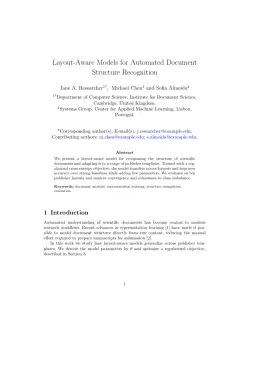

Analytical and Bioanalytical Chemistry template — frequently asked questions
How do I write a paper in the Analytical and Bioanalytical Chemistry format?
In DocuGuru you write your manuscript in a normal editor — no LaTeX setup required — and select the Analytical and Bioanalytical Chemistry template. When you export, DocuGuru compiles the paper into the official Springer Nature format and hands you a submission-ready PDF along with the editable LaTeX source.
What reference style does Analytical and Bioanalytical Chemistry use?
Analytical and Bioanalytical Chemistry uses Numbered (Springer Basic) references, shown as numbered [1], [2] markers in the text. DocuGuru formats every in-text citation and the reference list in this exact style automatically. A reference appears like this: 1. Smith A, Jones B, Lee C (2023) A representative article title. Analytical and Bioanalytical Chemistry 12:45–58
Do I need to know LaTeX to submit to Analytical and Bioanalytical Chemistry?
No. DocuGuru generates the sn-jnl LaTeX class and compiles the PDF for you in the background, so you get a Springer Nature-ready Analytical and Bioanalytical Chemistry document without writing any LaTeX. If you do want it, the LaTeX source is included in the export.
Can I import an existing draft into the Analytical and Bioanalytical Chemistry template?
Yes. Paste or upload your current manuscript — Word, LaTeX, Markdown, or plain text — and DocuGuru reflows it into the Analytical and Bioanalytical Chemistry format with correct headings, figures, tables, and numbered citations.
What is Analytical and Bioanalytical Chemistry?
Journal covering analytical and bioanalytical chemistry. It is a multidisciplinary journal, published by Springer Nature.
Can I export a submission-ready Analytical and Bioanalytical Chemistry PDF?
Yes — DocuGuru produces a PDF built with the official Analytical and Bioanalytical Chemistry template (the sn-jnl class) that is ready to submit to Springer Nature, together with the matching LaTeX source files.
How much does the Analytical and Bioanalytical Chemistry template cost?
You can start writing in the Analytical and Bioanalytical Chemistry template for free. Exporting the final submission-ready Analytical and Bioanalytical Chemistry PDF and LaTeX source is part of DocuGuru's paid plans — see the app for current pricing.