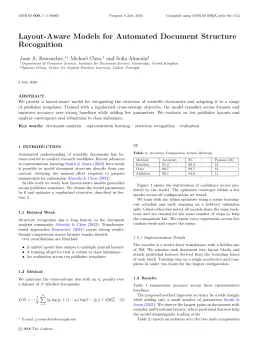
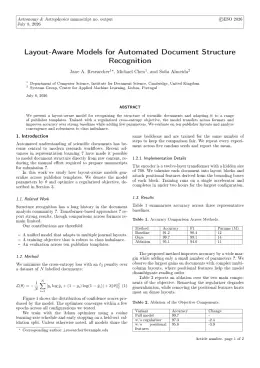
About the RAS Techniques and Instruments format
RAS Techniques and Instruments is a peer-reviewed journal published by Royal Astronomical Society, covering Stellar, planetary, and galactic studies, Astronomy and Astrophysical Research, Radio Astronomy Observations and Technology. Over its lifetime it has published 246 papers, which have received 824 citations.
| Publisher | Royal Astronomical Society |
|---|
| Reference style | Author–year (MNRAS) Author–year — (Smith, 2023) in the text
Smith, A., Jones, B. and Lee, C. (2023) 'A representative article title', RAS Techniques and Instruments, 12(3), pp. 45–58.
Formats any DOI in the closest standard style — RAS Techniques and Instruments has no published style definition, so this is an approximation. No sign-up.
|
|---|
| Publishes research in | Stellar, planetary, and galactic studies Astronomy and Astrophysical Research Radio Astronomy Observations and Technology Galaxies: Formation, Evolution, Phenomena Gamma-ray bursts and supernovae |
|---|
| ISSN | 2752-8200 |
|---|
| Citation impact (2-yr) | 1.79 |
|---|
| h-index | 14 |
|---|
| i10-index | 25 |
|---|
| Open access | Yes — indexed in DOAJ |
|---|
| Top institutions publishing here | University College London |
|---|
| You get | A submission-ready PDF and the editable LaTeX source — ready to submit. |
|---|
Papers published in RAS Techniques and Instruments per year
Citation impact of RAS Techniques and Instruments by publication year
Citations each year’s papers have accumulated so far — the most recent years are still building up.
Most-cited papers in RAS Techniques and Instruments
The effect of stellar contamination on low-resolution transmission spectroscopy: needs identified by NASA’s Exoplanet Exploration Program Study Analysis Group 21
Benjamin V. Rackham, Néstor Espinoza, S. V. Berdyugina et al. · 1 Jan 2023
Abstract Study Analysis Group 21 (SAG21) of NASA’s Exoplanet Exploration Program Analysis Group was organized to study the effect of stellar contamination on space-based transmission spectroscopy, a method for studying exoplanetary atmospheres by measuring the wavelength-dependent radius of a planet as it transits its star. Transmission spectroscopy relies on a precise understanding of the spectrum…
Radio galaxy zoo: towards building the first multipurpose foundation model for radio astronomy with self-supervised learning
Inigo Val Slijepcevic, Anna M. M. Scaife, Mike Walmsley et al. · 18 Dec 2023
Abstract In this work, we apply self-supervised learning with instance differentiation to learn a robust, multipurpose representation for image analysis of resolved extragalactic continuum images. We train a multi-use model which compresses our unlabelled data into a structured, low dimensional representation which can be used for a variety of downstream tasks (e.g. classification, similarity search).…
Bayesian model comparison for simulation-based inference
A. Spurio Mancini, Matthew M. Docherty, Matt A. Price et al. · 1 Jan 2023
Abstract Comparison of appropriate models to describe observational data is a fundamental task of science. The Bayesian model evidence, or marginal likelihood, is a computationally challenging, yet crucial, quantity to estimate to perform Bayesian model comparison. We introduce a methodology to compute the Bayesian model evidence in simulation-based inference (SBI) scenarios (often called likelihood-free inference).…
Data availability and requirements relevant for the <i>Ariel</i> space mission and other exoplanet atmosphere applications
K. L. Chubb, Séverine Robert, Clara Sousa‐Silva et al. · 1 Jan 2024
ABSTRACT The goal of this white paper is to provide a snapshot of the data availability and data needs primarily for the Ariel space mission, but also for related atmospheric studies of exoplanets and cool stars. It covers the following data-related topics: molecular and atomic line lists, line profiles, computed cross-sections and opacities, collision-induced absorption…
A brief review of contrastive learning applied to astrophysics
Regina Sarmiento, J. H. Knapen · 1 Jan 2023
Abstract Reliable tools to extract patterns from high-dimensionality spaces are becoming more necessary as astronomical data sets increase both in volume and complexity. Contrastive Learning is a self-supervised machine learning algorithm that extracts informative measurements from multidimensional data sets, which has become increasingly popular in the computer vision and Machine Learning communities in recent years.…