Inderscience

International Journal of Functional Informatics and Personalised Medicine Template

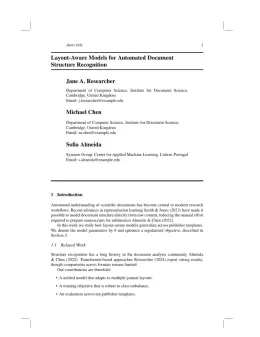
Write in a clean editor, then format for International Journal of Functional Informatics and Personalised Medicine in one click — DocuGuru applies the official Inderscience template with author–year references and exports a submission-ready PDF plus the editable LaTeX source. Free to start.

About the International Journal of Functional Informatics and Personalised Medicine format

International Journal of Functional Informatics and Personalised Medicine is a peer-reviewed journal published by Inderscience, covering Machine Learning in Bioinformatics, Biomedical Text Mining and Ontologies, Traditional Chinese Medicine Studies.

PublisherInderscience
Reference styleAuthor–year (Harvard/AGSM)
Author–year — (Smith, 2023) in the text
Smith, A., Jones, B. and Lee, C. (2023) 'A representative article title', International Journal of Functional Informatics and Personalised Medicine, 12(3), pp. 45–58.

Formats any DOI in International Journal of Functional Informatics and Personalised Medicine style. No sign-up.

Publishes research inMachine Learning in Bioinformatics Biomedical Text Mining and Ontologies Traditional Chinese Medicine Studies Gene expression and cancer classification Bioinformatics and Genomic Networks
ISSN1756-2104
h-index11
i10-index14
Total citations462
Top institutions publishing hereSouthern Illinois University Carbondale
Journal websitewww.inderscience.com
You getA submission-ready PDF and the editable LaTeX source — ready to submit.

Papers published in International Journal of Functional Informatics and Personalised Medicine per year

29
2008
28
2009
21
2010
6
2012
6
2013
6
2014

Citation impact of International Journal of Functional Informatics and Personalised Medicine by publication year

95
2008
172
2009
140
2010
41
2012
12
2013
1
2014

Citations each year’s papers have accumulated so far — the most recent years are still building up.

Most-cited papers in International Journal of Functional Informatics and Personalised Medicine

LOINC®: a universal catalogue of individual clinical observations and uniform representation of enumerated collections

Daniel J. Vreeman, Clement J. McDonald, Stanley M. Huff · 1 Jan 2010

In many areas of practice and research, clinical observations are recorded on data collection forms by asking and answering questions, yet without being represented in accepted terminology standards these results cannot be easily shared among clinical care and research systems. LOINC contains a well-developed model for representing variables, answer lists, and the collections that contain…

Compressed-sensing Photoacoustic Imaging based on random optical illumination

Dong Liang, Hao F. Zhang, Leslie Ying · 1 Jan 2009

Limited-view acquisition suffers from artefacts and loss of resolution for reconstruction-based Photoacoustic Imaging (PAI). In this paper, a completely new acquisition and reconstruction scheme is reported to achieve artefact-free imaging from limited-view acquisition. The method employs spatially and temporally varying random optical illumination instead of the uniform illumination used in conventional PAI methods. Compressed Sensing…

Integrated optimisation method for personalised modelling and case studies for medical decision support

Nikola Kasabov, Yingjie Hu · 1 Jan 2010

Personalised modelling aims to create a unique computational diagnostic or prognostic model for an individual. The paper reports a new Integrated Method for Personalised Modelling (IMPM) that applies global optimisation of variables (features) and neighbourhood of appropriate data samples to create an accurate personalised model for an individual. The proposed IMPM allows for adaptation, monitoring…

Computer-aided disease diagnosis system in TCM based on facial image analysis

Xiaoqiang Li, Fufeng Li, Yiqin Wang et al. · 1 Jan 2009

Diagnosing diseases through observing the personal face is the Traditional Chinese Medicine (TCM), which is a unique diagnostic method. Clinical experiences in TCM have proved that facial complexion can tell whether the one is healthy. A novel Computer-Aided Disease Diagnosis System (CADDS), acquiring the facial complexion information based on analysing image captured by digital camera,…

An automatic tongue detection and segmentation framework for computer-aided tongue image analysis

Ratchadaporn Kanawong, Wentao Xu, Dong Xu et al. · 1 Jan 2012

Traditional Chinese Medicine (TCM) has a long history and has been recognised as a popular alternative medicine in western countries. Tongue diagnosis is a significant procedure in computer–aided TCM, where tongue image analysis plays a dominant role. In this paper, we propose a fully automatic tongue detection and segmentation framework that includes a Principal Component…

International Journal of Functional Informatics and Personalised Medicine template — frequently asked questions

How do I write a paper in the International Journal of Functional Informatics and Personalised Medicine format?
In DocuGuru you write your manuscript in a normal editor — no LaTeX setup required — and select the International Journal of Functional Informatics and Personalised Medicine template. When you export, DocuGuru compiles the paper into the official Inderscience format and hands you a submission-ready PDF along with the editable LaTeX source.
What reference style does International Journal of Functional Informatics and Personalised Medicine use?
International Journal of Functional Informatics and Personalised Medicine uses Author–year (Harvard/AGSM) references, shown as author–year markers such as (Smith, 2023) in the text. DocuGuru formats every in-text citation and the reference list in this exact style automatically. A reference appears like this: Smith, A., Jones, B. and Lee, C. (2023) 'A representative article title', International Journal of Functional Informatics and Personalised Medicine, 12(3), pp. 45–58.
Do I need to know LaTeX to submit to International Journal of Functional Informatics and Personalised Medicine?
No. DocuGuru generates the singlecol-new LaTeX class and compiles the PDF for you in the background, so you get a Inderscience-ready International Journal of Functional Informatics and Personalised Medicine document without writing any LaTeX. If you do want it, the LaTeX source is included in the export.
Can I import an existing draft into the International Journal of Functional Informatics and Personalised Medicine template?
Yes. Paste or upload your current manuscript — Word, LaTeX, Markdown, or plain text — and DocuGuru reflows it into the International Journal of Functional Informatics and Personalised Medicine format with correct headings, figures, tables, and author–year citations.
Who publishes International Journal of Functional Informatics and Personalised Medicine?
International Journal of Functional Informatics and Personalised Medicine is a engineering and computer science journal published by Inderscience. DocuGuru's International Journal of Functional Informatics and Personalised Medicine template matches Inderscience's official submission format.
Can I export a submission-ready International Journal of Functional Informatics and Personalised Medicine PDF?
Yes — DocuGuru produces a PDF built with the official International Journal of Functional Informatics and Personalised Medicine template (the singlecol-new class) that is ready to submit to Inderscience, together with the matching LaTeX source files.
How much does the International Journal of Functional Informatics and Personalised Medicine template cost?
You can start writing in the International Journal of Functional Informatics and Personalised Medicine template for free. Exporting the final submission-ready International Journal of Functional Informatics and Personalised Medicine PDF and LaTeX source is part of DocuGuru's paid plans — see the app for current pricing.

Use the International Journal of Functional Informatics and Personalised Medicine template