Inderscience

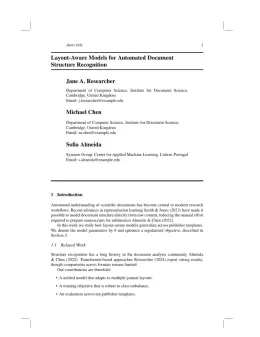
International Journal of Data Mining and Bioinformatics Template

Write in a clean editor, then format for International Journal of Data Mining and Bioinformatics in one click — DocuGuru applies the official Inderscience template with author–year references and exports a submission-ready PDF plus the editable LaTeX source. Free to start.

About the International Journal of Data Mining and Bioinformatics format

International Journal of Data Mining and Bioinformatics is a peer-reviewed journal published by Inderscience, covering Gene expression and cancer classification, Bioinformatics and Genomic Networks, Machine Learning in Bioinformatics.

PublisherInderscience
Reference styleAuthor–year (Harvard/AGSM)
Author–year — (Smith, 2023) in the text
Smith, A., Jones, B. and Lee, C. (2023) 'A representative article title', International Journal of Data Mining and Bioinformatics, 12(3), pp. 45–58.

Formats any DOI in International Journal of Data Mining and Bioinformatics style. No sign-up.

Publishes research inGene expression and cancer classification Bioinformatics and Genomic Networks Machine Learning in Bioinformatics Genomics and Phylogenetic Studies Biomedical Text Mining and Ontologies
ISSN1748-5673
Citation impact (2-yr)0.7
h-index30
i10-index144
Total citations5,036
Top institutions publishing hereSeoul National University
Journal websitewww.inderscience.com
You getA submission-ready PDF and the editable LaTeX source — ready to submit.

Papers published in International Journal of Data Mining and Bioinformatics per year

51
2014
74
2015
76
2016
117
2017
76
2018
36
2019
82
2020
49
2021
28
2022
29
2023
87
2024
18
2025

Citation impact of International Journal of Data Mining and Bioinformatics by publication year

249
2014
460
2015
352
2016
644
2017
234
2018
90
2019
128
2020
47
2021
41
2022
17
2023
104
2024
2
2025

Citations each year’s papers have accumulated so far — the most recent years are still building up.

Most-cited papers in International Journal of Data Mining and Bioinformatics

Predicting human microRNA-disease associations based on support vector machine

Qinghua Jiang, Guohua Wang, Shuilin Jin et al. · 1 Jan 2013

The identification of disease-related microRNAs is vital for understanding the pathogenesis of disease at the molecular level and may lead to the design of specific molecular tools for diagnosis, treatment and prevention. Experimental identification of disease-related microRNAs poses difficulties. Computational prediction of microRNA-disease associations is one of the complementary means. However, one major issue in…

The semantic connectivity map: an adapting self-organising knowledge discovery method in data bases. Experience in gastro-oesophageal reflux disease

Massimo Buscema, Enzo Grossi · 1 Jan 2008

We describe here a new mapping method able to find out connectivity traces among variables thanks to an artificial adaptive system, the Auto Contractive Map (AutoCM), able to define the strength of the associations of each variable with all the others in a dataset. After the training phase, the weights matrix of the AutoCM represents…

Gene selection for cancer classification by combining minimum redundancy maximum relevancy and bat-inspired algorithm

Osama Ahmad Alomari, Ahamad Tajudin Khader, Mohammed Azmi Al‐Betar et al. · 1 Jan 2017

In this paper, the bat-inspired algorithm (BA) is tolerated to gene selection for cancer classification using microarray datasets. Microarray data consists of irrelevant, redundant, and noisy genes. Gene selection problem is tackled by determining the most informative genes taken from microarray data to accurately diagnose the cancer disease. Gene selection problem is widely solved by…

Discovery of metabolite features for the modelling and analysis of high-resolution NMR spectra

Hyun Woo Cho, Seoung Bum Kim, Myong K. Jeong et al. · 1 Jan 2008

This study presents three feature selection methods for identifying the metabolite features in nuclear magnetic resonance spectra that contribute to the distinction of samples among varying nutritional conditions. Principal component analysis, Fisher discriminant analysis, and Partial Least Square Discriminant Analysis (PLS-DA) were used to calculate the importance of individual metabolite feature in spectra. Moreover, an…

MentalSquares: A generic bipolar Support Vector Machine for psychiatric disorder classification, diagnostic analysis and neurobiological data mining

Wen Ran Zhang, Anand K. Pandurangi, Karl E. Peace et al. · 1 Jan 2011

MentalSquares (MSQs)--an equilibrium-based dimensional approach is presented for the classification and diagnostic analysis of psychological conditions with Bipolar Disorders (BPDs) as an example. While a Support Vector Machine (SVM) is defined in Hilbert space. A MSQ can be considered as a generic SVM for improved classification. Different from the traditional categorical model of BPDs, the…

International Journal of Data Mining and Bioinformatics template — frequently asked questions

How do I write a paper in the International Journal of Data Mining and Bioinformatics format?
In DocuGuru you write your manuscript in a normal editor — no LaTeX setup required — and select the International Journal of Data Mining and Bioinformatics template. When you export, DocuGuru compiles the paper into the official Inderscience format and hands you a submission-ready PDF along with the editable LaTeX source.
What reference style does International Journal of Data Mining and Bioinformatics use?
International Journal of Data Mining and Bioinformatics uses Author–year (Harvard/AGSM) references, shown as author–year markers such as (Smith, 2023) in the text. DocuGuru formats every in-text citation and the reference list in this exact style automatically. A reference appears like this: Smith, A., Jones, B. and Lee, C. (2023) 'A representative article title', International Journal of Data Mining and Bioinformatics, 12(3), pp. 45–58.
Do I need to know LaTeX to submit to International Journal of Data Mining and Bioinformatics?
No. DocuGuru generates the singlecol-new LaTeX class and compiles the PDF for you in the background, so you get a Inderscience-ready International Journal of Data Mining and Bioinformatics document without writing any LaTeX. If you do want it, the LaTeX source is included in the export.
Can I import an existing draft into the International Journal of Data Mining and Bioinformatics template?
Yes. Paste or upload your current manuscript — Word, LaTeX, Markdown, or plain text — and DocuGuru reflows it into the International Journal of Data Mining and Bioinformatics format with correct headings, figures, tables, and author–year citations.
Who publishes International Journal of Data Mining and Bioinformatics?
International Journal of Data Mining and Bioinformatics is a engineering and computer science journal published by Inderscience. DocuGuru's International Journal of Data Mining and Bioinformatics template matches Inderscience's official submission format.
Can I export a submission-ready International Journal of Data Mining and Bioinformatics PDF?
Yes — DocuGuru produces a PDF built with the official International Journal of Data Mining and Bioinformatics template (the singlecol-new class) that is ready to submit to Inderscience, together with the matching LaTeX source files.
How much does the International Journal of Data Mining and Bioinformatics template cost?
You can start writing in the International Journal of Data Mining and Bioinformatics template for free. Exporting the final submission-ready International Journal of Data Mining and Bioinformatics PDF and LaTeX source is part of DocuGuru's paid plans — see the app for current pricing.

Use the International Journal of Data Mining and Bioinformatics template