IEEE

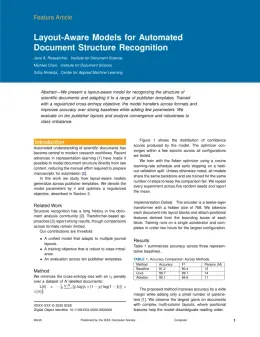
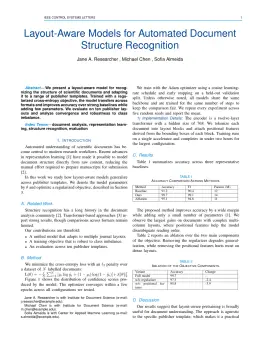
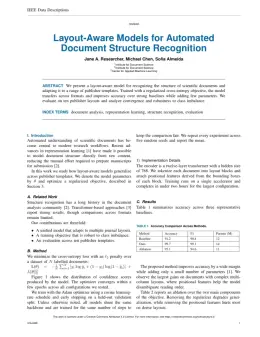
Intelligent and Converged Networks Template

Write in a clean editor, then format for Intelligent and Converged Networks in one click — DocuGuru applies the official IEEE template with numbered references and exports a submission-ready PDF plus the editable LaTeX source. Free to start.

About the Intelligent and Converged Networks format

Intelligent and Converged Networks is a peer-reviewed journal published by IEEE, covering IoT and Edge/Fog Computing, Advanced Wireless Communication Technologies, Advanced MIMO Systems Optimization.

PublisherIEEE
Reference styleNumbered (IEEE)
Numbered — [1], [2] in the text
[1] A. Smith, B. Jones, and C. Lee, "A representative article title," Intelligent and Converged Networks, vol. 12, no. 3, pp. 45–58, 2023.

Formats any DOI in Intelligent and Converged Networks style. No sign-up.

Publishes research inIoT and Edge/Fog Computing Advanced Wireless Communication Technologies Advanced MIMO Systems Optimization UAV Applications and Optimization Cooperative Communication and Network Coding
ISSN2708-6240
Citation impact (2-yr)1.81
h-index27
i10-index55
Total citations2,671
Open accessYes
Top institutions publishing hereTsinghua University
You getA submission-ready PDF and the editable LaTeX source — ready to submit.

Papers published in Intelligent and Converged Networks per year

31
2020
36
2021
37
2022
38
2023
34
2024
35
2025

Citation impact of Intelligent and Converged Networks by publication year

1.2K
2020
388
2021
692
2022
228
2023
109
2024
30
2025

Citations each year’s papers have accumulated so far — the most recent years are still building up.

Most-cited papers in Intelligent and Converged Networks

Reconfigurable intelligent surfaces for wireless communications: Overview of hardware designs, channel models, and estimation techniques

Mengnan Jian, George C. Alexandropoulos, Ertuğrul Başar et al. · 1 Mar 2022

The demanding objectives for the future sixth generation (6G) of wireless communication networks have spurred recent research efforts on novel materials and radio-frequency front-end architectures for wireless connectivity, as well as revolutionary communication and computing paradigms. Among the pioneering candidate technologies for 6G belong the reconfigurable intelligent surfaces (RISs), which are artificial planar structures with…

Deep reinforcement learning for dynamic computation offloading and resource allocation in cache-assisted mobile edge computing systems

Samrat Nath, Jingxian Wu · 1 Sep 2020

Mobile Edge Computing (MEC) is one of the most promising techniques for next-generation wireless communication systems. In this paper, we study the problem of dynamic caching, computation offloading, and resource allocation in cache-assisted multi-user MEC systems with stochastic task arrivals. There are multiple computationally intensive tasks in the system, and each Mobile User (MU) needs…

Research and application of wireless sensor network technology in power transmission and distribution system

Jianming Liu, Ziyan Zhao, Jerry Ji et al. · 1 Sep 2020

Power is an important part of the energy industry, relating to national economy and people's livelihood, and it is of great significance to ensure the security and stability in operation of power transmission and distribution system. Based on Wireless Sensor Network technology (WSN) and combined with the monitoring and operating requirements of power transmission and…

Space-air-ground integrated vehicular network for connected and automated vehicles: Challenges and solutions

Zhisheng Niu, Xuemin Shen, Qinyu Zhang et al. · 1 Sep 2020

Unlimited and seamless coverage as well as ultra-reliable and low-latency communications are vital for connected vehicles, in particular for new use cases like autonomous driving and vehicle platooning. In this paper, we propose a novel Space-Air-Ground integrated vehicular network (SAGiven) architecture to gracefully integrate the multi-dimensional and multi-scale context-information and network resources from satellites, High-Altitude…

An intelligent self-sustained RAN slicing framework for diverse service provisioning in 5G-beyond and 6G networks

Jie Mei, Xianbin Wang, Kan Zheng · 1 Dec 2020

Network slicing is a key technology to support the concurrent provisioning of heterogeneous Quality of Service (QoS) in the 5th Generation (5G)-beyond and the 6th Generation (6G) networks. However, effective slicing of Radio Access Network (RAN) is very challenging due to the diverse QoS requirements and dynamic conditions in the 6G networks. In this paper,…

Intelligent and Converged Networks template — frequently asked questions

How do I write a paper in the Intelligent and Converged Networks format?
In DocuGuru you write your manuscript in a normal editor — no LaTeX setup required — and select the Intelligent and Converged Networks template. When you export, DocuGuru compiles the paper into the official IEEE format and hands you a submission-ready PDF along with the editable LaTeX source.
What reference style does Intelligent and Converged Networks use?
Intelligent and Converged Networks uses Numbered (IEEE) references, shown as numbered [1], [2] markers in the text. DocuGuru formats every in-text citation and the reference list in this exact style automatically. A reference appears like this: [1] A. Smith, B. Jones, and C. Lee, "A representative article title," Intelligent and Converged Networks, vol. 12, no. 3, pp. 45–58, 2023.
Do I need to know LaTeX to submit to Intelligent and Converged Networks?
No. DocuGuru generates the IEEEtran LaTeX class and compiles the PDF for you in the background, so you get a IEEE-ready Intelligent and Converged Networks document without writing any LaTeX. If you do want it, the LaTeX source is included in the export.
Can I import an existing draft into the Intelligent and Converged Networks template?
Yes. Paste or upload your current manuscript — Word, LaTeX, Markdown, or plain text — and DocuGuru reflows it into the Intelligent and Converged Networks format with correct headings, figures, tables, and numbered citations.
Who publishes Intelligent and Converged Networks?
Intelligent and Converged Networks is a engineering and computer science journal published by IEEE. DocuGuru's Intelligent and Converged Networks template matches IEEE's official submission format.
Can I export a submission-ready Intelligent and Converged Networks PDF?
Yes — DocuGuru produces a PDF built with the official Intelligent and Converged Networks template (the IEEEtran class) that is ready to submit to IEEE, together with the matching LaTeX source files.
How much does the Intelligent and Converged Networks template cost?
You can start writing in the Intelligent and Converged Networks template for free. Exporting the final submission-ready Intelligent and Converged Networks PDF and LaTeX source is part of DocuGuru's paid plans — see the app for current pricing.

Use the Intelligent and Converged Networks template