IEEE

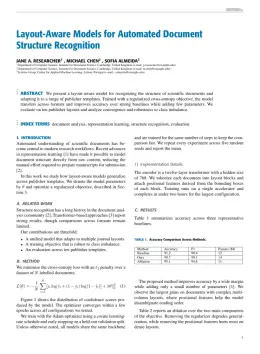
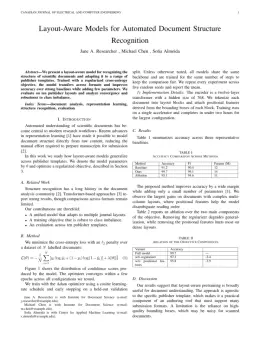
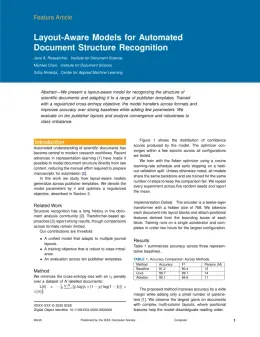
IEEE Cloud Computing Template

Write in a clean editor, then format for IEEE Cloud Computing in one click — DocuGuru applies the official IEEE template with numbered references and exports a submission-ready PDF plus the editable LaTeX source. Free to start.

About the IEEE Cloud Computing format

IEEE Cloud Computing is a peer-reviewed journal published by IEEE, covering Cloud Computing and Resource Management, IoT and Edge/Fog Computing, Cloud Data Security Solutions.

PublisherIEEE
Reference styleNumbered (IEEE)
Numbered — [1], [2] in the text
[1] A. Smith, B. Jones, and C. Lee, "A representative article title," IEEE Cloud Computing, vol. 12, no. 3, pp. 45–58, 2023.

Formats any DOI in IEEE Cloud Computing style. No sign-up.

Publishes research inCloud Computing and Resource Management IoT and Edge/Fog Computing Cloud Data Security Solutions Diverse Scientific and Economic Studies Big Data and Digital Economy
ISSN2325-6095
h-index57
i10-index176
Total citations13,101
Top institutions publishing hereDeutsche Telekom (Singapore)
Journal websitewww.computer.org
You getA submission-ready PDF and the editable LaTeX source — ready to submit.

Papers published in IEEE Cloud Computing per year

90
2014
133
2015
158
2016
126
2017
103
2018
1
2019

Citation impact of IEEE Cloud Computing by publication year

2.4K
2014
1.8K
2015
3.2K
2016
3.4K
2017
2.2K
2018
6
2019

Citations each year’s papers have accumulated so far — the most recent years are still building up.

Most-cited papers in IEEE Cloud Computing

Containers and Cloud: From LXC to Docker to Kubernetes

David Bernstein · 1 Sep 2014

This issue's "Cloud Tidbit" focuses on container technology and how it's emerging as an important part of the cloud computing infrastructure. It looks at Docker, an open source project that automates the faster deployment of Linux applications, and Kubernetes, an open source cluster manager for Docker containers.

1,098 citations Cite SaveGo to paper →
Blockchain: A Panacea for Healthcare Cloud-Based Data Security and Privacy?

Christian Esposito, Alfredo De Santis, Genny Tortora et al. · 1 Jan 2018

One particular trend observed in healthcare is the progressive shift of data and services to the cloud, partly due to convenience (e.g. availability of complete patient medical history in real-time) and savings (e.g. economics of healthcare data management). There are, however, limitations to using conventional cryptographic primitives and access control models to address security and…

Containerization and the PaaS Cloud

Claus Pahl · 1 May 2015

Containerization is widely discussed as a lightweight virtualization solution. Apart from exhibiting benefits over traditional virtual machines in the cloud, containers are especially relevant for platform-as-a-service (PaaS) clouds to manage and orchestrate applications through containers as an application packaging mechanism. This article discusses the requirements that arise from having to facilitate applications through distributed multicloud…

Mobility-Aware Application Scheduling in Fog Computing

Luiz F. Bittencourt, Javier Diaz‐Montes, Rajkumar Buyya et al. · 1 Mar 2017

Fog computing provides a distributed infrastructure at the edges of the network, resulting in low-latency access and faster response to application requests when compared to centralized clouds. With this new level of computing capacity introduced between users and the data center-based clouds, new forms of resource allocation and management can be developed to take advantage…

Osmotic Computing: A New Paradigm for Edge/Cloud Integration

Massimo Villari, Maria Fazio, Schahram Dustdar et al. · 1 Nov 2016

Osmotic computing is a new paradigm to support the efficient execution of Internet of Things (IoT) services and applications at the network edge. This paradigm is founded on the need for a holistic distributed system abstraction enabling the deployment of lightweight microservices on resource-constrained IoT platforms at the network edge, coupled with more complex microservices…

IEEE Cloud Computing template — frequently asked questions

How do I write a paper in the IEEE Cloud Computing format?
In DocuGuru you write your manuscript in a normal editor — no LaTeX setup required — and select the IEEE Cloud Computing template. When you export, DocuGuru compiles the paper into the official IEEE format and hands you a submission-ready PDF along with the editable LaTeX source.
What reference style does IEEE Cloud Computing use?
IEEE Cloud Computing uses Numbered (IEEE) references, shown as numbered [1], [2] markers in the text. DocuGuru formats every in-text citation and the reference list in this exact style automatically. A reference appears like this: [1] A. Smith, B. Jones, and C. Lee, "A representative article title," IEEE Cloud Computing, vol. 12, no. 3, pp. 45–58, 2023.
Do I need to know LaTeX to submit to IEEE Cloud Computing?
No. DocuGuru generates the IEEEtran LaTeX class and compiles the PDF for you in the background, so you get a IEEE-ready IEEE Cloud Computing document without writing any LaTeX. If you do want it, the LaTeX source is included in the export.
Can I import an existing draft into the IEEE Cloud Computing template?
Yes. Paste or upload your current manuscript — Word, LaTeX, Markdown, or plain text — and DocuGuru reflows it into the IEEE Cloud Computing format with correct headings, figures, tables, and numbered citations.
Who publishes IEEE Cloud Computing?
IEEE Cloud Computing is a engineering and computer science journal published by IEEE. DocuGuru's IEEE Cloud Computing template matches IEEE's official submission format.
Can I export a submission-ready IEEE Cloud Computing PDF?
Yes — DocuGuru produces a PDF built with the official IEEE Cloud Computing template (the IEEEtran class) that is ready to submit to IEEE, together with the matching LaTeX source files.
How much does the IEEE Cloud Computing template cost?
You can start writing in the IEEE Cloud Computing template for free. Exporting the final submission-ready IEEE Cloud Computing PDF and LaTeX source is part of DocuGuru's paid plans — see the app for current pricing.

Use the IEEE Cloud Computing template