IEEE

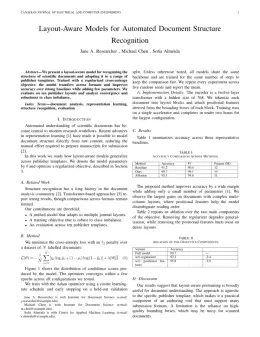
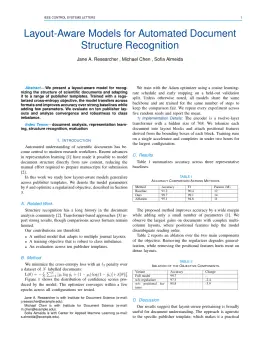
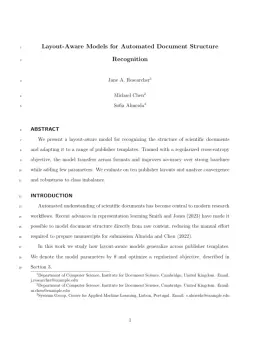
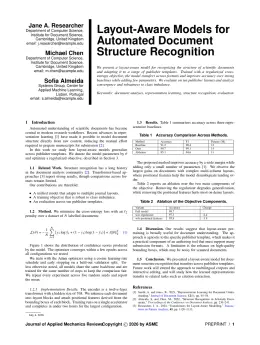
IEEE Antennas and Wireless Propagation Letters Template

Write in a clean editor, then format for IEEE Antennas and Wireless Propagation Letters in one click — DocuGuru applies the official IEEE template with numbered references and exports a submission-ready PDF plus the editable LaTeX source. Free to start.

About the IEEE Antennas and Wireless Propagation Letters format

IEEE Antennas and Wireless Propagation Letters is a peer-reviewed journal published by IEEE, covering Antenna Design and Analysis, Advanced Antenna and Metasurface Technologies, Microwave Engineering and Waveguides. Over its lifetime it has published 11,727 papers, which have received 333,611 citations.

PublisherIEEE
Reference styleNumbered (IEEE)
Numbered — [1], [2] in the text
[1] A. Smith, B. Jones, and C. Lee, "A representative article title," IEEE Antennas and Wireless Propagation Letters, vol. 12, no. 3, pp. 45–58, 2023.

Formats any DOI in IEEE Antennas and Wireless Propagation Letters style. No sign-up.

Abbreviation (ISO-4)AWPL
Publishes research inAntenna Design and Analysis Advanced Antenna and Metasurface Technologies Microwave Engineering and Waveguides Antenna Design and Optimization Energy Harvesting in Wireless Networks
ISSN1536-1225
Citation impact (2-yr)2.98
h-index171
i10-index7,018
Top institutions publishing hereXidian University
Journal websiteieee-awpl.eecs.qmul.ac.uk
You getA submission-ready PDF and the editable LaTeX source — ready to submit.

Papers published in IEEE Antennas and Wireless Propagation Letters per year

713
2014
602
2015
545
2016
564
2017
589
2018
598
2019
537
2020
621
2021
638
2022
698
2023
970
2024
1.1K
2025

Citation impact of IEEE Antennas and Wireless Propagation Letters by publication year

30.4K
2014
26.7K
2015
21.9K
2016
22.2K
2017
21.5K
2018
21.1K
2019
15.6K
2020
14.5K
2021
11.5K
2022
9K
2023
5.7K
2024
1.4K
2025

Citations each year’s papers have accumulated so far — the most recent years are still building up.

Most-cited papers in IEEE Antennas and Wireless Propagation Letters

Local Metamaterial-Based Waveguides in Gaps Between Parallel Metal Plates

Per-Simon Kildal, E. Alfonso, Alejandro Valero‐Nogueira et al. · 1 Jan 2009

This letter presents a new metamaterial-based waveguide technology referred to as ridge gap waveguides. The main advantages of the ridge gap waveguides compared to hollow waveguides are that they are planar and much cheaper to manufacture, in particular at high frequencies such as for millimeter and sub- millimeter waves. The latter is due to the…

An idea for thin subwavelength cavity resonators using metamaterials with negative permittivity and permeability

Nader Engheta · 1 Jan 2002

We present and analyze theoretically some ideas for thin one-dimensional (1D) cavity resonators in which a combination of a conventional dielectric material and a metamaterial possessing negative permittivity and permeability has been inserted. It is shown that a slab of metamaterial with negative permittivity and permeability can act as a phase compensator/conjugator and, thus, by…

Mutual Coupling Reduction for UWB MIMO Antennas With a Wideband Neutralization Line

Shuai Zhang, Gert Frølund Pedersen · 21 May 2015

A wideband neutralization line is proposed to reduce the mutual coupling of a compact ultrawideband (UWB) multiple-input-multiple-output (MIMO) antenna. With the introduced decoupling method, the designed UWB MIMO antenna covers the band of 3.1-5 GHz with an isolation of higher than 22 dB. The proposed wideband neutralization line is not necessarily placed in the clearance…

Planar Slot Antenna Backed by Substrate Integrated Waveguide Cavity

Guo Qing Luo, Zhi Fang Hu, Lin Xi Dong et al. · 1 Jan 2008

A novel design method of low profile cavity backed planar slot antenna has been described in this paper. The whole antenna including backed cavity and feeding element is completely constructed at a single substrate by using substrate integrated waveguide technique and grounded coplanar waveguide. An example with 1.7% bandwidth has been presented, which has 5.4…

Sideband suppression in time-modulated linear arrays by the differential evolution algorithm

Shiwen Yang, Yeow Beng Gan, Anyong Qing · 1 Jan 2002

A novel approach based on the differential evolution (DE) algorithm is proposed to suppress the sideband radiation patterns in time modulated linear antenna arrays. The sideband level of a time modulated linear array can be reduced significantly by rearranging the static excitation amplitudes as well as the switch-on time intervals of each element. The approach…

IEEE Antennas and Wireless Propagation Letters template — frequently asked questions

How do I write a paper in the IEEE Antennas and Wireless Propagation Letters format?
In DocuGuru you write your manuscript in a normal editor — no LaTeX setup required — and select the IEEE Antennas and Wireless Propagation Letters template. When you export, DocuGuru compiles the paper into the official IEEE format and hands you a submission-ready PDF along with the editable LaTeX source.
What reference style does IEEE Antennas and Wireless Propagation Letters use?
IEEE Antennas and Wireless Propagation Letters uses Numbered (IEEE) references, shown as numbered [1], [2] markers in the text. DocuGuru formats every in-text citation and the reference list in this exact style automatically. A reference appears like this: [1] A. Smith, B. Jones, and C. Lee, "A representative article title," IEEE Antennas and Wireless Propagation Letters, vol. 12, no. 3, pp. 45–58, 2023.
Do I need to know LaTeX to submit to IEEE Antennas and Wireless Propagation Letters?
No. DocuGuru generates the IEEEtran LaTeX class and compiles the PDF for you in the background, so you get a IEEE-ready IEEE Antennas and Wireless Propagation Letters document without writing any LaTeX. If you do want it, the LaTeX source is included in the export.
Can I import an existing draft into the IEEE Antennas and Wireless Propagation Letters template?
Yes. Paste or upload your current manuscript — Word, LaTeX, Markdown, or plain text — and DocuGuru reflows it into the IEEE Antennas and Wireless Propagation Letters format with correct headings, figures, tables, and numbered citations.
Who publishes IEEE Antennas and Wireless Propagation Letters?
IEEE Antennas and Wireless Propagation Letters is a engineering and computer science journal published by IEEE. DocuGuru's IEEE Antennas and Wireless Propagation Letters template matches IEEE's official submission format.
Can I export a submission-ready IEEE Antennas and Wireless Propagation Letters PDF?
Yes — DocuGuru produces a PDF built with the official IEEE Antennas and Wireless Propagation Letters template (the IEEEtran class) that is ready to submit to IEEE, together with the matching LaTeX source files.
How much does the IEEE Antennas and Wireless Propagation Letters template cost?
You can start writing in the IEEE Antennas and Wireless Propagation Letters template for free. Exporting the final submission-ready IEEE Antennas and Wireless Propagation Letters PDF and LaTeX source is part of DocuGuru's paid plans — see the app for current pricing.
Use the IEEE Antennas and Wireless Propagation Letters template