Frontiers

Frontiers in Neuroinformatics Template

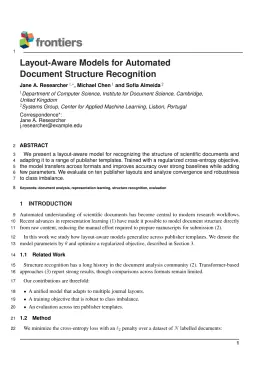
Write in a clean editor, then format for Frontiers in Neuroinformatics in one click — DocuGuru applies the official Frontiers template with author–year references and exports a submission-ready PDF plus the editable LaTeX source. Free to start.

About the Frontiers in Neuroinformatics format

Frontiers in Neuroinformatics is a peer-reviewed journal published by Frontiers, covering Neural dynamics and brain function, Functional Brain Connectivity Studies, EEG and Brain-Computer Interfaces. Over its lifetime it has published 2,180 papers, which have received 62,110 citations.

PublisherFrontiers
Reference styleAuthor–year (Harvard)
Author–year — (Smith, 2023) in the text
Smith, A., Jones, B. and Lee, C. (2023) 'A representative article title', Frontiers in Neuroinformatics, 12(3), pp. 45–58.

Formats any DOI in Frontiers in Neuroinformatics style. No sign-up.

Publishes research inNeural dynamics and brain function Functional Brain Connectivity Studies EEG and Brain-Computer Interfaces Cell Image Analysis Techniques Neural Networks and Applications
ISSN1662-5196
Citation impact (2-yr)4.83
h-index113
i10-index722
Article processing charge$2,950
Open accessYes — indexed in DOAJ
Top institutions publishing hereForschungszentrum Jülich
Journal websitewww.frontiersin.org
You getA submission-ready PDF and the editable LaTeX source — ready to submit.

Papers published in Frontiers in Neuroinformatics per year

316
2014
78
2015
150
2016
74
2017
103
2018
79
2019
63
2020
76
2021
148
2022
89
2023
81
2024
55
2025

Citation impact of Frontiers in Neuroinformatics by publication year

10.6K
2014
4.5K
2015
3.3K
2016
2.9K
2017
5.7K
2018
2.8K
2019
1.7K
2020
1.6K
2021
2.2K
2022
758
2023
518
2024
176
2025

Citations each year’s papers have accumulated so far — the most recent years are still building up.

Most-cited papers in Frontiers in Neuroinformatics

Machine learning for neuroimaging with scikit-learn

Alexandre Abraham, Fabian Pedregosa, Michael Eickenberg et al. · 1 Jan 2014

Statistical machine learning methods are increasingly used for neuroimaging data analysis. Their main virtue is their ability to model high-dimensional datasets, e.g., multivariate analysis of activation images or resting-state time series. Supervised learning is typically used in decoding or encoding settings to relate brain images to behavioral or clinical observations, while unsupervised learning can uncover…

2,659 citations Cite SaveGo to paper →
Nipype: A Flexible, Lightweight and Extensible Neuroimaging Data Processing Framework in Python

Krzysztof J. Gorgolewski, Christopher D. Burns, Cindee Madison et al. · 1 Jan 2011

Current neuroimaging software offer users an incredible opportunity to analyze their data in different ways, with different underlying assumptions. Several sophisticated software packages (e.g., AFNI, BrainVoyager, FSL, FreeSurfer, Nipy, R, SPM) are used to process and analyze large and often diverse (highly multi-dimensional) data. However, this heterogeneous collection of specialized applications creates several issues that…

2,477 citations Cite SaveGo to paper →
Generating stimuli for neuroscience using PsychoPy

Jonathan W. Peirce · 1 Jan 2008

PsychoPy is a software library written in Python, using OpenGL to generate very precise visual stimuli on standard personal computers. It is designed to allow the construction of as wide a variety of neuroscience experiments as possible, with the least effort. By writing scripts in standard Python syntax users can generate an enormous variety of…

1,793 citations Cite SaveGo to paper →
Dipy, a library for the analysis of diffusion MRI data

Eleftherios Garyfallidis, Matthew Brett, Bagrat Amirbekian et al. · 21 Feb 2014

Diffusion Imaging in Python (Dipy) is a free and open source software project for the analysis of data from diffusion magnetic resonance imaging (dMRI) experiments. dMRI is an application of MRI that can be used to measure structural features of brain white matter. Many methods have been developed to use dMRI data to model the…

1,470 citations Cite SaveGo to paper →
The PREP pipeline: standardized preprocessing for large-scale EEG analysis

Nima Bigdely-Shamlo, Tim Mullen, Christian Kothe et al. · 18 Jun 2015

The technology to collect brain imaging and physiological measures has become portable and ubiquitous, opening the possibility of large-scale analysis of real-world human imaging. By its nature, such data is large and complex, making automated processing essential. This paper shows how lack of attention to the very early stages of an EEG preprocessing pipeline can…

1,427 citations Cite SaveGo to paper →

Frontiers in Neuroinformatics template — frequently asked questions

How do I write a paper in the Frontiers in Neuroinformatics format?
In DocuGuru you write your manuscript in a normal editor — no LaTeX setup required — and select the Frontiers in Neuroinformatics template. When you export, DocuGuru compiles the paper into the official Frontiers format and hands you a submission-ready PDF along with the editable LaTeX source.
What reference style does Frontiers in Neuroinformatics use?
Frontiers in Neuroinformatics uses Author–year (Harvard) references, shown as author–year markers such as (Smith, 2023) in the text. DocuGuru formats every in-text citation and the reference list in this exact style automatically. A reference appears like this: Smith, A., Jones, B. and Lee, C. (2023) 'A representative article title', Frontiers in Neuroinformatics, 12(3), pp. 45–58.
Do I need to know LaTeX to submit to Frontiers in Neuroinformatics?
No. DocuGuru generates the FrontiersinHarvard LaTeX class and compiles the PDF for you in the background, so you get a Frontiers-ready Frontiers in Neuroinformatics document without writing any LaTeX. If you do want it, the LaTeX source is included in the export.
Can I import an existing draft into the Frontiers in Neuroinformatics template?
Yes. Paste or upload your current manuscript — Word, LaTeX, Markdown, or plain text — and DocuGuru reflows it into the Frontiers in Neuroinformatics format with correct headings, figures, tables, and author–year citations.
What is Frontiers in Neuroinformatics?
Frontiers journal. It is a life sciences and medicine journal, published by Frontiers.
Can I export a submission-ready Frontiers in Neuroinformatics PDF?
Yes — DocuGuru produces a PDF built with the official Frontiers in Neuroinformatics template (the FrontiersinHarvard class) that is ready to submit to Frontiers, together with the matching LaTeX source files.
How much does the Frontiers in Neuroinformatics template cost?
You can start writing in the Frontiers in Neuroinformatics template for free. Exporting the final submission-ready Frontiers in Neuroinformatics PDF and LaTeX source is part of DocuGuru's paid plans — see the app for current pricing.
Use the Frontiers in Neuroinformatics template

