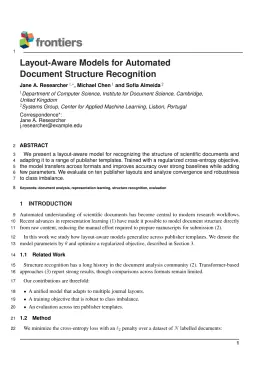
Frontiers

Frontiers in Epidemiology Template

Write in a clean editor, then format for Frontiers in Epidemiology in one click — DocuGuru applies the official Frontiers template with numbered references and exports a submission-ready PDF plus the editable LaTeX source. Free to start.

About the Frontiers in Epidemiology format

Frontiers in Epidemiology is a peer-reviewed journal published by Frontiers, covering COVID-19 epidemiological studies, Malaria Research and Control, Mosquito-borne diseases and control. Over its lifetime it has published 302 papers, which have received 1,712 citations.

PublisherFrontiers
Reference styleNumbered (Vancouver)
Numbered — [1], [2] in the text
1. Smith A, Jones B, Lee C. A representative article title. Frontiers in Epidemiology. 2023;12(3):45–58.

Formats any DOI in Frontiers in Epidemiology style. No sign-up.

Publishes research inCOVID-19 epidemiological studies Malaria Research and Control Mosquito-borne diseases and control Health disparities and outcomes SARS-CoV-2 and COVID-19 Research
ISSN2674-1199
Citation impact (2-yr)2.4
h-index18
i10-index38
Open accessYes — indexed in DOAJ
Top institutions publishing hereJohns Hopkins University
You getA submission-ready PDF and the editable LaTeX source — ready to submit.

Papers published in Frontiers in Epidemiology per year

2
2021
63
2022
80
2023
57
2024
60
2025

Citation impact of Frontiers in Epidemiology by publication year

4
2021
625
2022
671
2023
236
2024
108
2025

Citations each year’s papers have accumulated so far — the most recent years are still building up.

Most-cited papers in Frontiers in Epidemiology

Mortality, and life expectancy in Epilepsy and Status epilepticus—current trends and future aspects

Eugen Trinka, Lucas Rainer, Claudia A. Granbichler et al. · 23 Feb 2023

Patients with epilepsy carry a risk of premature death which is on average two to three times higher than in the general population. The risk of death is not homogenously distributed over all ages, etiologies, and epilepsy syndromes. People with drug resistant seizures carry the highest risk of death compared to those who are seizure…

Modeling non-linear relationships in epidemiological data: The application and interpretation of spline models

Noah A. Schuster, Judith J. M. Rijnhart, Jos W. R. Twisk et al. · 18 Aug 2022

Objective Traditional methods to deal with non-linearity in regression analysis often result in loss of information or compromised interpretability of the results. A recommended but underutilized method for modeling non-linear associations in regression models is spline functions. We explain spline functions in a non-mathematical way and illustrate the application and interpretation to an empirical data…

Cardiovascular disease, associated risk factors, and risk of dementia: An umbrella review of meta-analyses

Jacob Brain, Leanne Greene, Eugene Tang et al. · 9 Feb 2023

Introduction: Cardiovascular diseases (CVDs) have been associated with an increased risk of dementia; yet the evidence is mixed. This review critically appraises and synthesises current evidence exploring associations between dementia risk and CVD and their risk factors, including coronary heart disease, heart failure, atrial fibrillation, hypertension, hyperlipidaemia, and arterial stiffness. Methods: MEDLINE, Embase, PsycINFO, and…

Job-Exposure Matrix: A Useful Tool for Incorporating Workplace Exposure Data Into Population Health Research and Practice

Alexis Descatha, Marc Fadel, Grace Sembajwe et al. · 26 Apr 2022

Workplace exposures to physical, chemical, and psychosocial factors account for a large burden of chronic diseases. Obtaining useful estimates of current and past workplace exposures is challenging, particularly in large general population studies. Job-exposure matrices (JEMs) are a useful tool for exposure assessment, particularly when no individual level exposure data are available. A JEM provides…

Greedy knot selection algorithm for restricted cubic spline regression

Jo Inge Arnes, Alexander Hapfelmeier, Alexander Horsch et al. · 18 Dec 2023

Non-linear regression modeling is common in epidemiology for prediction purposes or estimating relationships between predictor and response variables. Restricted cubic spline (RCS) regression is one such method, for example, highly relevant to Cox proportional hazard regression model analysis. RCS regression uses third-order polynomials joined at knot points to model non-linear relationships. The standard approach is…


Frontiers in Epidemiology template — frequently asked questions

How do I write a paper in the Frontiers in Epidemiology format?
In DocuGuru you write your manuscript in a normal editor — no LaTeX setup required — and select the Frontiers in Epidemiology template. When you export, DocuGuru compiles the paper into the official Frontiers format and hands you a submission-ready PDF along with the editable LaTeX source.
What reference style does Frontiers in Epidemiology use?
Frontiers in Epidemiology uses Numbered (Vancouver) references, shown as numbered [1], [2] markers in the text. DocuGuru formats every in-text citation and the reference list in this exact style automatically. A reference appears like this: 1. Smith A, Jones B, Lee C. A representative article title. Frontiers in Epidemiology. 2023;12(3):45–58.
Do I need to know LaTeX to submit to Frontiers in Epidemiology?
No. DocuGuru generates the FrontiersinVancouver LaTeX class and compiles the PDF for you in the background, so you get a Frontiers-ready Frontiers in Epidemiology document without writing any LaTeX. If you do want it, the LaTeX source is included in the export.
Can I import an existing draft into the Frontiers in Epidemiology template?
Yes. Paste or upload your current manuscript — Word, LaTeX, Markdown, or plain text — and DocuGuru reflows it into the Frontiers in Epidemiology format with correct headings, figures, tables, and numbered citations.
What is Frontiers in Epidemiology?
Frontiers journal. It is a life sciences and medicine journal, published by Frontiers.
Can I export a submission-ready Frontiers in Epidemiology PDF?
Yes — DocuGuru produces a PDF built with the official Frontiers in Epidemiology template (the FrontiersinVancouver class) that is ready to submit to Frontiers, together with the matching LaTeX source files.
How much does the Frontiers in Epidemiology template cost?
You can start writing in the Frontiers in Epidemiology template for free. Exporting the final submission-ready Frontiers in Epidemiology PDF and LaTeX source is part of DocuGuru's paid plans — see the app for current pricing.
Use the Frontiers in Epidemiology template