Frontiers

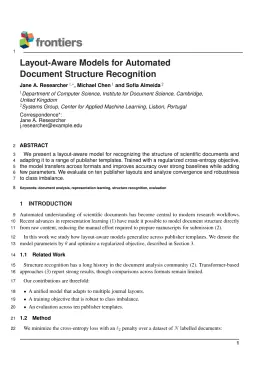
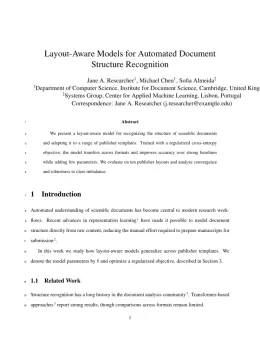
Frontiers in Environmental Chemistry Template

Write in a clean editor, then format for Frontiers in Environmental Chemistry in one click — DocuGuru applies the official Frontiers template with author–year references and exports a submission-ready PDF plus the editable LaTeX source. Free to start.

About the Frontiers in Environmental Chemistry format

Frontiers in Environmental Chemistry is a peer-reviewed journal published by Frontiers, covering Mercury impact and mitigation studies, Toxic Organic Pollutants Impact, Adsorption and biosorption for pollutant removal. Over its lifetime it has published 159 papers, which have received 1,501 citations.

PublisherFrontiers
Reference styleAuthor–year (Harvard)
Author–year — (Smith, 2023) in the text
Smith, A., Jones, B. and Lee, C. (2023) 'A representative article title', Frontiers in Environmental Chemistry, 12(3), pp. 45–58.

Formats any DOI in Frontiers in Environmental Chemistry style. No sign-up.

Publishes research inMercury impact and mitigation studies Toxic Organic Pollutants Impact Adsorption and biosorption for pollutant removal Heavy metals in environment Per- and polyfluoroalkyl substances research
ISSN2673-4486
Citation impact (2-yr)5.87
h-index19
i10-index45
Article processing charge$1,900
Open accessYes — indexed in DOAJ
Top institutions publishing hereCentre National de la Recherche Scientifique
Journal websitewww.frontiersin.org
You getA submission-ready PDF and the editable LaTeX source — ready to submit.

Papers published in Frontiers in Environmental Chemistry per year

14
2020
25
2021
29
2022
21
2023
28
2024
29
2025

Citation impact of Frontiers in Environmental Chemistry by publication year

353
2020
263
2021
224
2022
232
2023
283
2024
102
2025

Citations each year’s papers have accumulated so far — the most recent years are still building up.

Most-cited papers in Frontiers in Environmental Chemistry

Microbial Biodiversity and Bioremediation Assessment Through Omics Approaches

Hema Chandran, Mukesh Meena, Kanika Sharma · 25 Sep 2020

Industrialization, population burst, and changing lifestyles have resulted in the genesis of non-degradable pollutants languishing the environment and human health. Biological approaches using microorganisms are gaining importance as an eco-friendly and cost-effective substitute to mitigate the pollution load. Microorganisms can survive in a divergent environment and produce metabolites that can degrade and transform pollutants making…

Comparing silicon mineral species of different crystallinity using Fourier transform infrared spectroscopy

Ruth H. Ellerbrock, Mathias Stein, Jörg Schaller · 23 Oct 2024

In soils, various solid silica (Si) species exhibit different weathering behaviors and surface reactivities, which are among other characteristics related to the crystallinity of the silicate tetrahedral network. Amorphous species exhibit faster weathering and generally possess a larger specific surface area in comparison to crystalline species. However, the characterization of these different species is commonly…

A review of per- and polyfluoroalkyl substances in biosolids: geographical distribution and regulations

Toyin Dunsin Saliu, Sébastien Sauvé · 13 Jun 2024

Applying sewage sludge and biosolids to agricultural lands has become an increasingly essential aspect of sustainable waste management and circular economy as it contributes positively to nutrient recycling, soil fertility and environmental health. Due to the widespread presence of per and poly-fluoroalkyl substances (PFAS) globally, wastewater treatment plants have become a sink for PFAS. PFAS…

Grand Challenges for Catalytic Remediation in Environmental and Energy Applications Toward a Cleaner and Sustainable Future

Ioannis V. Yentekakis, Fan Dong · 8 Jul 2020

This article presents and discusses several hot topics and current trends for Catalytic Remediation in processes of significant environmental and energy importance. These topics seem to have the potentiality to guide future endeavors and synergistic interactions of several scientific disciplines, not limited to the chemists' and chemical engineers' communities, toward a common goal of great…

Recent Advances in Molecular-Imprinting-Based Solid-Phase Extraction of Antibiotics Residues Coupled With Chromatographic Analysis

Dani Sun, Zhihua Song, Yue Zhang et al. · 17 Aug 2021

Abuse and residues of antibiotics cause great harm to organisms and the environment. Appropriate sample pretreatment is usually required for sensitive determination, because of the low content presence of a variety of antibiotics in complicated matrices. Molecular-imprinting-based solid-phase extraction (MISPE) has been widely used for sample pretreatment of antibiotics, using molecularly imprinted polymers (MIPs) as…

Frontiers in Environmental Chemistry template — frequently asked questions

How do I write a paper in the Frontiers in Environmental Chemistry format?
In DocuGuru you write your manuscript in a normal editor — no LaTeX setup required — and select the Frontiers in Environmental Chemistry template. When you export, DocuGuru compiles the paper into the official Frontiers format and hands you a submission-ready PDF along with the editable LaTeX source.
What reference style does Frontiers in Environmental Chemistry use?
Frontiers in Environmental Chemistry uses Author–year (Harvard) references, shown as author–year markers such as (Smith, 2023) in the text. DocuGuru formats every in-text citation and the reference list in this exact style automatically. A reference appears like this: Smith, A., Jones, B. and Lee, C. (2023) 'A representative article title', Frontiers in Environmental Chemistry, 12(3), pp. 45–58.
Do I need to know LaTeX to submit to Frontiers in Environmental Chemistry?
No. DocuGuru generates the FrontiersinHarvard LaTeX class and compiles the PDF for you in the background, so you get a Frontiers-ready Frontiers in Environmental Chemistry document without writing any LaTeX. If you do want it, the LaTeX source is included in the export.
Can I import an existing draft into the Frontiers in Environmental Chemistry template?
Yes. Paste or upload your current manuscript — Word, LaTeX, Markdown, or plain text — and DocuGuru reflows it into the Frontiers in Environmental Chemistry format with correct headings, figures, tables, and author–year citations.
What is Frontiers in Environmental Chemistry?
Frontiers journal. It is a life sciences and medicine journal, published by Frontiers.
Can I export a submission-ready Frontiers in Environmental Chemistry PDF?
Yes — DocuGuru produces a PDF built with the official Frontiers in Environmental Chemistry template (the FrontiersinHarvard class) that is ready to submit to Frontiers, together with the matching LaTeX source files.
How much does the Frontiers in Environmental Chemistry template cost?
You can start writing in the Frontiers in Environmental Chemistry template for free. Exporting the final submission-ready Frontiers in Environmental Chemistry PDF and LaTeX source is part of DocuGuru's paid plans — see the app for current pricing.
Use the Frontiers in Environmental Chemistry template