Frontiers

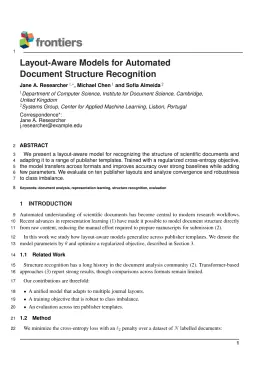
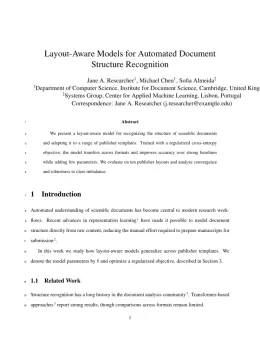
Frontiers in Computer Science Template

Write in a clean editor, then format for Frontiers in Computer Science in one click — DocuGuru applies the official Frontiers template with author–year references and exports a submission-ready PDF plus the editable LaTeX source. Free to start.

About the Frontiers in Computer Science format

Frontiers in Computer Science is a peer-reviewed journal published by Frontiers, covering Virtual Reality Applications and Impacts, Innovative Human-Technology Interaction, AI in Service Interactions. Over its lifetime it has published 1,109 papers, which have received 12,510 citations.

PublisherFrontiers
Reference styleAuthor–year (Harvard)
Author–year — (Smith, 2023) in the text
Smith, A., Jones, B. and Lee, C. (2023) 'A representative article title', Frontiers in Computer Science, 12(3), pp. 45–58.

Formats any DOI in Frontiers in Computer Science style. No sign-up.

Publishes research inVirtual Reality Applications and Impacts Innovative Human-Technology Interaction AI in Service Interactions Emotion and Mood Recognition Network Security and Intrusion Detection
ISSN2624-9898
Citation impact (2-yr)4.03
h-index47
i10-index299
Article processing charge$1,150
Open accessYes — indexed in DOAJ
Top institutions publishing hereDelft University of Technology
Journal websitewww.frontiersin.org
You getA submission-ready PDF and the editable LaTeX source — ready to submit.

Papers published in Frontiers in Computer Science per year

11
2019
56
2020
127
2021
179
2022
160
2023
166
2024
233
2025

Citation impact of Frontiers in Computer Science by publication year

752
2019
1.6K
2020
3.1K
2021
2.6K
2022
1.9K
2023
1.1K
2024
969
2025

Citations each year’s papers have accumulated so far — the most recent years are still building up.

Most-cited papers in Frontiers in Computer Science

Phishing Attacks: A Recent Comprehensive Study and a New Anatomy

Zainab Alkhalil, Chaminda Hewage, Liqaa Nawaf et al. · 9 Mar 2021

With the significant growth of internet usage, people increasingly share their personal information online. As a result, an enormous amount of personal information and financial transactions become vulnerable to cybercriminals. Phishing is an example of a highly effective form of cybercrime that enables criminals to deceive users and steal important data. Since the first reported…

A Comparative Analysis of Student Performance in an Online vs. Face-to-Face Environmental Science Course From 2009 to 2016

Jasmine Paul, Felicia Jefferson · 12 Nov 2019

A growing number of students are now opting for online classes. They find the traditional classroom modality restrictive, inflexible, and impractical. In this age of technological advancement, schools can now provide effective classroom teaching via the Web. This shift in pedagogical medium is forcing academic institutions to rethink how they want to deliver their course…

LABKIT: Labeling and Segmentation Toolkit for Big Image Data

Matthias Arzt, J.R. Deschamps, Christopher Schmied et al. · 10 Feb 2022

We present LABKIT, a user-friendly Fiji plugin for the segmentation of microscopy image data. It offers easy to use manual and automated image segmentation routines that can be rapidly applied to single- and multi-channel images as well as to timelapse movies in 2D or 3D. LABKIT is specifically designed to work efficiently on big image…

Eye Movement and Pupil Measures: A Review

Bhanuka Mahanama, Yasith Jayawardana, Sundararaman Rengarajan et al. · 11 Jan 2022

Our subjective visual experiences involve complex interaction between our eyes, our brain, and the surrounding world. It gives us the sense of sight, color, stereopsis, distance, pattern recognition, motor coordination, and more. The increasing ubiquity of gaze-aware technology brings with it the ability to track gaze and pupil measures with varying degrees of fidelity. With…

FusionNet: A Deep Fully Residual Convolutional Neural Network for Image Segmentation in Connectomics

Tran Minh Quan, David G. C. Hildebrand, Won‐Ki Jeong · 13 May 2021

Cellular-resolution connectomics is an ambitious research direction with the goal of generating comprehensive brain connectivity maps using high-throughput, nano-scale electron microscopy. One of the main challenges in connectomics research is developing scalable image analysis algorithms that require minimal user intervention. Deep learning has provided exceptional performance in image classification tasks in computer vision, leading to…


Frontiers in Computer Science template — frequently asked questions

How do I write a paper in the Frontiers in Computer Science format?
In DocuGuru you write your manuscript in a normal editor — no LaTeX setup required — and select the Frontiers in Computer Science template. When you export, DocuGuru compiles the paper into the official Frontiers format and hands you a submission-ready PDF along with the editable LaTeX source.
What reference style does Frontiers in Computer Science use?
Frontiers in Computer Science uses Author–year (Harvard) references, shown as author–year markers such as (Smith, 2023) in the text. DocuGuru formats every in-text citation and the reference list in this exact style automatically. A reference appears like this: Smith, A., Jones, B. and Lee, C. (2023) 'A representative article title', Frontiers in Computer Science, 12(3), pp. 45–58.
Do I need to know LaTeX to submit to Frontiers in Computer Science?
No. DocuGuru generates the FrontiersinHarvard LaTeX class and compiles the PDF for you in the background, so you get a Frontiers-ready Frontiers in Computer Science document without writing any LaTeX. If you do want it, the LaTeX source is included in the export.
Can I import an existing draft into the Frontiers in Computer Science template?
Yes. Paste or upload your current manuscript — Word, LaTeX, Markdown, or plain text — and DocuGuru reflows it into the Frontiers in Computer Science format with correct headings, figures, tables, and author–year citations.
What is Frontiers in Computer Science?
Frontiers journal. It is a life sciences and medicine journal, published by Frontiers.
Can I export a submission-ready Frontiers in Computer Science PDF?
Yes — DocuGuru produces a PDF built with the official Frontiers in Computer Science template (the FrontiersinHarvard class) that is ready to submit to Frontiers, together with the matching LaTeX source files.
How much does the Frontiers in Computer Science template cost?
You can start writing in the Frontiers in Computer Science template for free. Exporting the final submission-ready Frontiers in Computer Science PDF and LaTeX source is part of DocuGuru's paid plans — see the app for current pricing.
Use the Frontiers in Computer Science template