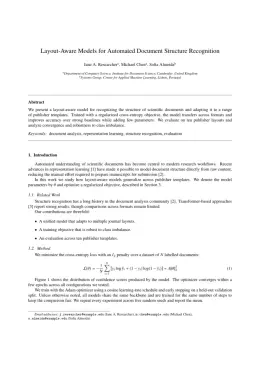
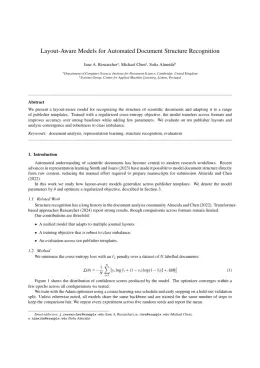
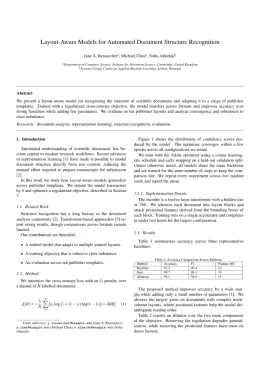
Elsevier

Research in Diagnostic and Interventional Imaging Template

Write in a clean editor, then format for Research in Diagnostic and Interventional Imaging in one click — DocuGuru applies the official Elsevier template with numbered references and exports a submission-ready PDF plus the editable LaTeX source. Free to start.

About the Research in Diagnostic and Interventional Imaging format

Research in Diagnostic and Interventional Imaging is a peer-reviewed journal published by Elsevier, covering Radiomics and Machine Learning in Medical Imaging, Hepatocellular Carcinoma Treatment and Prognosis, Lung Cancer Diagnosis and Treatment.

PublisherElsevier
Reference styleNumbered (Elsevier)
Numbered — [1], [2] in the text
[1] A. Smith, B. Jones, C. Lee, A representative article title, Research in Diagnostic and Interventional Imaging 12 (2023) 45–58.

Formats any DOI in Research in Diagnostic and Interventional Imaging style. No sign-up.

Publishes research inRadiomics and Machine Learning in Medical Imaging Hepatocellular Carcinoma Treatment and Prognosis Lung Cancer Diagnosis and Treatment Radiation Dose and Imaging Advanced X-ray and CT Imaging
ISSN2772-6525
Citation impact (2-yr)1.65
h-index5
i10-index1
Total citations120
Open accessYes
Top institutions publishing hereInserm
You getA submission-ready PDF and the editable LaTeX source — ready to submit.

Papers published in Research in Diagnostic and Interventional Imaging per year

15
2022
17
2023
15
2024
8
2025

Citation impact of Research in Diagnostic and Interventional Imaging by publication year

29
2022
52
2023
31
2024
7
2025

Citations each year’s papers have accumulated so far — the most recent years are still building up.

Most-cited papers in Research in Diagnostic and Interventional Imaging

BERT-based natural language processing analysis of French CT reports: Application to the measurement of the positivity rate for pulmonary embolism

Émilien Jupin-Delevaux, Aïssam Djahnine, François Talbot et al. · 27 Mar 2023

Rationale and objectives: To develop a Natural Language Processing (NLP) method based on Bidirectional Encoder Representations from Transformers (BERT) adapted to French CT reports and to evaluate its performance to calculate the diagnostic yield of CT in patients with clinical suspicion of pulmonary embolism (PE). Materials and methods: All the CT reports performed in our…

Value and prognostic impact of a deep learning segmentation model of COVID-19 lung lesions on low-dose chest CT

Axel Bartoli, Joris Fournel, Arnaud Maurin et al. · 1 Mar 2022

1) To develop a deep learning (DL) pipeline allowing quantification of COVID-19 pulmonary lesions on low-dose computed tomography (LDCT). 2) To assess the prognostic value of DL-driven lesion quantification. This monocentric retrospective study included training and test datasets taken from 144 and 30 patients, respectively. The reference was the manual segmentation of 3 labels: normal…

(18F)-PSMA-1007PET/CT in patients with biochemical recurrence after radical prostatectomy: Diagnostic performance and impact on treatment management

Jia Jiang, Lei Chen, Xiaowei Ji et al. · 6 Jan 2023

To evaluate the diagnostic performance of (18F)-PSMA-1007 PET/CT in prostate cancer patients with biochemical recurrence (BCR) after radical prostatectomy and the effect of (18F)-PSMA-1007 PET/CT on treatment strategy. A total of 114 patients with BCR after radical prostatectomy who performed (18F)-PSMA-1007 PET/CT were retrospectively analyzed. The Gleason scores (GS), maximum standardized uptake values (SUVmax) and…

Improved image quality with deep learning reconstruction – a study on a semi-anthropomorphic upper-abdomen phantom

Tormund S. Njølstad, Anselm Schulz, Kristin Jensen et al. · 13 Jan 2023

Purpose: To assess image quality of a deep learning reconstruction (DLR) algorithm across dose levels using a semi-anthropomorphic upper-abdominal phantom, and compare with filtered back projection (FBP) and hybrid iterative reconstruction (IR). Material and methods: 5, 10, 15, 20 and 25 mGy) were reconstructed with FBP, hybrid IR (IR50, IR70 and IR90) and DLR of…

Feasibility of deep learning-reconstructed thin-slice single-breath-hold HASTE for detecting pancreatic lesions: A comparison with two conventional T2-weighted imaging sequences

Kai Liu, Qing Li, Xingxing Wang et al. · 31 Jan 2024

The objective of this study was to evaluate the clinical feasibility of deep learning reconstruction-accelerated thin-slice single-breath-hold half-Fourier single-shot turbo spin echo imaging (HASTEDL) for detecting pancreatic lesions, in comparison with two conventional T2-weighted imaging sequences: compressed-sensing HASTE (HASTECS) and BLADE. From March 2022 to January 2023, a total of 63 patients with suspected pancreatic-related…

Research in Diagnostic and Interventional Imaging template — frequently asked questions

How do I write a paper in the Research in Diagnostic and Interventional Imaging format?
In DocuGuru you write your manuscript in a normal editor — no LaTeX setup required — and select the Research in Diagnostic and Interventional Imaging template. When you export, DocuGuru compiles the paper into the official Elsevier format and hands you a submission-ready PDF along with the editable LaTeX source.
What reference style does Research in Diagnostic and Interventional Imaging use?
Research in Diagnostic and Interventional Imaging uses Numbered (Elsevier) references, shown as numbered [1], [2] markers in the text. DocuGuru formats every in-text citation and the reference list in this exact style automatically. A reference appears like this: [1] A. Smith, B. Jones, C. Lee, A representative article title, Research in Diagnostic and Interventional Imaging 12 (2023) 45–58.
Do I need to know LaTeX to submit to Research in Diagnostic and Interventional Imaging?
No. DocuGuru generates the elsarticle LaTeX class and compiles the PDF for you in the background, so you get a Elsevier-ready Research in Diagnostic and Interventional Imaging document without writing any LaTeX. If you do want it, the LaTeX source is included in the export.
Can I import an existing draft into the Research in Diagnostic and Interventional Imaging template?
Yes. Paste or upload your current manuscript — Word, LaTeX, Markdown, or plain text — and DocuGuru reflows it into the Research in Diagnostic and Interventional Imaging format with correct headings, figures, tables, and numbered citations.
Who publishes Research in Diagnostic and Interventional Imaging?
Research in Diagnostic and Interventional Imaging is a multidisciplinary journal published by Elsevier. DocuGuru's Research in Diagnostic and Interventional Imaging template matches Elsevier's official submission format.
Can I export a submission-ready Research in Diagnostic and Interventional Imaging PDF?
Yes — DocuGuru produces a PDF built with the official Research in Diagnostic and Interventional Imaging template (the elsarticle class) that is ready to submit to Elsevier, together with the matching LaTeX source files.
How much does the Research in Diagnostic and Interventional Imaging template cost?
You can start writing in the Research in Diagnostic and Interventional Imaging template for free. Exporting the final submission-ready Research in Diagnostic and Interventional Imaging PDF and LaTeX source is part of DocuGuru's paid plans — see the app for current pricing.

Use the Research in Diagnostic and Interventional Imaging template