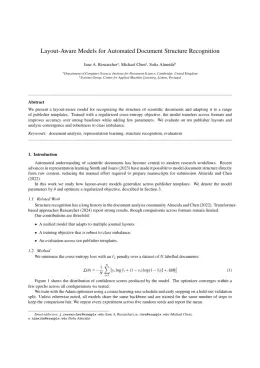
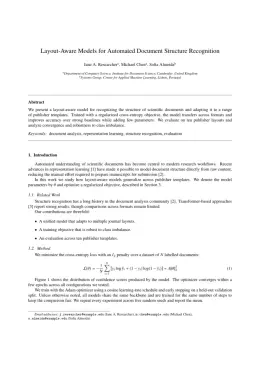
Elsevier

Perspectives in Science Template

Write in a clean editor, then format for Perspectives in Science in one click — DocuGuru applies the official Elsevier template with author–year references and exports a submission-ready PDF plus the editable LaTeX source. Free to start.

About the Perspectives in Science format

Perspectives in Science is a peer-reviewed journal published by Elsevier, covering Microbial Metabolic Engineering and Bioproduction, Enzyme Catalysis and Immobilization, Trace Elements in Health.

PublisherElsevier
Reference styleAuthor–year (Harvard)
Author–year — (Smith, 2023) in the text
Smith, A., Jones, B. and Lee, C. (2023) 'A representative article title', Perspectives in Science, 12(3), pp. 45–58.

Formats any DOI in Perspectives in Science style. No sign-up.

Publishes research inMicrobial Metabolic Engineering and Bioproduction Enzyme Catalysis and Immobilization Trace Elements in Health Science Education and Pedagogy Glycosylation and Glycoproteins Research
ISSN2213-0209
h-index44
i10-index196
Total citations8,171
Top institutions publishing hereVSB - Technical University of Ostrava
Journal websitewww.journals.elsevier.com
You getA submission-ready PDF and the editable LaTeX source — ready to submit.

Papers published in Perspectives in Science per year

54
2014
81
2015
259
2016
19
2019

Citation impact of Perspectives in Science by publication year

1.6K
2014
869
2015
5.6K
2016
99
2019

Citations each year’s papers have accumulated so far — the most recent years are still building up.

Most-cited papers in Perspectives in Science

Enzyme assays

Hans Bisswanger · 23 Mar 2014

The essential requirements for enzyme assays are described and frequently occurring errors and pitfalls as well as their avoidance are discussed. The main factors, which must be considered for assaying enzymes, are temperature, pH, ionic strength and the proper concentrations of the essential components like substrates and enzymes. Standardization of these parameters would be desirable,…

Considerations for the design and reporting of enzyme assays in high-throughput screening applications

Michael Acker, Douglas S. Auld · 22 Mar 2014

This review describes the key steps and methods which are used to develop enzyme assays suitable for high-throughput screening (HTS) applications. The goals of HTS enzyme assays are defined relative to lower-throughput bench top assays and important aspects which go into constructing robust and sensitive enzyme assays are described. Methods that have been applied to…

Dimensionality reduction using Principal Component Analysis for network intrusion detection

K. Keerthi Vasan, B. Surendiran · 3 Jul 2016

Intrusion detection is the identification of malicious activities in a given network by analyzing its traffic. Data mining techniques used for this analysis study the traffic traces and identify hostile flows in the traffic. Dimensionality reduction in data mining focuses on representing data with minimum number of dimensions such that its properties are not lost…

One hundred years of Michaelis–Menten kinetics

Athel Cornish‐Bowden · 24 Dec 2014

The year 2013 marked the centenary of the paper of Leonor Michaelis and Maud Menten (Michaelis and Menten, 1913), and the 110th anniversary of the doctoral thesis of Victor Henri (Henri, 1903). These publications have had an enormous influence on the progress of biochemistry, and are more often cited in the 21st century than they…

Microstructural and optical properties of CuS nanoparticles prepared by sol–gel route

Sana Riyaz, Azra Parveen, Ameer Azam · 7 Jul 2016

This paper demonstrates the synthesis of CuS nanoparticles using sol–gel route in the presence of distilled water at 100 °C for 3 h. X-ray diffraction (XRD), energy dispersive X-ray spectrum (EDS), and scanning electron microscope (SEM) techniques were employed to study the microstructural properties of the prepared sample. Crystallite size was determined by Debye–Scherrer formula…

Perspectives in Science template — frequently asked questions

How do I write a paper in the Perspectives in Science format?
In DocuGuru you write your manuscript in a normal editor — no LaTeX setup required — and select the Perspectives in Science template. When you export, DocuGuru compiles the paper into the official Elsevier format and hands you a submission-ready PDF along with the editable LaTeX source.
What reference style does Perspectives in Science use?
Perspectives in Science uses Author–year (Harvard) references, shown as author–year markers such as (Smith, 2023) in the text. DocuGuru formats every in-text citation and the reference list in this exact style automatically. A reference appears like this: Smith, A., Jones, B. and Lee, C. (2023) 'A representative article title', Perspectives in Science, 12(3), pp. 45–58.
Do I need to know LaTeX to submit to Perspectives in Science?
No. DocuGuru generates the elsarticle LaTeX class and compiles the PDF for you in the background, so you get a Elsevier-ready Perspectives in Science document without writing any LaTeX. If you do want it, the LaTeX source is included in the export.
Can I import an existing draft into the Perspectives in Science template?
Yes. Paste or upload your current manuscript — Word, LaTeX, Markdown, or plain text — and DocuGuru reflows it into the Perspectives in Science format with correct headings, figures, tables, and author–year citations.
Who publishes Perspectives in Science?
Perspectives in Science is a multidisciplinary journal published by Elsevier. DocuGuru's Perspectives in Science template matches Elsevier's official submission format.
Can I export a submission-ready Perspectives in Science PDF?
Yes — DocuGuru produces a PDF built with the official Perspectives in Science template (the elsarticle class) that is ready to submit to Elsevier, together with the matching LaTeX source files.
How much does the Perspectives in Science template cost?
You can start writing in the Perspectives in Science template for free. Exporting the final submission-ready Perspectives in Science PDF and LaTeX source is part of DocuGuru's paid plans — see the app for current pricing.

Use the Perspectives in Science template