Elsevier

Patterns Template

Write in a clean editor, then format for Patterns in one click — DocuGuru applies the official Elsevier template with numbered references and exports a submission-ready PDF plus the editable LaTeX source. Free to start.

About the Patterns format

Patterns is a peer-reviewed journal published by Elsevier, covering Cell Image Analysis Techniques, Scientific Computing and Data Management, Single-cell and spatial transcriptomics.

PublisherElsevier
Reference styleNumbered (Elsevier)
Numbered — [1], [2] in the text
[1] A. Smith, B. Jones, C. Lee, A representative article title, Patterns 12 (2023) 45–58.

Formats any DOI in Patterns style. No sign-up.

Publishes research inCell Image Analysis Techniques Scientific Computing and Data Management Single-cell and spatial transcriptomics Artificial Intelligence in Healthcare and Education Machine Learning in Materials Science
ISSN2666-3899
Citation impact (2-yr)10.93
h-index78
i10-index443
Total citations25,733
Article processing charge$5,200
Open accessYes
Top institutions publishing hereHarvard University
Journal websitewww.journals.elsevier.com
You getA submission-ready PDF and the editable LaTeX source — ready to submit.

Papers published in Patterns per year

1
1975
12
2018
134
2020
175
2021
175
2022
146
2023
121
2024
137
2025

Citation impact of Patterns by publication year

1
1975
0
2018
4.1K
2020
7.1K
2021
5.8K
2022
4.7K
2023
2.2K
2024
1.1K
2025

Citations each year’s papers have accumulated so far — the most recent years are still building up.

Most-cited papers in Patterns

Addressing bias in big data and AI for health care: A call for open science

Natalia Norori, Qiyang Hu, Florence M. Aellen et al. · 1 Oct 2021

Artificial intelligence (AI) has an astonishing potential in assisting clinical decision making and revolutionizing the field of health care. A major open challenge that AI will need to address before its integration in the clinical routine is that of algorithmic bias. Most AI algorithms need big datasets to learn from, but several groups of the…

Leakage and the reproducibility crisis in machine-learning-based science

Sayash Kapoor, Arvind Narayanan · 4 Aug 2023

Machine-learning (ML) methods have gained prominence in the quantitative sciences. However, there are many known methodological pitfalls, including data leakage, in ML-based science. We systematically investigate reproducibility issues in ML-based science. Through a survey of literature in fields that have adopted ML methods, we find 17 fields where leakage has been found, collectively affecting 294…

Algorithmic injustice: a relational ethics approach

Abeba Birhane · 1 Feb 2021

It has become trivial to point out that algorithmic systems increasingly pervade the social sphere. Improved efficiency-the hallmark of these systems-drives their mass integration into day-to-day life. However, as a robust body of research in the area of algorithmic injustice shows, algorithmic systems, especially when used to sort and predict social outcomes, are not only…

The real climate and transformative impact of ICT: A critique of estimates, trends, and regulations

Charlotte Freitag, Mike Berners-Lee, Kelly Widdicks et al. · 1 Sep 2021

In this paper, we critique ICT's current and projected climate impacts. Peer-reviewed studies estimate ICT's current share of global greenhouse gas (GHG) emissions at 1.8%-2.8% of global GHG emissions; adjusting for truncation of supply chain pathways, we find that this share could actually be between 2.1% and 3.9%. For ICT's future emissions, we explore assumptions…

GPT detectors are biased against non-native English writers

Weixin Liang, Mert Yüksekgönül, Yining Mao et al. · 1 Jul 2023

GPT detectors frequently misclassify non-native English writing as AI generated, raising concerns about fairness and robustness. Addressing the biases in these detectors is crucial to prevent the marginalization of non-native English speakers in evaluative and educational settings and to create a more equitable digital landscape.

Patterns template — frequently asked questions

How do I write a paper in the Patterns format?
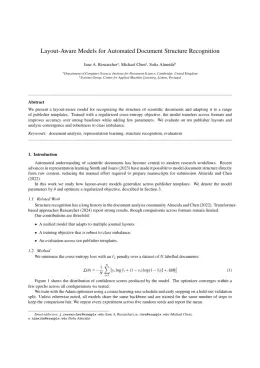
In DocuGuru you write your manuscript in a normal editor — no LaTeX setup required — and select the Patterns template. When you export, DocuGuru compiles the paper into the official Elsevier format and hands you a submission-ready PDF along with the editable LaTeX source.
What reference style does Patterns use?
Patterns uses Numbered (Elsevier) references, shown as numbered [1], [2] markers in the text. DocuGuru formats every in-text citation and the reference list in this exact style automatically. A reference appears like this: [1] A. Smith, B. Jones, C. Lee, A representative article title, Patterns 12 (2023) 45–58.
Do I need to know LaTeX to submit to Patterns?
No. DocuGuru generates the elsarticle LaTeX class and compiles the PDF for you in the background, so you get a Elsevier-ready Patterns document without writing any LaTeX. If you do want it, the LaTeX source is included in the export.
Can I import an existing draft into the Patterns template?
Yes. Paste or upload your current manuscript — Word, LaTeX, Markdown, or plain text — and DocuGuru reflows it into the Patterns format with correct headings, figures, tables, and numbered citations.
Who publishes Patterns?
Patterns is a multidisciplinary journal published by Elsevier. DocuGuru's Patterns template matches Elsevier's official submission format.
Can I export a submission-ready Patterns PDF?
Yes — DocuGuru produces a PDF built with the official Patterns template (the elsarticle class) that is ready to submit to Elsevier, together with the matching LaTeX source files.
How much does the Patterns template cost?
You can start writing in the Patterns template for free. Exporting the final submission-ready Patterns PDF and LaTeX source is part of DocuGuru's paid plans — see the app for current pricing.
Use the Patterns template