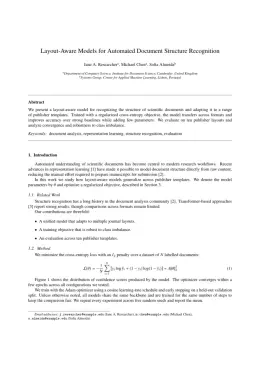
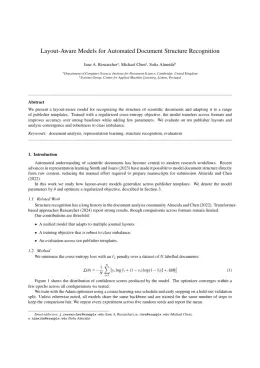
Elsevier

Journal of Magnetic Resonance Open Template

Write in a clean editor, then format for Journal of Magnetic Resonance Open in one click — DocuGuru applies the official Elsevier template with numbered references and exports a submission-ready PDF plus the editable LaTeX source. Free to start.

About the Journal of Magnetic Resonance Open format

Journal of Magnetic Resonance Open is a peer-reviewed journal published by Elsevier, covering Advanced NMR Techniques and Applications, NMR spectroscopy and applications, Advanced MRI Techniques and Applications.

PublisherElsevier
Reference styleNumbered (Elsevier)
Numbered — [1], [2] in the text
[1] A. Smith, B. Jones, C. Lee, A representative article title, Journal of Magnetic Resonance Open 12 (2023) 45–58.

Formats any DOI in Journal of Magnetic Resonance Open style. No sign-up.

Publishes research inAdvanced NMR Techniques and Applications NMR spectroscopy and applications Advanced MRI Techniques and Applications Atomic and Subatomic Physics Research Electron Spin Resonance Studies
ISSN2666-4410
Citation impact (2-yr)2.18
h-index17
i10-index43
Total citations1,275
Article processing charge$1,500
Open accessYes
Top institutions publishing hereCentre National de la Recherche Scientifique
Journal websitewww.journals.elsevier.com
You getA submission-ready PDF and the editable LaTeX source — ready to submit.

Papers published in Journal of Magnetic Resonance Open per year

2
2019
5
2020
21
2021
62
2022
51
2023
38
2024
27
2025

Citation impact of Journal of Magnetic Resonance Open by publication year

10
2019
51
2020
224
2021
425
2022
391
2023
108
2024
41
2025

Citations each year’s papers have accumulated so far — the most recent years are still building up.

Most-cited papers in Journal of Magnetic Resonance Open

Facile hyperpolarization chemistry for molecular imaging and metabolic tracking of [1–13C]pyruvate in vivo

Keilian MacCulloch, Austin Browning, David Guarin et al. · 13 Jul 2023

Hyperpolarization chemistry based on reversible exchange of parahydrogen, also known as Signal Amplification By Reversible Exchange (SABRE), is a particularly simple approach to attain high levels of nuclear spin hyperpolarization, which can enhance NMR and MRI signals by many orders of magnitude. SABRE has received significant attention in the scientific community since its inception because…

An automated system for fast transfer and injection of hyperpolarized solutions

Morgan Ceillier, Olivier Cala, Théo El Daraï et al. · 1 Aug 2021

Dissolution dynamic nuclear polarization (dDNP) has become a hyperpolarization method of choice for enhancing nuclear magnetic resonance (NMR) signals. Nuclear spins are polarized in solid frozen samples (in a so-called polarizer) that are subsequently dissolved and transferred to an NMR spectrometer for high sensitivity detection. One of the critical challenges of dDNP is that it…

Limits to flow detection in phase contrast MRI

Nathan H. Williamson, Michal E. Komlosh, Dan Benjamini et al. · 1 Jun 2020

Pulsed gradient spin echo (PGSE) complex signal behavior becomes dominated by attenuation rather than oscillation when displacements due to flow are similar or less than diffusive displacements. In this “slow-flow” regime, the optimal displacement encoding parameter q for phase contrast velocimetry depends on the diffusive length scale qslow=1/lD=1/2DΔ rather than the velocity encoding parameter venc=π/(qΔ).…

Application of <mml:math xmlns:mml="http://www.w3.org/1998/Math/MathML" altimg="si8.svg"> <mml:msup> <mml:mrow/> <mml:mn>1</mml:mn> </mml:msup> </mml:math> H proton NMR relaxometry to building materials – A review

Sarah Mandy Nagel, Christoph Strangfeld, Sabine Kruschwitz · 16 Feb 2021

Since nuclear magnetic resonance with focus on 1H protons is highly sensitive to pore filling fluids, it is nowadays often applied for the investigation of porous media. Mainly in materials research and especially in the field of non-destructive testing in civil engineering it is increasingly used. Scientific questions about and based on NMR meanwhile cover…

1H and 19F NMR chemical shifts for hydrogen bond strength determination: Correlations between experimental and computed values

Claudio Dalvit, Marina Veronesi, Anna Vulpetti · 12 Sep 2022

1 H and 19 F NMR methods based on chemical shift measurements of different hydrogen bond donors used for quantifying hydrogen bond strength were analyzed and compared. The extracted values from these different methods are shown to be highly correlated with each other and with several experimental and ab initio computed quantities characterizing hydrogen bond…

Journal of Magnetic Resonance Open template — frequently asked questions

How do I write a paper in the Journal of Magnetic Resonance Open format?
In DocuGuru you write your manuscript in a normal editor — no LaTeX setup required — and select the Journal of Magnetic Resonance Open template. When you export, DocuGuru compiles the paper into the official Elsevier format and hands you a submission-ready PDF along with the editable LaTeX source.
What reference style does Journal of Magnetic Resonance Open use?
Journal of Magnetic Resonance Open uses Numbered (Elsevier) references, shown as numbered [1], [2] markers in the text. DocuGuru formats every in-text citation and the reference list in this exact style automatically. A reference appears like this: [1] A. Smith, B. Jones, C. Lee, A representative article title, Journal of Magnetic Resonance Open 12 (2023) 45–58.
Do I need to know LaTeX to submit to Journal of Magnetic Resonance Open?
No. DocuGuru generates the elsarticle LaTeX class and compiles the PDF for you in the background, so you get a Elsevier-ready Journal of Magnetic Resonance Open document without writing any LaTeX. If you do want it, the LaTeX source is included in the export.
Can I import an existing draft into the Journal of Magnetic Resonance Open template?
Yes. Paste or upload your current manuscript — Word, LaTeX, Markdown, or plain text — and DocuGuru reflows it into the Journal of Magnetic Resonance Open format with correct headings, figures, tables, and numbered citations.
Who publishes Journal of Magnetic Resonance Open?
Journal of Magnetic Resonance Open is a multidisciplinary journal published by Elsevier. DocuGuru's Journal of Magnetic Resonance Open template matches Elsevier's official submission format.
Can I export a submission-ready Journal of Magnetic Resonance Open PDF?
Yes — DocuGuru produces a PDF built with the official Journal of Magnetic Resonance Open template (the elsarticle class) that is ready to submit to Elsevier, together with the matching LaTeX source files.
How much does the Journal of Magnetic Resonance Open template cost?
You can start writing in the Journal of Magnetic Resonance Open template for free. Exporting the final submission-ready Journal of Magnetic Resonance Open PDF and LaTeX source is part of DocuGuru's paid plans — see the app for current pricing.

Use the Journal of Magnetic Resonance Open template