Elsevier

iScience Template

Write in a clean editor, then format for iScience in one click — DocuGuru applies the official Elsevier template with numbered references and exports a submission-ready PDF plus the editable LaTeX source. Free to start.

About the iScience format

iScience is a peer-reviewed journal published by Elsevier, covering RNA modifications and cancer, SARS-CoV-2 and COVID-19 Research, Immune Cell Function and Interaction.

PublisherElsevier
Reference styleNumbered (Elsevier)
Numbered — [1], [2] in the text
[1] A. Smith, B. Jones, C. Lee, A representative article title, iScience 12 (2023) 45–58.

Formats any DOI in iScience style. No sign-up.

Publishes research inRNA modifications and cancer SARS-CoV-2 and COVID-19 Research Immune Cell Function and Interaction RNA Research and Splicing Neural dynamics and brain function
ISSN2589-0042
Citation impact (2-yr)4.37
h-index137
i10-index7,029
Total citations255,256
Article processing charge$3,000
Open accessYes
Top institutions publishing hereChinese Academy of Sciences
Journal websitewww.sciencedirect.com
You getA submission-ready PDF and the editable LaTeX source — ready to submit.

Papers published in iScience per year

5
2013
3
2014
1
2015
1
2016
256
2018
558
2019
1.3K
2020
1.6K
2021
2.1K
2022
2.8K
2023
2.9K
2024
2.9K
2025

Citation impact of iScience by publication year

6
2013
0
2014
0
2015
0
2016
12.5K
2018
24.6K
2019
48.1K
2020
49.5K
2021
45.5K
2022
37.6K
2023
24.3K
2024
7.5K
2025

Citations each year’s papers have accumulated so far — the most recent years are still building up.

Most-cited papers in iScience

Current Contributions of Organofluorine Compounds to the Agrochemical Industry

Yuta Ogawa, Etsuko Tokunaga, Osamu Kobayashi et al. · 18 Aug 2020

Currently, more than 1,200 agrochemicals are listed and many of these are regularly used by farmers to generate the food supply to support the expanding global population. However, resistance to pesticides is an ever more frequently occurring phenomenon, and thus, a continuous supply of novel agrochemicals with high efficiency, selectivity, and low toxicity is required.…

1,216 citations Cite SaveGo to paper →
Current and future lithium-ion battery manufacturing

Yangtao Liu, Ruihan Zhang, Jun Wang et al. · 20 Mar 2021

Lithium-ion batteries (LIBs) have become one of the main energy storage solutions in modern society. The application fields and market share of LIBs have increased rapidly and continue to show a steady rising trend. The research on LIB materials has scored tremendous achievements. Many innovative materials have been adopted and commercialized by the industry. However,…

The mRNA-LNP platform's lipid nanoparticle component used in preclinical vaccine studies is highly inflammatory

Sonia Ndeupen, Zhen Qin, Sonya Jacobsen et al. · 20 Nov 2021

Vaccines based on mRNA-containing lipid nanoparticles (LNPs) are a promising new platform used by two leading vaccines against COVID-19. Clinical trials and ongoing vaccinations present with varying degrees of protection levels and side effects. However, the drivers of the reported side effects remain poorly defined. Here we present evidence that Acuitas' LNPs used in preclinical…

Mesenchymal Stromal Cell Homing: Mechanisms and Strategies for Improvement

Mujib Ullah, Daniel Dan Liu, Avnesh S. Thakor · 1 May 2019

Mesenchymal stromal cells (MSCs) have been widely investigated for their therapeutic potential in regenerative medicine, owing to their ability to home damaged tissue and serve as a reservoir of growth factors and regenerative molecules. As such, clinical applications of MSCs are reliant on these cells successfully migrating to the desired tissue following their administration. Unfortunately,…

Prussian Blue Analogs for Rechargeable Batteries

Baoqi Wang, Yu Han, Xiao Wang et al. · 17 Apr 2018

Non-lithium energy storage devices, especially sodium ion batteries, are drawing attention due to insufficient and uneven distribution of lithium resources. Prussian blue and its analogs (Prussian blue analogs [PBAs]), or hexacyanoferrates, are well-known since the 18th century and have been used for hydrogen storage, cancer therapy, biosensing, seawater desalination, and sewage treatment. Owing to their…

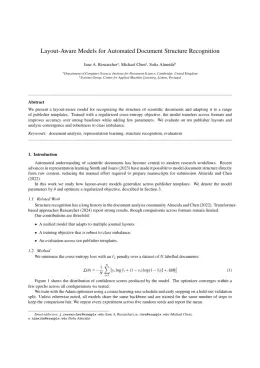
iScience template — frequently asked questions

How do I write a paper in the iScience format?
In DocuGuru you write your manuscript in a normal editor — no LaTeX setup required — and select the iScience template. When you export, DocuGuru compiles the paper into the official Elsevier format and hands you a submission-ready PDF along with the editable LaTeX source.
What reference style does iScience use?
iScience uses Numbered (Elsevier) references, shown as numbered [1], [2] markers in the text. DocuGuru formats every in-text citation and the reference list in this exact style automatically. A reference appears like this: [1] A. Smith, B. Jones, C. Lee, A representative article title, iScience 12 (2023) 45–58.
Do I need to know LaTeX to submit to iScience?
No. DocuGuru generates the elsarticle LaTeX class and compiles the PDF for you in the background, so you get a Elsevier-ready iScience document without writing any LaTeX. If you do want it, the LaTeX source is included in the export.
Can I import an existing draft into the iScience template?
Yes. Paste or upload your current manuscript — Word, LaTeX, Markdown, or plain text — and DocuGuru reflows it into the iScience format with correct headings, figures, tables, and numbered citations.
Who publishes iScience?
iScience is a multidisciplinary journal published by Elsevier. DocuGuru's iScience template matches Elsevier's official submission format.
Can I export a submission-ready iScience PDF?
Yes — DocuGuru produces a PDF built with the official iScience template (the elsarticle class) that is ready to submit to Elsevier, together with the matching LaTeX source files.
How much does the iScience template cost?
You can start writing in the iScience template for free. Exporting the final submission-ready iScience PDF and LaTeX source is part of DocuGuru's paid plans — see the app for current pricing.
Use the iScience template