
1,564 citations
Cite
SaveGo to paper →
Elsevier
Graphical Models and Image Processing Template
Write in a clean editor, then format for Graphical Models and Image Processing in one click — DocuGuru applies the official Elsevier template with numbered references and exports a submission-ready PDF plus the editable LaTeX source. Free to start.
About the Graphical Models and Image Processing format
Graphical Models and Image Processing is a peer-reviewed journal published by Elsevier, covering Medical Image Segmentation Techniques, Advanced Numerical Analysis Techniques, Computer Graphics and Visualization Techniques.
| Publisher | Elsevier |
|---|---|
| Reference style | Numbered (Elsevier) Numbered — [1], [2] in the text [1] A. Smith, B. Jones, C. Lee, A representative article title, Graphical Models and Image Processing 12 (2023) 45–58.
Formats any DOI in Graphical Models and Image Processing style. No sign-up. |
| Publishes research in | Medical Image Segmentation Techniques Advanced Numerical Analysis Techniques Computer Graphics and Visualization Techniques Digital Image Processing Techniques Image and Signal Denoising Methods |
| ISSN | 1077-3169 |
| h-index | 52 |
| i10-index | 154 |
| Total citations | 11,883 |
| Top institutions publishing here | Pohang University of Science and Technology |
| Journal website | www.sciencedirect.com |
| You get | A submission-ready PDF and the editable LaTeX source — ready to submit. |
Papers published in Graphical Models and Image Processing per year
Citation impact of Graphical Models and Image Processing by publication year
Citations each year’s papers have accumulated so far — the most recent years are still building up.
Most-cited papers in Graphical Models and Image Processing
Images are by nature fuzzy. Approaches to object information extraction from images should attempt to use this fact and retain fuzziness as realistically as possible. In past image segmentation research, the notion of “hanging togetherness” of image elements specified by their fuzzy connectedness has been lacking. We present a theory of fuzzy objects forn-dimensional digital…
842 citations
Cite
SaveGo to paper →
We present a comprehensive methodology for realistically animating liquid phenomena. Our approach unifies existing computer graphics techniques for simulating fluids and extends them by incorporating more complex behavior. It is based on the Navier–Stokes equations which couple momentum and mass conservation to completely describe fluid motion. Our starting point is an environment containing an arbitrary…
674 citations
Cite
SaveGo to paper →
556 citations
Cite
SaveGo to paper →
In multidimensional image analysis, there are, and will continue to be, situations wherein automatic image segmentation methods fail, calling for considerable user assistance in the process. The main goals of segmentation research for such situations ought to be (i) to provideeffective controlto the user on the segmentation processwhileit is being executed, and (ii) to minimize…
487 citations
Cite
SaveGo to paper →
Related journal templates
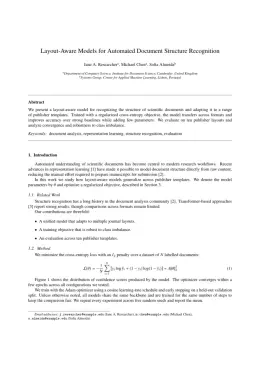
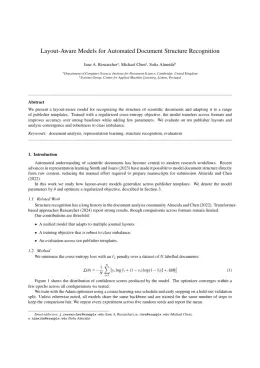
Graphical Models and Image Processing template — frequently asked questions
How do I write a paper in the Graphical Models and Image Processing format?
In DocuGuru you write your manuscript in a normal editor — no LaTeX setup required — and select the Graphical Models and Image Processing template. When you export, DocuGuru compiles the paper into the official Elsevier format and hands you a submission-ready PDF along with the editable LaTeX source.
What reference style does Graphical Models and Image Processing use?
Graphical Models and Image Processing uses Numbered (Elsevier) references, shown as numbered [1], [2] markers in the text. DocuGuru formats every in-text citation and the reference list in this exact style automatically. A reference appears like this: [1] A. Smith, B. Jones, C. Lee, A representative article title, Graphical Models and Image Processing 12 (2023) 45–58.
Do I need to know LaTeX to submit to Graphical Models and Image Processing?
No. DocuGuru generates the elsarticle LaTeX class and compiles the PDF for you in the background, so you get a Elsevier-ready Graphical Models and Image Processing document without writing any LaTeX. If you do want it, the LaTeX source is included in the export.
Can I import an existing draft into the Graphical Models and Image Processing template?
Yes. Paste or upload your current manuscript — Word, LaTeX, Markdown, or plain text — and DocuGuru reflows it into the Graphical Models and Image Processing format with correct headings, figures, tables, and numbered citations.
Who publishes Graphical Models and Image Processing?
Graphical Models and Image Processing is a multidisciplinary journal published by Elsevier. DocuGuru's Graphical Models and Image Processing template matches Elsevier's official submission format.
Can I export a submission-ready Graphical Models and Image Processing PDF?
Yes — DocuGuru produces a PDF built with the official Graphical Models and Image Processing template (the elsarticle class) that is ready to submit to Elsevier, together with the matching LaTeX source files.
How much does the Graphical Models and Image Processing template cost?
You can start writing in the Graphical Models and Image Processing template for free. Exporting the final submission-ready Graphical Models and Image Processing PDF and LaTeX source is part of DocuGuru's paid plans — see the app for current pricing.