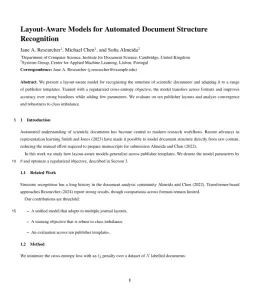
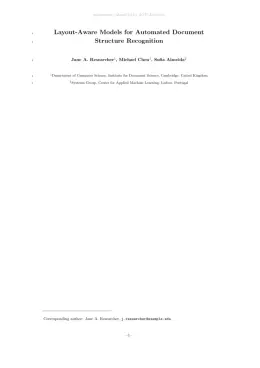
Copernicus Publications

Web Ecology Template

Write in a clean editor, then format for Web Ecology in one click — DocuGuru applies the official Copernicus Publications template with author–year references and exports a submission-ready PDF plus the editable LaTeX source. Free to start.

About the Web Ecology format

Web Ecology is a peer-reviewed journal published by Copernicus Publications, covering Ecology and Vegetation Dynamics Studies, Plant and animal studies, Species Distribution and Climate Change. Over its lifetime it has published 277 papers, which have received 3,541 citations.

PublisherCopernicus Publications
Reference styleAuthor–year (Copernicus)
Author–year — (Smith, 2023) in the text
Smith, A., Jones, B., and Lee, C.: A representative article title, Web Ecology, 12, 45–58, 2023.

Formats any DOI in Web Ecology style. No sign-up.

Publishes research inEcology and Vegetation Dynamics Studies Plant and animal studies Species Distribution and Climate Change Wildlife Ecology and Conservation Forest Ecology and Biodiversity Studies
ISSN1399-1183
Citation impact (2-yr)1.95
h-index29
i10-index116
Open accessYes — indexed in DOAJ
Top institutions publishing hereUniversity of Coimbra
Journal websitewww.web-ecology.net
You getA submission-ready PDF and the editable LaTeX source — ready to submit.

Papers published in Web Ecology per year

9
2014
14
2015
20
2016
9
2017
17
2018
5
2019
13
2020
8
2021
9
2022
9
2023
10
2024
18
2025

Citation impact of Web Ecology by publication year

121
2014
129
2015
202
2016
184
2017
239
2018
65
2019
240
2020
166
2021
101
2022
60
2023
34
2024
29
2025

Citations each year’s papers have accumulated so far — the most recent years are still building up.

Most-cited papers in Web Ecology

An assessment of wildlife road casulties – the potential discrepancy between numbers counted and numbers killed

Frederick Maurice Slater · 24 May 2002

Abstract. By artificially baiting roads, it is shown that simple counts of wildlife corpses found on roads are severe underestimate of the actual road casualty rate. The death rate can be 12–16 times that observed by simply counting corpses particularly from a moving vehicle. Removal rates depend on a range of factors including species of…

The ecology of subindividual variability in plants: patterns, processes, and prospects

Carlos M. Herrera · 8 Dec 2017

Abstract. Diversification of ecology into subdisciplines that run from macroecology to landscape, community, and population ecology largely reflects its specialization on different segments of the spatial gradient over which recognizable ecological patterns and processes occur. In all these cases, the elemental units involved in the patterns and processes of interest to ecologists are individuals from…

Mediterranean-climate oak savannas: the interplay between abiotic environment and species interactions

Teodoro Marañón, Francisco I. Pugnaire, Ragan M. Callaway · 4 Jun 2009

Abstract. Mediterranean oak savannas cover about 4 million ha in California (northwest America) and 3 million ha in Spain and Portugal (southwest Europe), and are ecologically and socio-economically important systems. Here we review literature on the interactions between the two dominant elements of savannas – the oak overstorey, the herbaceous understorey, and the surrounding grassland…

Plotting partial correlation and regression in ecological studies

Jordi Moya‐Laraño, Guadalupe Corcobado · 4 Jun 2008

Abstract. Multiple regression, the General linear model (GLM) and the Generalized linear model (GLZ) are widely used in ecology. The widespread use of graphs that include fitted regression lines to document patterns in simple linear regression can be easily extended to these multivariate techniques in plots that show the partial relationship of the dependent variable…

Scientists' warning on endangered food webs

Rúben Heleno, William J. Ripple, Anna Traveset · 3 Apr 2020

Abstract. All organisms are ultimately dependent on a large diversity of consumptive and non-consumptive interactions established with other organisms, forming an intricate web of interdependencies. In 1992, when 1700 concerned scientists issued the first “World Scientists' Warning to Humanity”, our understanding of such interaction networks was still in its infancy. By simultaneously considering the species…

Web Ecology template — frequently asked questions

How do I write a paper in the Web Ecology format?
In DocuGuru you write your manuscript in a normal editor — no LaTeX setup required — and select the Web Ecology template. When you export, DocuGuru compiles the paper into the official Copernicus Publications format and hands you a submission-ready PDF along with the editable LaTeX source.
What reference style does Web Ecology use?
Web Ecology uses Author–year (Copernicus) references, shown as author–year markers such as (Smith, 2023) in the text. DocuGuru formats every in-text citation and the reference list in this exact style automatically. A reference appears like this: Smith, A., Jones, B., and Lee, C.: A representative article title, Web Ecology, 12, 45–58, 2023.
Do I need to know LaTeX to submit to Web Ecology?
No. DocuGuru generates the copernicus LaTeX class and compiles the PDF for you in the background, so you get a Copernicus Publications-ready Web Ecology document without writing any LaTeX. If you do want it, the LaTeX source is included in the export.
Can I import an existing draft into the Web Ecology template?
Yes. Paste or upload your current manuscript — Word, LaTeX, Markdown, or plain text — and DocuGuru reflows it into the Web Ecology format with correct headings, figures, tables, and author–year citations.
What is Web Ecology?
Copernicus Publications journal. It is a earth and environmental sciences journal, published by Copernicus Publications.
Can I export a submission-ready Web Ecology PDF?
Yes — DocuGuru produces a PDF built with the official Web Ecology template (the copernicus class) that is ready to submit to Copernicus Publications, together with the matching LaTeX source files.
How much does the Web Ecology template cost?
You can start writing in the Web Ecology template for free. Exporting the final submission-ready Web Ecology PDF and LaTeX source is part of DocuGuru's paid plans — see the app for current pricing.
Use the Web Ecology template