Cambridge University Press

Development and Psychopathology Template

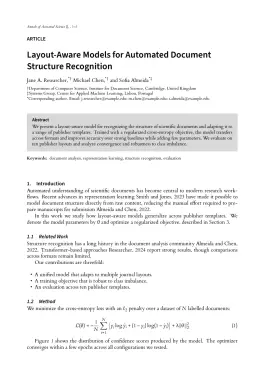
Write in a clean editor, then format for Development and Psychopathology in one click — DocuGuru applies the official Cambridge University Press template with numbered references and exports a submission-ready PDF plus the editable LaTeX source. Free to start.

About the Development and Psychopathology format

Development and Psychopathology is a peer-reviewed journal published by Cambridge University Press, covering Child and Adolescent Psychosocial and Emotional Development, Child Abuse and Trauma, Early Childhood Education and Development.

PublisherCambridge University Press
Reference styleNumbered
Numbered — [1], [2] in the text
[1] A. Smith, B. Jones, and C. Lee, A representative article title, Development and Psychopathology 12 (2023) 45–58.

Formats any DOI in the closest standard style — Development and Psychopathology has no published style definition, so this is an approximation. No sign-up.

Publishes research inChild and Adolescent Psychosocial and Emotional Development Child Abuse and Trauma Early Childhood Education and Development Maternal Mental Health During Pregnancy and Postpartum Attachment and Relationship Dynamics
ISSN0954-5794
Citation impact (2-yr)3.31
h-index263
i10-index2,587
Total citations309,372
Top institutions publishing hereUniversity of Minnesota
Journal websitejournals.cambridge.org
You getA submission-ready PDF and the editable LaTeX source — ready to submit.

Papers published in Development and Psychopathology per year

140
2014
145
2015
137
2016
165
2017
158
2018
178
2019
182
2020
208
2021
171
2022
174
2023
199
2024
141
2025

Citation impact of Development and Psychopathology by publication year

7.4K
2014
7.3K
2015
6.4K
2016
7.2K
2017
4.8K
2018
7.3K
2019
4.7K
2020
3.4K
2021
3K
2022
1.9K
2023
1K
2024
208
2025

Citations each year’s papers have accumulated so far — the most recent years are still building up.

Most-cited papers in Development and Psychopathology

Resilience and development: Contributions from the study of children who overcome adversity

Ann S. Masten, Karin M. Best, Norman Garmezy · 1 Oct 1990

Abstract This article reviews the research on resilience in order to delineate its significance and potential for understanding normal development. Resilience refers to the process of, capacity for, or outcome of successful adaptation despite challenging or threatening circumstances. Three resilience phenomena are reviewed: (a) good outcomes in high-risk children, (b) sustained competence in children under…

3,346 citations Cite SaveGo to paper →
The circumplex model of affect: An integrative approach to affective neuroscience, cognitive development, and psychopathology

Jonathan Posner, James A. Russell, Bradley S. Peterson · 1 Sep 2005

The circumplex model of affect proposes that all affective states arise from cognitive interpretations of core neural sensations that are the product of two independent neurophysiological systems. This model stands in contrast to theories of basic emotions, which posit that a discrete and independent neural system subserves every emotion. We propose that basic emotion theories…

2,585 citations Cite SaveGo to paper →
The construct of resilience: Implications for interventions and social policies

Suniya S. Luthar, Dante Cicchetti · 1 Dec 2000

The focus of this article is on the interface between research on resilience-a construct representing positive adaptation despite adversity--and the applications of this work to the development of interventions and social policies. Salient defining features of research on resilience are delineated, as are various advantages, limitations, and precautions linked with the application of the resilience…

2,353 citations Cite SaveGo to paper →
Biological sensitivity to context: I. An evolutionary–developmental theory of the origins and functions of stress reactivity

W. Thomas Boyce, Bruce J. Ellis · 12 May 2005

Biological reactivity to psychological stressors comprises a complex, integrated, and highly conserved repertoire of central neural and peripheral neuroendocrine responses designed to prepare the organism for challenge or threat. Developmental experience plays a role, along with heritable, polygenic variation, in calibrating the response dynamics of these systems, with early adversity biasing their combined effects toward…

2,079 citations Cite SaveGo to paper →
Equifinality and multifinality in developmental psychopathology

Dante Cicchetti, Fred A. Rogosch · 1 Jan 1996

Since its inception as an emergent interdisci-epigenesis, may lead to the same outcome, plinary science, diversity in process and out-Stated differently, in an open system (i.e., one come have been conceived as among the hall-where there is maintenance in change, dymarks of the developmental psychopathology namic order of processes, organization, selfperspective This Sroufe, 1986, 1989;…

1,833 citations Cite SaveGo to paper →

Development and Psychopathology template — frequently asked questions

How do I write a paper in the Development and Psychopathology format?
In DocuGuru you write your manuscript in a normal editor — no LaTeX setup required — and select the Development and Psychopathology template. When you export, DocuGuru compiles the paper into the official Cambridge University Press format and hands you a submission-ready PDF along with the editable LaTeX source.
What reference style does Development and Psychopathology use?
Development and Psychopathology uses Numbered references, shown as numbered [1], [2] markers in the text. DocuGuru formats every in-text citation and the reference list in this exact style automatically. A reference appears like this: [1] A. Smith, B. Jones, and C. Lee, A representative article title, Development and Psychopathology 12 (2023) 45–58.
Do I need to know LaTeX to submit to Development and Psychopathology?
No. DocuGuru generates the null LaTeX class and compiles the PDF for you in the background, so you get a Cambridge University Press-ready Development and Psychopathology document without writing any LaTeX. If you do want it, the LaTeX source is included in the export.
Can I import an existing draft into the Development and Psychopathology template?
Yes. Paste or upload your current manuscript — Word, LaTeX, Markdown, or plain text — and DocuGuru reflows it into the Development and Psychopathology format with correct headings, figures, tables, and numbered citations.
Who publishes Development and Psychopathology?
Development and Psychopathology is a multidisciplinary journal published by Cambridge University Press. DocuGuru's Development and Psychopathology template matches Cambridge University Press's official submission format.
Can I export a submission-ready Development and Psychopathology PDF?
Yes — DocuGuru produces a PDF built with the official Development and Psychopathology template (the null class) that is ready to submit to Cambridge University Press, together with the matching LaTeX source files.
How much does the Development and Psychopathology template cost?
You can start writing in the Development and Psychopathology template for free. Exporting the final submission-ready Development and Psychopathology PDF and LaTeX source is part of DocuGuru's paid plans — see the app for current pricing.
Use the Development and Psychopathology template